Sign up with Google
 Sign in with Zoho
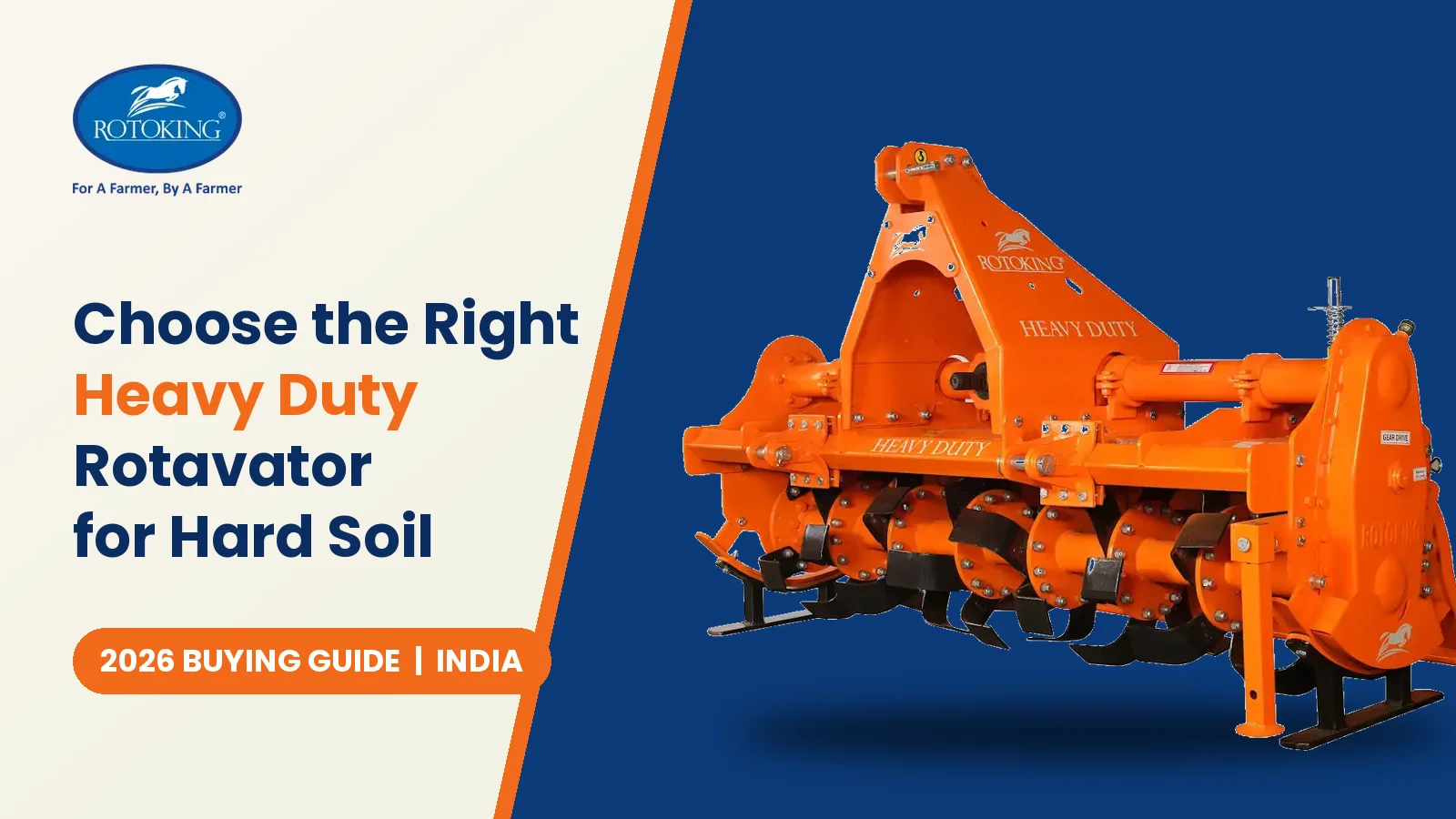
Preparing black cotton or compacted farmland requires more than a standard rotary tiller. A heavy duty rotavator is built with a stronger gearbox, heavier frame, and multiple speed settings so it can bury into hard clods and mix soil efficiently. In this guide, we’ll help Indian farmers match the right machine to their tractor and soil. We focus on practical buying factors – horsepower, blade style, and common pitfalls – so you end up with one pass seedbed, not multiple frustrating passes.
Why Hard Soil Needs a Special Rotavator
Hard, dry soil (especially in post-rain or fallow fields) can literally stop a normal tiller. The blades on a standard machine may simply skid over crusted clods, forcing you to drive extra passes or even plough first. By contrast, a heavy-duty multi-speed rotavator lets you drop to a low gear for high torque, cutting deep into tough ground.
Rotoking explains that in hard, compacted soil the low-speed setting “provides significantly higher torque to the blades, allowing them to penetrate [and] handle hard soil where standard rotavators struggle”. In practice, this means you finish one pass faster (often 2–3 days of work saved) and create a fine, level seedbed without overtaxing the tractor.
Heavy Duty vs Standard Rotavator
Standard rotavator: Light and simple, suited to loose, moist soils (e.g. after a plough or on paddy fields). These are often centre-drive models with a lighter frame. For example, Agrikarm’s “Standard Series” is described as lightweight and specialised for moist/wet lands like paddy.
Standard rotavators work well in prepared fields but can bog down in black cotton or clay soil. They also typically have higher rotor speeds with less torque.
Heavy duty rotavator: Heavier frame, gear-drive (side gear) design, and built for tough jobs. Agrikarm’s “Premium” series illustrates this – it’s a “monster” machine for all soils, with deeper tillage and advanced power transmission for hard-duty work.
Rotoking similarly emphasizes that heavy-duty models are made for medium-to-hard ground: their Champion and multi-speed lines use boron steel blades, reinforced frames, and “built for sustained stress”. In short, a heavy-duty tiller is the practical choice if your land is unforgiving or you plan long rental/custom-hire hours – it can handle heavier loads consistently and lower your cost of ownership over multiple seasons.
Choosing by Tractor HP (30–65+ HP)
Match the rotavator size to your tractor’s power and farm area:
- 30–40 HP tractors: Use narrower, lower-capacity models. Even “heavy duty” machines usually start around 30 HP. For example, Rotoking’s RRT 4 is rated 30 HP and has ~30 blades (working width ~145 cm). Ensure the implement’s weight and draft won’t overload your tractor. A good rule of thumb: allow ~30–40 HP per metre of width in heavy soil.
- 40–50 HP tractors: You can handle mid-sized machines (like Rotoking RRT 5.5 or RRT 6). These might carry 39–42 blades for 40+ HP. In more forgiving soils, even 40 HP tractors can operate 5–6 ft heavy rotavators.
- 50–65+ HP tractors: This range fits the largest heavy-duty models (Rotoking RRT 7 or RRT 8). These can be 6–8 ft wide with 48–54 blades for 50–65+ HP tractors. Larger width covers more acres per pass, but again only if your tractor has the lift capacity and PTO power.
Tip: One source advises choosing a width at least as wide as your rear tyres, and using the higher end of the power range in heavy soil. If in doubt, err on the smaller side to avoid stalling the engine. Always confirm the machine’s required PTO speed (most Indian rotavators run at 540 RPM) and ensure your tractor matches it.
Rotoking’s Heavy Duty Multi Speed models are designed for roughly 50–75 HP machines (their RRT 7/RRT 8 models), though they offer smaller sizes down to ~30 HP. When you request a quote, give your exact tractor make, horsepower, rear track width, and lifting specs – this helps avoid mismatches.
Which Blade Type Suits Your Soil (L, C or J)
Heavy-duty rotavators often allow different blade shapes. Rotoking’s Champion series, for example, offers L-, C- or J-type blades to adapt to soil and crop needs. Here’s a quick guide (always check with the dealer for your model):
- L-type blades: Shovel-shaped (angle ~90°). They cut aggressively and throw soil deep. Good for deep tilling or breaking hard layers. Use L-blades if you need maximum penetration.
- C-type blades: Curved (like a hook). They mix soil more thoroughly, giving a finer tilth. C-blades often suit general field preparation and residue mixing in medium soils.
- J-type blades (spike/battip): Typically fewer in number but handle sticky, rooty, or cloddy soil well. The spikes fracture lumps and resist clogging in wet or trashy fields.
In practice, heavy black soils often do better with fewer, sturdier blades (as [13] notes, “fewer blades work better in sticky soil and heavy residue”). Always discuss blade choice with the supplier – they may equip your machine differently if you grow cotton vs. wheat, or if your land has lots of stones or debris.
State-wise Soil and Crop Considerations
Soil varies across India, but those four states mostly share black cotton soil or clay-heavy fields that crack when dry. Here’s how to think of each:
- Gujarat & Maharashtra (black soil): Fields often harden in summer. Use a heavy-duty tiller at the proper moisture (not bone dry). Rotoking explicitly recommends a low-speed, high-torque setting with aggressive blades for black cotton soils found in these states. After sugarcane or cotton harvest, mulch crop residue well before rotavating.
- Madhya Pradesh (mixed soils): Some districts (Vidarbha region, etc.) have black soil, others loamy or red. Test your field: hard black patches need the heavy multi-speed approach, while loamy tracts may not require the largest model. Plan for your worst areas so that the machine can handle them.
- Telangana (Deccan plateau black soil): Similar to Gujarat – very sticky when moist, very hard when dry. A multi-speed rotavator is useful here. Also watch groundwater – sometimes fields stay wet after Kharif. Avoid tilling waterlogged soil; wait for a plastic (optimally moist) condition as suggested by Rotoking.
In all cases, local conditions prevail: irrigated vs. rainfed, residue load (rice stubble vs. soybean stalks), etc. Use the above as a starting guide, but tell your dealer the exact location and cropping patterns – they can recommend a specific config or even an alternate implement (like their Roto Cultivator, which is tailored for sugarcane/maize and hard soils).
Common Buying Mistakes to Avoid
- Buying on width alone: Don’t choose the widest model just because it covers more ground. A 6‑ft heavy-duty tiller may overtax a 30 HP tractor. As one expert warns, “a wide heavy-duty rotary tiller overloads a small tractor”. Match width to power.
- Ignoring PTO spec: Many Indian tractors have only a 540 RPM PTO. Ensure the machine matches. Rotoking runs all its tillers at 540 RPM. If your tractor is an older 720 RPM model, conversion kits or different implements might be needed.
- Neglecting ploughing on very hard land: Even a strong rotavator can stall on rock-hard, unbroken soil. Several sources advise ploughing or subsoiling first in very hard ground. After loosening, the rotavator can do a complete seedbed in one pass.
- Overlooking maintenance and parts: Working hard fields wears machines faster. Confirm that local dealers stock blades, bearings, and gearbox parts. Rotoking emphasizes that spares are stocked nationwide – check that any brand you buy has similar support.
- Buying on price alone: A cheaper model may save upfront but cost more in downtime and fuel. Evaluate total cost: a multi-speed rotavator might run slower PTO for savings, and fewer passes mean fuel savings.
By avoiding these mistakes, you’ll pick a machine that runs reliably during peak seasons.
Why Choose Rotoking Heavy Duty Models
There are many rotavator brands in India, but some features set Rotoking apart for hard-soil farming:
- Built for Indian soils: Rotoking machines are designed and field-tested on Indian soil types, not just imported designs. They stress that every model is validated for conditions like yours.
- Proven in the field: Thousands of their tillers run in India. The Champion and Heavy-Duty Multi-Speed series have proven performance in heavy residue and clay.
- Nationwide support: Blades, gear parts, and bearings are stocked at dealers across India. During tight sowing windows, you won’t wait long for a spare. Rotoking’s dealer network stretches from Gujarat/Maharashtra to UP/Karnataka.
- After-sales service: The company promises hands-on support – from installation to maintenance tips. You get a “real person to call” rather than a generic support line.
- Clarity and subsidies: Rotoking machines are priced transparently (often subsidy-approved). They advertise “no hidden charges” and straightforward quotes. If government farm mech subsidies apply, Rotoking’s subsidy-approved status can simplify paperwork.
Plus, they offer a product line for related needs:
- The Champion Series (side-drive rotavator) is another heavy-duty option, featuring L/C/J blades and a reinforced gearbox.
- The Roto Cultivator we saw is built for hard soil and high-residue crops.
- For residue and sowing in one go, Rotoking’s Super Seeder combines rotavator, seeder, and straw management (ideal for post-paddy wheat).
- For ultra-hardpan, their heavy Rotary Disc Harrow breaks soil before rotavating.
Get a Quote
Choosing the right heavy-duty rotavator can save fuel, time, and labour. To find your best fit, tell Rotoking your tractor HP, soil type, crop and location. Their experts will recommend the ideal model and configuration.
Ready to proceed? Visit our Heavy Duty Multi Speed Rotavator page and Request a Quote. Share your tractor model, acreage, and main crops – we’ll get you a customized recommendation and price.