Sign up with Google
 Sign in with Zoho

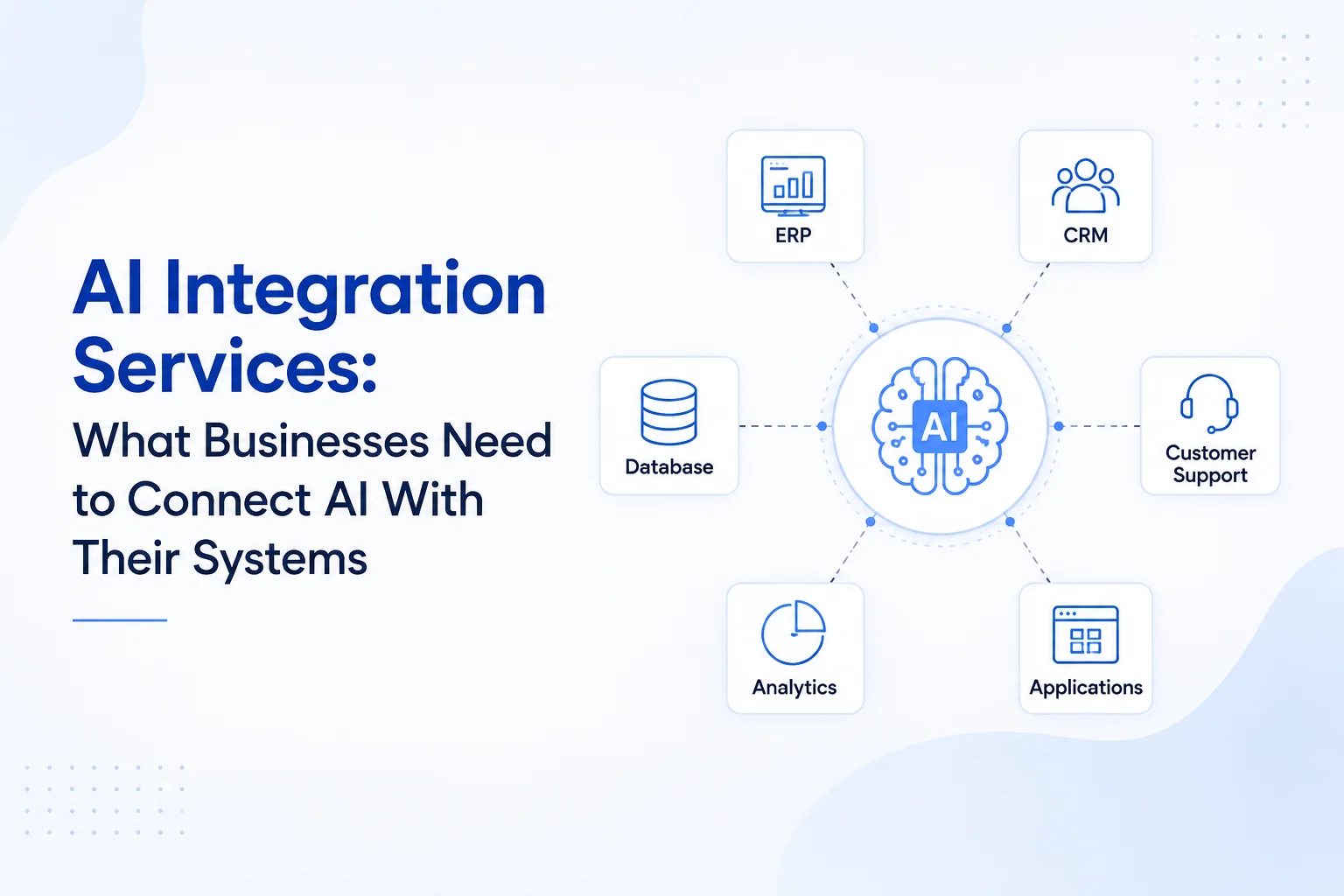
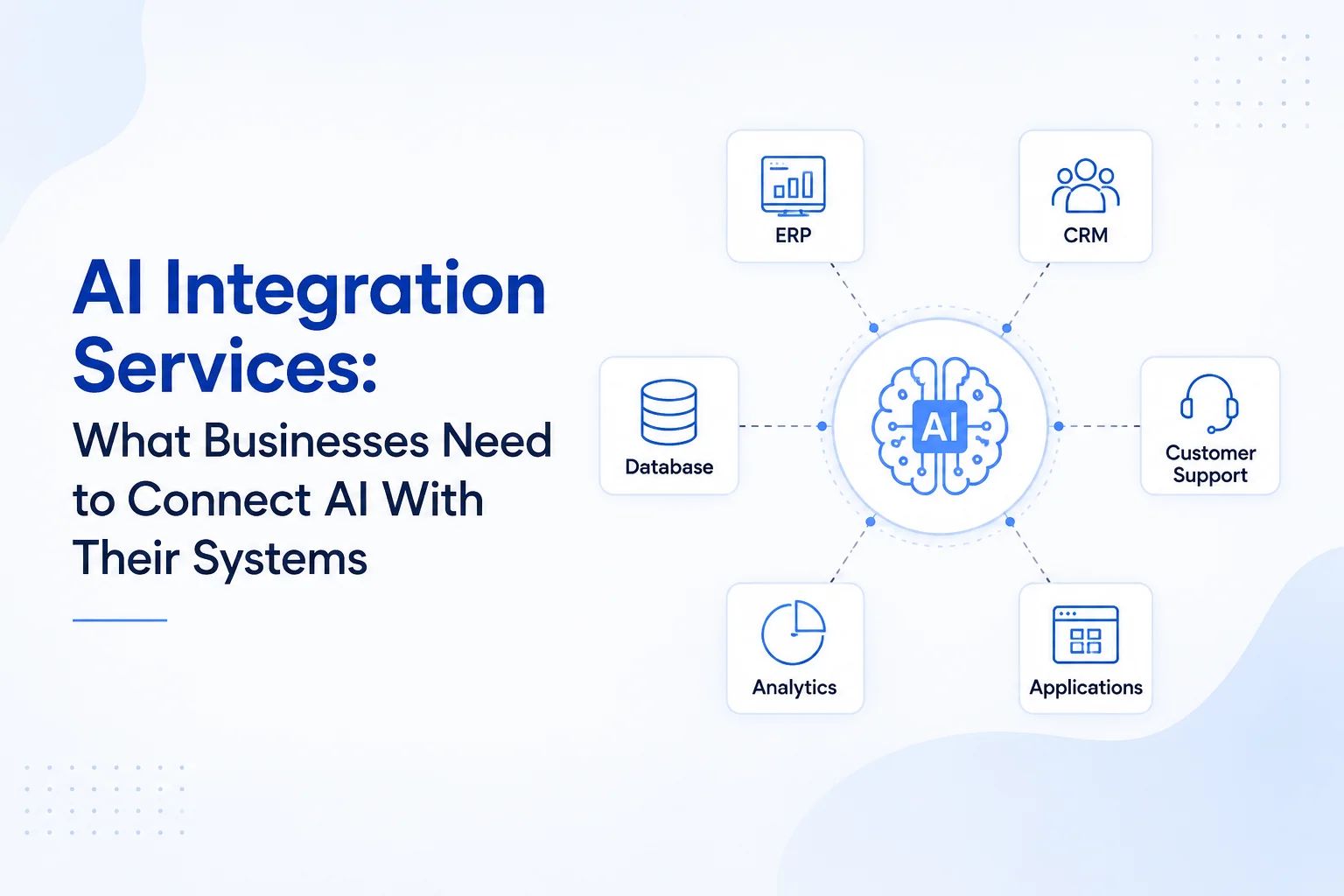
Imagine a business has a powerful AI assistant that can analyze information, answer questions, and automate tasks. But the AI cannot access the company's CRM, ERP, customer database or internal documents.
The technology may be impressive, but its business value remains limited.
This is where AI integration services become important. AI integration connects artificial intelligence with the systems, applications, data, and workflows a business already uses. Instead of keeping AI as a separate tool, businesses can make it part of everyday operations.
Recent industry developments show that enterprises are moving from AI experiments toward AI that works at scale. The challenge is no longer only selecting a good AI model. Businesses also need reliable data, system integration, governance, security, and the right technical skills to make AI work in production.
What Are AI Integration Services?
AI integration services help businesses connect AI models, applications and agents with their existing technology environment.
This can include:
- CRM and ERP systems
- Customer support platforms
- Databases and data warehouses
- Websites and mobile applications
- HR and recruitment systems
- Finance and accounting software
- Cloud platforms
- Business intelligence tools
- Internal knowledge bases
- Cybersecurity platforms
The objective is simple: connect AI to where business work actually happens.
For example, instead of asking an AI chatbot to provide a sales report manually, an integrated AI system could retrieve approved information from a CRM, analyze the data and generate the report automatically.
Why Do Businesses Need AI Integration?
Many organizations already have multiple software systems. The problem is that these systems often operate separately.
Customer information may exist in the CRM, financial information in the ERP and operational data in another database.
AI can provide much greater value when it can securely work across these systems.
Current enterprise AI research and industry reporting point to disconnected and fragmented data as one of the major barriers to scaling AI beyond pilots.
With effective integration, businesses can use AI to:
- Automate repetitive processes
- Improve customer service
- Analyze business data
- Generate reports
- Predict demand
- Support employees
- Personalize customer experiences
- Detect unusual activity
- Improve decision-making
- Automate selected workflows
What Can Businesses Integrate With AI?
1. CRM Systems
AI can be integrated with CRM platforms to help sales and customer service teams.
It can summarize customer conversations, identify potential leads, analyze customer behavior, and recommend the next action.
For example, when a sales employee opens a customer record, an integrated AI system could provide a summary of previous interactions, recent purchases, and relevant recommendations.
2. ERP Systems
ERP platforms contain important information about finance, procurement, inventory, operations, and other business activities.
AI integration can help analyze this information and automate selected workflows.
Potential applications include:
- Invoice processing
- Inventory forecasting
- Demand prediction
- Financial reporting
- Procurement analysis
- Supply chain optimization
This is particularly valuable because AI can work with existing enterprise processes instead of forcing employees to move information between separate applications.
3. Customer Support Systems
AI can connect with helpdesk software, knowledge bases, and customer databases.
A customer could ask a question through a website or messaging platform. AI can understand the request, retrieve relevant information, and provide an answer.
For more complex issues, the system can create or update a support ticket and transfer the case to a human employee.
This creates a connected workflow rather than simply adding another chatbot.
4. Business Data and Analytics
Data is one of the most important components of successful AI integration.
Businesses can connect AI with databases, data warehouses, analytics platforms and internal documents.
This can support:
- Sales forecasting
- Customer segmentation
- Fraud detection
- Business intelligence
- Demand forecasting
- Operational analysis
However, AI integration should not begin before understanding data quality, ownership, access and security.
AI Readiness Should Come Before Integration
Before connecting AI to business systems, organizations should understand whether their technology and data environment is ready.
This is where AI readiness becomes important.
An AI readiness assessment can examine:
- Data quality
- Existing technology infrastructure
- APIs and system connectivity
- Security controls
- Business processes
- AI use cases
- Compliance requirements
- Employee capabilities
- Integration requirements
This step can prevent businesses from investing in an AI solution that their existing infrastructure cannot properly support.
Recent industry guidance also highlights the importance of centralized data, real-time context, orchestration and governance when organizations prepare for AI-driven customer interactions.
AI Integration Also Requires the Right Skills
Integration is not simply about connecting an API.
Businesses may need professionals who understand software development, data engineering, machine learning, cloud infrastructure, cybersecurity, and business workflows.
This is where AI Staffing can help organizations build or strengthen teams with the skills required to implement and maintain AI projects.
For more advanced requirements, businesses may also need AI ML development services to build custom machine learning models, recommendation systems, predictive models or other AI capabilities that can be integrated into existing applications.
The combination of AI expertise and integration engineering becomes increasingly important as companies move from small experiments toward production deployments.
AI Software Solutions Can Become Part of Existing Workflows
Businesses do not always need to build a completely new platform.
An AI software solutions approach can embed intelligent capabilities into existing applications.
For example, a manufacturing company could integrate predictive maintenance into its operational software.
A retailer could connect recommendation capabilities with its e-commerce platform.
A logistics company could integrate demand forecasting and route optimization with its supply chain systems.
A financial organization could connect AI-based fraud detection with transaction monitoring.
The important question is not simply, “Where can we use AI?”
It is:
“Where can AI create measurable value inside our existing workflow?”
What Businesses Need for Successful AI Integration
Successful integration requires more than an AI model.
Reliable Data
AI needs access to accurate and relevant information.
APIs and Connectors
APIs allow AI applications to communicate with existing software and exchange information securely.
Security and Access Controls
AI should only access the information and systems it is authorized to use.
Cloud Infrastructure
Businesses need infrastructure capable of supporting their AI workload as usage grows.
Governance
Organizations need policies covering data usage, privacy, security, model behavior and accountability.
Human Oversight
Important decisions should still involve people where accuracy, compliance or business risk requires it.
Monitoring
AI systems need continuous monitoring for performance, accuracy, security and unexpected behavior.
The Rise of AI Agents
AI integration is also moving toward AI agents.
Traditional AI may provide an answer. An AI agent can potentially understand a request, retrieve information, use connected applications, and complete a defined workflow.
For example:
Customer request → AI understands the request → CRM lookup → Data analysis → Recommendation → Approval → Action
This type of workflow requires deep integration between AI, business applications and enterprise data.
The growing adoption of agentic AI is making governance and permission management even more important because AI systems can increasingly interact with business applications and take actions.
How Should Businesses Start?
Businesses do not need to integrate AI into every system immediately.
A practical approach is to:
- Identify a high-value business problem.
- Assess AI readiness.
- Map the data and systems involved.
- Select the appropriate AI technology.
- Build the required integrations.
- Test the workflow.
- Add security and human controls.
- Measure business results.
- Scale the solution to other processes.
Starting with one measurable use case allows businesses to understand the technology, risks and expected return before expanding.
The Future of AI Integration Services
AI is moving from standalone tools toward connected business systems. The organizations that gain the most value will not necessarily be those using the largest AI models. They will be the ones that connect AI effectively with their data, applications, employees, and workflows.
As AI becomes more autonomous, businesses will need stronger integration, governance, security and operational capabilities. This makes AI integration services an important part of moving from AI experimentation to real business impact.
For businesses looking to build this foundation, Rubixe can help bring together AI readiness, AI staffing, AI ML development services and AI software solutions as part of a broader AI integration strategy. The goal is not simply to add AI, but to connect intelligent capabilities with the systems and processes that drive the business.