Sign up with Google
 Sign in with Zoho

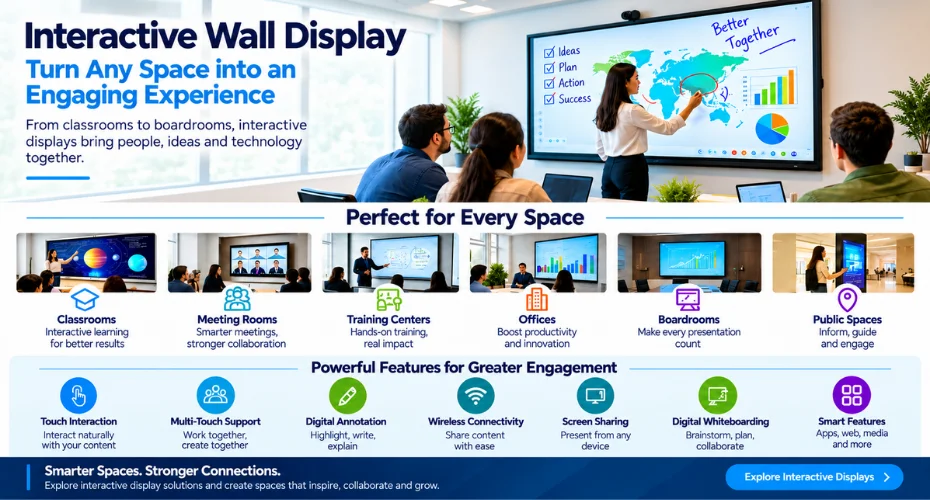
Imagine walking into a classroom, meeting room, training center, or business workspace where the wall is no longer just a surface for displaying information. Instead, it becomes a place where people can touch, explore, create, collaborate, and share ideas.
That is the idea behind an interactive wall display.
As businesses and educational institutions look for better ways to communicate and engage their audiences, interactive display technology is becoming an important part of modern spaces. Instead of simply showing static presentations, an interactive display allows users to interact directly with digital content.
From brainstorming sessions and business presentations to classroom lessons and employee training, interactive technology can make communication more visual and participatory.
For organizations looking to create modern and collaborative environments, Logic AV provides display solutions designed to support presentations, collaboration, learning, and communication.
This guide explains what an interactive wall display is, how it works, where it can be used, its benefits, and how organizations can choose the right interactive display solution.
What Is an Interactive Wall Display?
An interactive wall display is a large digital display that allows users to interact with content directly through touch or other interactive technologies.
Unlike a conventional digital screen that mainly displays information, an interactive display allows people to write, draw, navigate, annotate, present, and interact with digital content.
Depending on the technology and configuration, an interactive wall display can be used to display:
- Presentations
- Videos
- Images
- Documents
- Web pages
- Educational content
- Business dashboards
- Training materials
- Digital whiteboards
- Collaborative applications
The objective is simple: instead of asking people to passively watch a screen, the display encourages them to participate.
This makes an interactive wall display useful for environments where communication and engagement are important.
Why Are Interactive Displays Becoming Popular?
Traditional displays are useful for presenting information, but modern workplaces and classrooms often require more interaction.
People expect meetings, presentations, training sessions, and lessons to be more visual and collaborative.
This is where interactive displays can add value.
With an interactive display, users can interact with information instead of simply viewing it. A presenter can highlight important points, move between applications, write notes, or explain concepts visually.
In classrooms, teachers can use interactive content to make lessons more engaging. In businesses, teams can use displays for presentations, brainstorming, collaboration, and meetings.
The growing demand for hybrid work and digital learning has also increased the importance of collaborative display technology.
Interactive Wall Display vs Traditional Display
The biggest difference between an interactive wall display and a traditional display is the level of user interaction.
A traditional screen primarily acts as a viewing surface. An interactive display acts as both a viewing and working surface.
Consider a business presentation.
With a traditional display, the presenter may use a laptop or remote control to move between slides.
With an interactive display, the presenter can interact directly with the content, write notes, highlight information, open supporting documents, and navigate through digital content from the display itself.
Similarly, in a classroom, students can participate directly in activities rather than simply watching a presentation.
This creates a more active communication environment.