Sign up with Google
 Sign in with Zoho

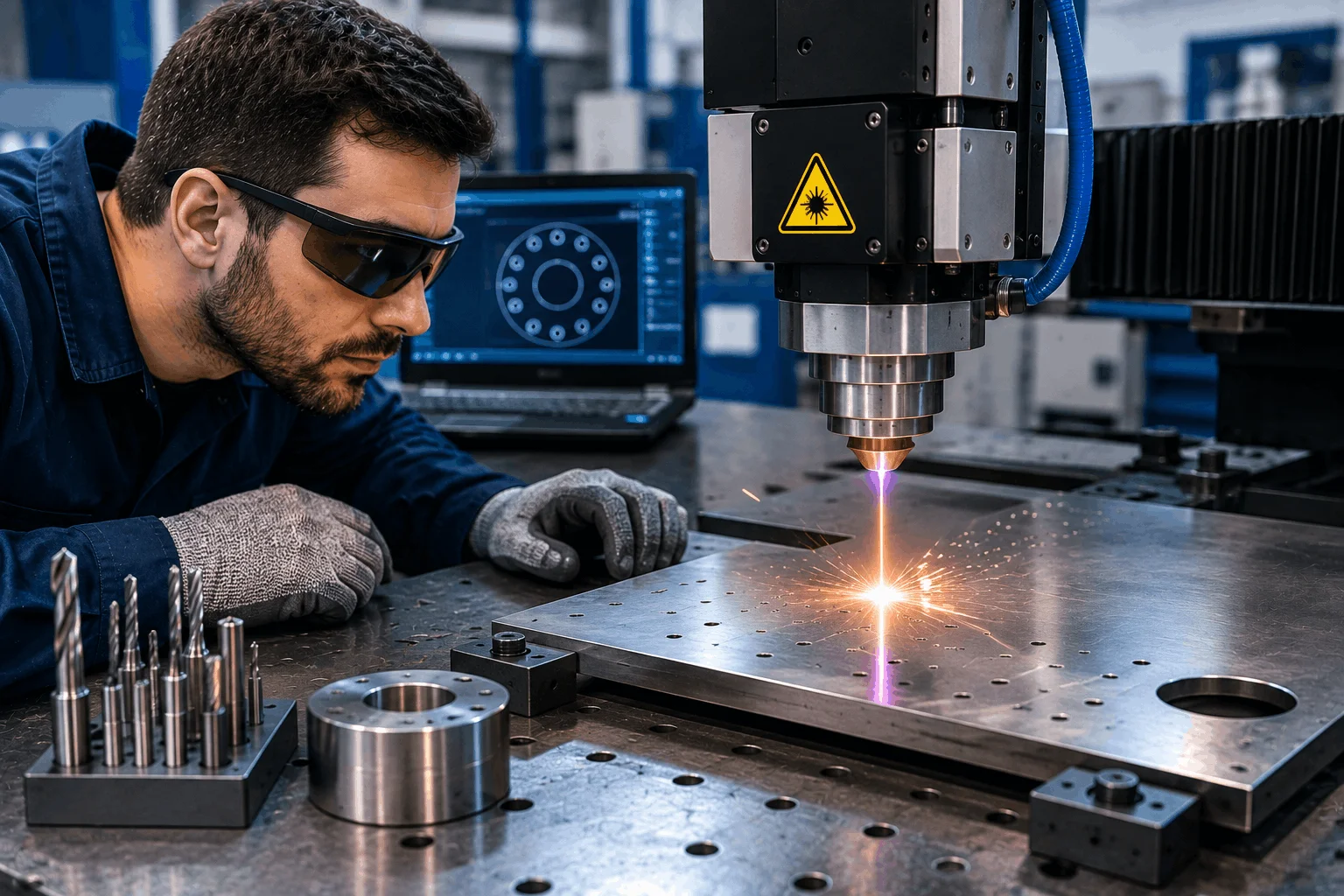
Picture trying to put a hole through a turbine blade that runs at temperatures exceeding 1,400 degrees Celsius, with walls thinner than a coin, using a drill bit. The bit would burn up before the hole finished. The part would crack. The tolerances would be nowhere close to acceptable. Traditional machining simply has no answer for problems like that.
Laser drilling does. And it handles them with a level of precision, repeatability, and material flexibility that no mechanical process can match. Whether you are working with superalloys in aerospace, fragile ceramics in electronics, or surgical-grade metals in medical manufacturing, laser drilling opens up possibilities that conventional drilling closes off completely.
Here is a thorough look at how it works, what it does well, and where it shows up in real production environments.
The Basic Concept Behind Laser Drilling
How a Laser Creates a Hole Without Touching the Material
Laser drilling is a non-contact material removal process. The laser beam, focused down to a very small spot, delivers concentrated energy to a precise location on the workpiece surface. That energy heats the material so rapidly and intensely that it melts, vaporizes, or ablates away, leaving a hole behind.
Because nothing physically touches the workpiece, there is no tool wear, no cutting force, no vibration, and no mechanical stress on the surrounding material. The hole is created purely through thermal energy interaction, which is what makes laser drilling viable on materials that would destroy or be destroyed by conventional tooling.
Laser Drilling vs. Mechanical Drilling: The Core Difference
Mechanical drilling removes material by rotating a cutting tool against the workpiece. It works brilliantly on machinable metals and plastics within certain size and geometry limits. Push it onto hard ceramics, brittle composites, extremely thin walls, very small diameters, or difficult angles and it starts to fail fast. Bits break, materials crack, holes wander, and edge quality degrades.
Laser drilling removes material without physical contact, which sidesteps those limitations entirely. Holes as small as 25 microns in diameter are achievable. Angles that would be impossible to approach with a drill chuck become straightforward. Hard, brittle, and heat-resistant materials that destroy tooling in seconds are drilled cleanly and repeatedly.
The tradeoff is that laser drilling is a thermal process, and thermal processes introduce heat into the surrounding material. Managing that heat-affected zone is one of the central challenges of laser drilling process development.
How the Laser Drilling Process Actually Works
Pulse Duration and Energy Delivery
Laser drilling almost always uses pulsed laser operation rather than continuous wave output. Pulses deliver intense bursts of energy in very short time intervals, which allows the material at the focal point to reach vaporization temperatures before the surrounding material has time to absorb significant heat. This keeps the heat-affected zone narrow and the hole geometry controlled.
Pulse duration ranges from milliseconds in traditional pulsed systems down to femtoseconds in ultrashort pulse lasers. The shorter the pulse, the less thermal energy spreads into the surrounding material during each burst. Ultrashort pulse lasers, picosecond and femtosecond systems, can drill with such minimal thermal impact that the surrounding material shows almost no heat-affected zone at all under microscopic inspection.
Single Pulse vs. Percussion Drilling vs. Trepanning
Three main drilling strategies handle different hole requirements. Single pulse drilling fires one high-energy pulse to create the entire hole in one shot. It is fast, but limited to relatively small, shallow holes where surface quality and taper control are not the primary concern.
Percussion drilling fires multiple pulses at the same location in sequence, progressively deepening the hole with each pulse. This allows much deeper holes with better aspect ratios than single pulse can achieve. Most production laser drilling of through-holes in aerospace components uses percussion drilling.
When Trepanning Is the Right Choice for Large Holes
Trepanning cuts around the perimeter of a larger hole rather than drilling straight through the center. The laser traces a circular or contoured path, essentially cutting out a disk of material to create the opening. This method produces larger holes with much better roundness and edge quality than percussion drilling can achieve at larger diameters, and it gives the operator control over the finished hole profile that other methods cannot match.
Trepanning is the standard approach for holes above roughly 0.5mm in diameter where edge quality and roundness are critical, and it is the method of choice for shaped holes and slots drilled at compound angles.
Assist Gas and Its Role in Clean Hole Formation
Assist gas flows coaxially with the laser beam through the cutting nozzle during drilling. Its job is to blow molten and vaporized material out of the hole as it forms, prevent recast material from re-solidifying inside the hole, and protect the focusing optics from contamination.
Oxygen assist gas promotes additional exothermic reaction with metals, which adds energy to the process and speeds material removal. Nitrogen and argon are inert options that protect reactive materials like titanium from oxidation during drilling. The choice of assist gas directly affects hole quality, recast layer thickness, and oxide formation on the drilled surface, so it is matched carefully to both the material and the application requirements.
Materials That Laser Drilling Works On
Metals and Superalloys
Laser drilling handles an extremely wide range of metals, from common mild steel and stainless steel through the most demanding aerospace superalloys. Nickel-based alloys like Inconel and Hastelloy, cobalt alloys, titanium and its alloys, and refractory metals like tungsten and molybdenum are all drilled by laser in production environments where mechanical drilling would be impractical or impossible.
The hardness and high-temperature strength that make superalloys so difficult to machine conventionally is irrelevant to a laser. The material's mechanical properties do not resist the laser; its thermal properties determine how it responds to the beam. This is why laser drilling became the enabling technology for turbine blade cooling holes that no other process could produce reliably.
Ceramics, Composites, and Hard Non-Metals
Drilling Carbon Fiber and CFRP Without Delamination
Carbon fiber reinforced polymer composites present a particular challenge for mechanical drilling. The fiber and matrix materials have very different mechanical properties, which causes drills to delaminate the layers at hole entry and exit, produce rough edges, and wear tooling rapidly. For precision applications, mechanically drilled CFRP holes often require additional finishing operations to achieve acceptable quality.
Laser drilling on CFRP, when done with appropriate pulse parameters and wavelength selection, ablates material cleanly without the mechanical forces that cause delamination. Ultrashort pulse lasers in particular are well suited to composite drilling because their minimal thermal impact reduces the risk of matrix charring and fiber-to-matrix delamination that longer pulse systems can introduce.
Technical ceramics, alumina, zirconia, silicon carbide, and similar materials are also strong candidates for laser drilling. Their hardness makes mechanical drilling extremely tool-intensive. Laser drilling removes their hardness as a barrier entirely.
Where Laser Drilling Gets Used Across Industries
Aerospace Cooling Holes and Turbine Blades
This is where laser drilling made its name and continues to represent some of the most demanding production drilling work anywhere in manufacturing. Turbine blades in jet engines run at temperatures that exceed the melting point of the blade material itself. The only reason they survive is a network of cooling holes, typically 0.3mm to 0.8mm in diameter, drilled at precise angles through the blade wall, that direct cooling air across the external surface.
A single turbine blade may have hundreds of these holes, all drilled at compound angles, all holding tight diameter and position tolerances, in Inconel or similar superalloy that defeats conventional tooling in seconds. Laser drilling is the only production-viable process for this application, and it has been refined over decades to deliver the consistency and traceability that engine manufacturers demand.
Medical Device and Surgical Instrument Applications
Precision holes in medical components must be clean, burr-free, and produced without contaminating the part or compromising material integrity. Catheter tubes, surgical instrument tips, orthopedic implant components, and drug delivery device orifices all require holes that meet those standards in materials like titanium, stainless steel, and various medical-grade polymers.
A laser engraver for metal in a precision medical manufacturing environment does more than mark surfaces. The same focused beam technology that creates permanent identification marks on implants is closely related to the drilling capability used to create functional features in those same components. The process cleanliness, parameter control, and documentation requirements are consistent across both operations.
Electronics, Semiconductors, and Microvia Drilling
How Microvia Drilling Changed PCB Manufacturing
Printed circuit board manufacturing went through a fundamental shift when laser drilling enabled microvias at scales that mechanical drilling could not achieve. Microvias are small holes, typically under 150 microns in diameter, that connect copper layers in a multilayer circuit board. As PCB designs have pushed toward higher density and more layers, the ability to drill these tiny interconnect holes accurately and at high speed became essential.
UV laser systems and CO2 lasers are both used for PCB via drilling depending on the layer structure and material involved. The speed of laser via drilling, capable of many thousands of holes per minute on automated systems, and the hole quality achievable at diameters impossible for mechanical drills, made it the production standard for high-density interconnect boards.
Laser Drilling Accuracy and What Controls It
Hole Diameter, Depth, and Taper Management
Laser drilled holes are not perfectly cylindrical. They taper slightly from entry to exit because the laser beam diverges slightly as it penetrates deeper into the material, and because energy delivery decreases with depth. The entry diameter is always slightly larger than the exit diameter. For many applications this taper is acceptable and designed for. For others, taper must be minimized through trepanning strategies, beam shaping, or secondary operations.
Hole diameter accuracy depends on focused spot size, pulse energy consistency, and the number of percussion pulses applied. Diameter repeatability across a production run of hundreds or thousands of holes depends on machine stability, beam quality consistency, and assist gas delivery uniformity.
Heat-Affected Zone and How to Minimize It
The heat-affected zone is the region of material surrounding the drilled hole that experiences elevated temperature during drilling without being removed. Within this zone, the material's microstructure may be altered: grain growth, oxidation, recast layer formation, and microcracks can all occur depending on material type and laser parameters.
For applications where HAZ is a concern, shorter pulse durations reduce thermal spread dramatically. Ultrashort pulse systems produce HAZ so minimal that it is essentially undetectable in many materials. Process cooling, parameter optimization, and multiple short pulses rather than fewer long ones all help manage the HAZ in production environments.
How Equipment Capability Affects Finished Hole Quality
Not all laser drilling systems are equal. Beam quality, pulse energy consistency, repetition rate stability, and motion system accuracy all determine what the machine can reliably produce. A high-beam-quality system with stable pulse energy delivers consistent holes across a production run. A system with degraded optics or unstable pulse energy produces variable results that inspection catches only after the fact.
For businesses evaluating laser technology, a best laser engraver for small business setup that handles marking and light engraving work is a very different investment than an industrial laser drilling system designed for aerospace superalloy work. Understanding that capability gap is essential when matching the tool to the application.
Laser Drilling vs. Laser Engraving: Understanding the Overlap
When the Same Machine Does Both Jobs
Laser drilling and laser engraving share fundamental technology. Both use a focused laser beam to remove material from a workpiece. The distinction is in the intent and the depth of removal. Engraving removes material from the surface to create marks, textures, or shallow features. Drilling removes material through the full thickness of the workpiece to create a through-hole, or to a precise depth for a blind hole.
Many laser systems are capable of both operations. A fiber laser used for marking serial numbers and part identification on aerospace components can also drill small reference holes or vent features in the same setup. The parameters differ, the strategies differ, but the underlying beam delivery technology is common.
Choosing the Right Setup for Your Application
The choice between a system optimized for engraving versus one set up for production drilling comes down to the specific requirements of the work. Engraving prioritizes mark contrast, edge definition, and surface finish. Drilling prioritizes hole geometry, aspect ratio, taper control, and HAZ management.
For shops considering adding laser capability, understanding which applications dominate your workflow determines which system configuration delivers the best return. Shops that primarily do identification marking and shallow surface work have different requirements than shops producing functional holes in structural or functional components.
Conclusion
Laser drilling is one of those technologies that quietly enables things that would otherwise be impossible. Turbine blades that survive conditions no material should survive. Circuit boards with more connections in less space than mechanical drilling could ever achieve. Medical components with features so small and clean that conventional tooling cannot touch them. The process works because focused light energy follows different rules than rotating cutting tools, and exploiting those different rules opens up a genuinely different set of manufacturing possibilities. Understanding how it works, what variables control it, and what it is best suited for puts you in a much better position to use it intelligently in your own programs.
Frequently Asked Questions
1. What is the smallest hole achievable with laser drilling?
Industrial laser drilling systems routinely produce holes as small as 25 to 50 microns in diameter in thin materials, with some specialized systems capable of going smaller under controlled conditions.
2. Is laser drilling faster than mechanical drilling?
For small-diameter holes and hard materials, laser drilling is significantly faster. For large-diameter holes in soft, machinable metals, mechanical drilling can be more cost-effective depending on volume and setup.
3. Does laser drilling work on reflective metals like copper and aluminum?
Yes, though reflective metals require higher power levels or specific wavelengths to overcome initial surface reflectivity. Fiber lasers handle aluminum and copper drilling well in production environments.
4. What causes taper in laser drilled holes?
Beam divergence and energy attenuation with depth both contribute to taper. Trepanning strategies and beam shaping optics reduce taper significantly for applications where cylindricity is critical.
5. Can laser drilling replace EDM for small holes in hard materials?
In many cases yes. Laser drilling is faster than EDM, requires no electrode fabrication, and handles a broader range of materials. EDM still holds advantages for very deep, very precise holes in conductive materials where HAZ is unacceptable.