Sign up with Google
 Sign in with Zoho

Walk into any air purifier shop and you will hear the same words repeated: HEPA, True HEPA, H13, medical grade. They sound similar, and many brands use them loosely. The result is confusion for buyers who simply want cleaner air at home.
This guide explains what each term really means, how the grades are tested, and which one makes sense for your home, based on the published filtration standards rather than marketing claims.
What Does HEPA Actually Mean?
HEPA stands for High-Efficiency Particulate Air. It describes a type of filter made of a dense mat of very fine fibres that trap airborne particles as air passes through.
The important point is that HEPA is a performance standard, not just a name. A filter only deserves the label if it meets a defined efficiency level in testing. That is why a filter sold as a HEPA-type filter, a HEPA-like filter or a filter with HEPA-style performance should make you cautious, because those phrases are not defined by any standard and promise nothing specific.
Why 0.3 Microns Is the Number You See Everywhere
Filter efficiency is often quoted at 0.3 microns. This is not because 0.3 microns is the smallest particle. Particles around this size are among the hardest for a fibre filter to catch, so testing at this size shows the filter's weakest point. Larger particles are caught more easily, and very small particles are also captured well through a process called diffusion. In simple terms, a filter that performs well at this size is likely to perform even better on many others.
True HEPA: The US-Style Definition
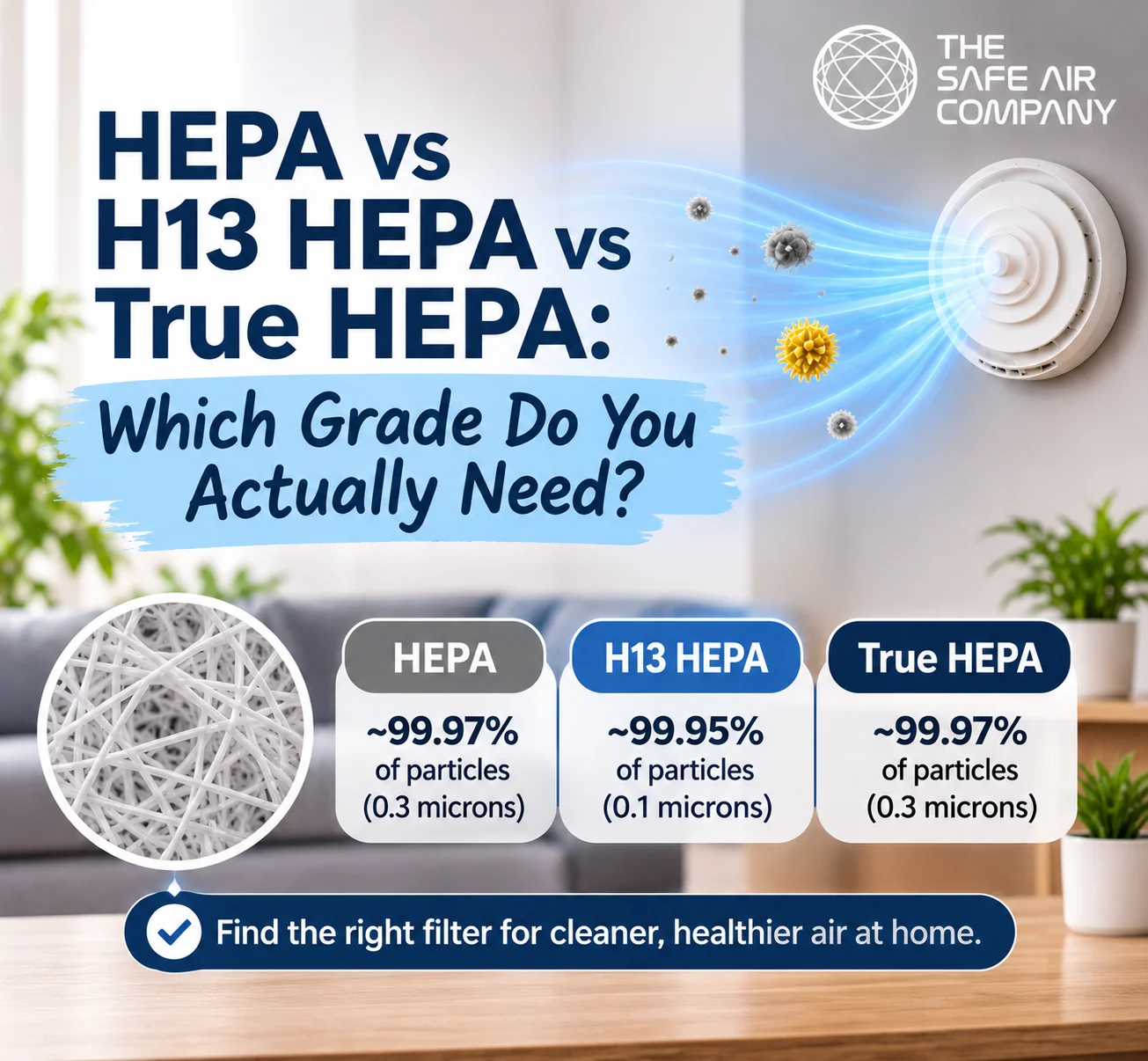
The term True HEPA usually refers to the definition used in the United States, where a HEPA filter must remove at least 99.97% of particles at 0.3 microns. Put another way, out of 10,000 particles of that size, no more than 3 should pass through.
The word True is a marketing signal. It is meant to separate genuine filters from the vague HEPA-type labels mentioned above. A reputable True HEPA product should be able to tell you the efficiency figure and the test standard behind it.
H13 HEPA: The European Classification
H13 comes from the European standard EN 1822, which is closely aligned with the international standard ISO 29463. This system classifies filters into grades such as H13 and H14, and tests them at the most penetrating particle size, which is usually between 0.1 and 0.3 microns, depending on the filter.
An H13 filter must achieve at least 99.95% efficiency at that size. An H14 filter must reach at least 99.995%, and it is more commonly used in hospitals, laboratories and cleanrooms.
HEPA vs H13 vs True HEPA: A Simple Comparison
At first glance, 99.97% looks higher than 99.95%, which leads some buyers to assume True HEPA beats H13. That is not a fair reading. The two numbers come from different test methods, and the European method tests at the hardest particle size for each filter, which makes it a stricter test in some respects. For household use, both True HEPA and H13 are considered high-performance filtration, and neither is automatically better.
Which Grade Do You Actually Need at Home?
For most homes, genuine True HEPA or H13 filtration is the right target. H14 is rarely needed outside medical and industrial settings, and paying for it in a home gives very little extra benefit.
When True HEPA or H13 Is Enough
- Everyday protection from dust, pollen and pet dander
- Reducing PM2.5 from outdoor pollution and smoke
- Homes with children, seniors or people with allergies or asthma
When You May Want to Ask for More
- Homes with a person who has a serious medical condition, where you should follow your doctor's advice
- Spaces with very specific cleanliness requirements
What the Grade Doesn't Tell You
Here is the part many buyers miss. A filter's grade describes the filter alone, not the whole purifier.
- Sealing matters. If air leaks around the filter, it bypasses it entirely, and the rating means little.
- Airflow matters. A top-grade filter in a weak unit will clean the air slowly.
- Coverage matters. A unit rated for a small room will not protect a large home.
- Gases are not covered. HEPA captures particles, not gases, fumes or odours, which need a different type of filter, such as activated carbon.
- Maintenance matters. A clogged filter loses performance, so replacement schedules are part of the real cost.
How to Check a Purifier's HEPA Claim
Before you buy, ask these questions:
- Which standard is the filter tested to? Look for named standards such as EN 1822 or ISO 29463, or a clear True HEPA efficiency figure.
- At what particle size is the efficiency measured? A genuine claim states this.
- Is a test report or certificate available?
- How is the filter sealed in the unit?
- How often do filters need replacing, and what does it cost?
- Can performance be verified in your home? Measured indoor results say more than a spec sheet.
Where Whole-Home Systems Fit In
Filter grade is only one part of the picture. Whole-home systems apply high-grade filtration to the entire living space, so the filter works for every room instead of one.
Safe Air Haven by The Safe Air Company is one example. A single unit placed outside the living space draws in outdoor air and passes it through three filtration stages:
- Washable pre-filter: captures larger dust particles, hair and lint, with 92.5% efficiency for particles of 3 microns and above.
- H13 HEPA, stage 1: 99.95% efficiency for particles at 0.3 microns.
- H13 HEPA, stage 2: a second H13 stage, also rated at 99.95% at 0.3 microns, that adds a final filtration safeguard before the air enters the home.
The filtered air is then supplied through the home, creating gentle positive pressure that helps keep polluted outdoor air from leaking in. At handover, indoor PM2.5 is measured against outdoor levels, so the result is checked rather than assumed. As with any HEPA-based system, it is a particle-filtration system and does not remove gases or odours.
If you are comparing a HEPA 13 air purifier with other options, look at coverage, sealing, fresh air supply and verified results alongside the filter grade.
Final Thoughts
HEPA, True HEPA and H13 are not three rival technologies. They are different ways of describing high-efficiency particle filtration, and what matters most is that the claim is real, tested and backed by a named standard.
For most homes, genuine True HEPA or H13 filtration is more than enough. Choose a HEPA air purifier that states its test standard, suits the size of your space and can show measurable results, and you will be paying for real performance instead of a label.