Sign up with Google
 Sign in with Zoho

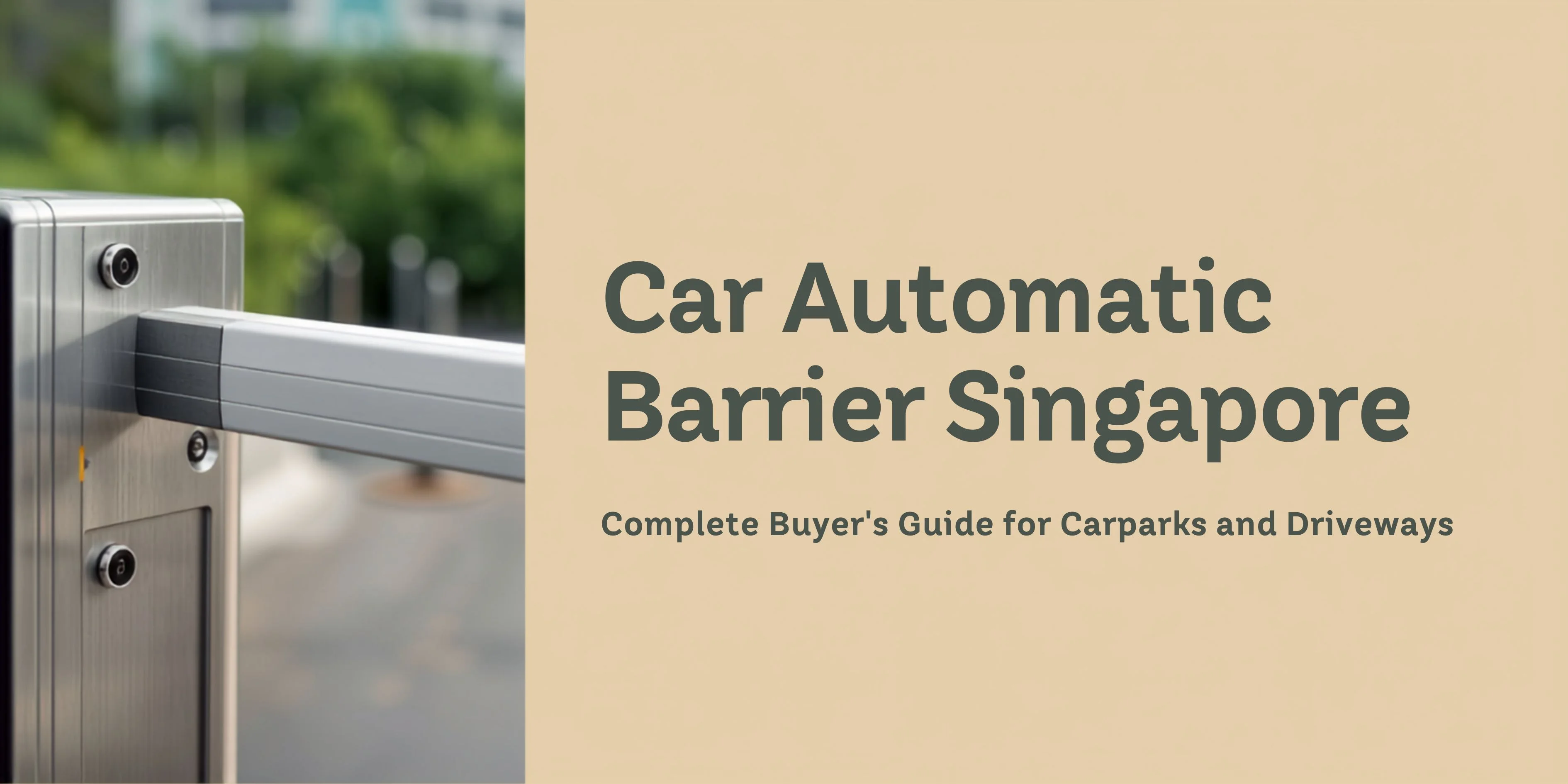
A car automatic barrier is one of the most practical vehicle access solutions available — used everywhere from private driveways to shopping mall carparks to industrial logistics yards. But the right barrier for a landed home is nothing like the right barrier for a 500-lot commercial carpark, and getting the specification wrong means either overpaying or installing something that fails under real-world use.
This guide walks through exactly what to consider before buying a car automatic barrier in Singapore — how it works, what affects cost, and how to match the right system to your property.
What Is a Car Automatic Barrier?
An automatic barrier is a boom-style arm that rises and lowers to control vehicle access into a driveway, carpark, or restricted zone. Unlike a full gate, a barrier doesn't enclose the property — it simply regulates the passage of vehicles at a single entry point, making it faster to operate and cheaper to install than a comparable gate system.
Barriers are typically used where pedestrian access doesn't need to be restricted at the same point, or where a full gate would be impractical — wide carpark entrances, multi-lane driveways, or high-traffic commercial access points.
Barrier vs Gate: When Each Makes Sense
- Choose a barrier: when you only need to control vehicle entry, traffic moves frequently, and a full enclosure isn't necessary — carparks, office complexes, gated communities with separate pedestrian access.
- Choose a gate: when you need full perimeter security, including pedestrian access control, or your property requires a continuous physical boundary.
- Some properties use both: a barrier for vehicle flow at the main entrance, combined with a perimeter gate or fence for full enclosure — common in condominiums and corporate campuses.
How a Car Automatic Barrier Works
The core components are simpler than a sliding or swing gate system, which is part of why barriers suit high-frequency use:
- Motor and gearbox: housed in the barrier's base cabinet, this drives the arm up and down using a torsion spring or counterweight system to balance the arm's weight.
- The arm: ranges from 2 to 6+ metres depending on lane width. Arms can be solid, articulated (with a folding joint for low headroom areas), or skirted with a mesh/fence-style barrier for added security.
- Control board: manages the open/close logic and integrates with access triggers — remotes, loop detectors, IU readers, or ANPR cameras.
- Loop detectors: buried sensors in the road surface that detect a vehicle's presence, used both to trigger opening and as a safety mechanism to prevent the arm from lowering onto a vehicle.
- Photocells: infrared safety beams that detect obstructions in the arm's path, just like in autogate systems.
Step 1: Define Your Use Case
Before comparing models, identify your primary need:
- Residential driveway access: control entry to a private driveway, often paired with a remote control and possibly an intercom for visitors.
- Carpark entry/exit management: regulates vehicle flow, often integrated with a ticketing or season parking (IU) system.
- Restricted zone access: control entry to staff-only or security-sensitive areas, often paired with ANPR or card-based access control.
Step 2: Match Arm Length to Your Lane Width
This is one of the most common specification errors. The barrier arm must fully cover the lane width with a small safety margin, but an oversized arm adds unnecessary stress on the motor and gearbox over time.
- Measure your actual lane width at the point of installation, not an estimate.
- For wide entrances (over 6m), consider a dual-barrier setup (two arms meeting in the middle) rather than a single oversized arm, which reduces wind load and mechanical strain.
Step 3: Understand Duty Cycle Ratings
Duty cycle tells you how many times per hour or day a barrier can operate without overheating or premature wear. This is the single biggest differentiator between a residential and commercial-grade barrier.
Residential/light use: fewer than 20 cycles per hour — typical for a private driveway with a handful of household vehicles.
Medium commercial use: standard office or small carpark with moderate, steady traffic throughout the day.
Heavy/continuous use: shopping mall carparks, logistics hubs, or any site with vehicles entering and exiting constantly — these need barriers explicitly rated for high-frequency, continuous operation.
Installing a residential-grade barrier in a commercial setting is one of the most expensive mistakes a property can make — the motor fails early, and replacement plus business disruption costs far more than specifying correctly from the start.
Step 4: Plan Your Access Trigger Method
How will vehicles actually open the barrier? This decision affects both convenience and ongoing operational cost:
• Remote control: simplest option, suited to low-traffic residential use.
• Push-button or intercom: common at staffed or semi-staffed entry points.
• Loop detector + token/ticket: standard for pay-per-use carparks.
• IU-based automatic access: vehicle is detected automatically via in-vehicle unit — no driver action needed, ideal for season parking holders.
• ANPR camera recognition: fully automated for registered vehicles, with built-in entry/exit logging — increasingly common for office and condo carparks.
2026 Cost Guide for Singapore
Costs vary significantly based on barrier grade, arm length, and integration complexity. Here's a realistic budget range:
These figures cover the barrier unit and standard installation. Integration with existing carpark management software, ANPR systems, or season parking infrastructure may add to commercial project costs.
Step 5: Consider Safety and Compliance
A barrier arm coming down on a vehicle or pedestrian is a genuine safety risk if the system isn't properly specified and maintained. Look for:
Photocell obstacle detection covering the full arm sweep, not just the centre point
Loop detector safety function that prevents the arm from lowering while a vehicle is detected beneath it
Compliance with relevant safety standards (EN 12453 / EN 12445 for automated barrier systems)
Visible arm markings or reflective strips, especially important for night-time visibility
Step 6: For High-Security Sites — Consider Crash-Rated Barriers
Standard automatic barriers are designed for traffic control, not for stopping a determined or hostile vehicle. Government buildings, data centres, embassies, and other high-security sites typically require crash-rated hostile vehicle mitigation (HVM) barriers, such as the HySecurity StrongArm range, which are independently certified to stop vehicles at specific speed and weight ratings.
If your site falls under heightened security requirements, this is a specialist conversation — standard commercial barriers will not meet the requirement, regardless of how robust they appear.
Questions to Ask Before You Buy
- Is the barrier rated for my actual usage frequency, not just my average traffic? — Always size for peak hours.
- What's the arm length, and does it fully cover my lane width with safety margin? — Measure on-site, don't estimate
- Can this integrate with my existing or planned access system? — IU, ANPR, or carpark software compatibility matters for commercial sites.
- What safety certifications does the system carry? — Ask specifically about EN 12453 / EN 12445 compliance.
- Is local servicing and parts availability guaranteed? — Authorised distributor support, like PCM's for NICE, ensures long-term reliability.
Recommended NICE Barrier Models
NICE S-Bar / Wide-S: compact residential and light commercial barriers, arm lengths up to 3–4m.
NICE M-Bar: medium-duty barriers suited to small-to-medium carparks and office complexes.
NICE L-Bar / Wide-L: heavy-duty barriers for high-traffic commercial carparks, with arm lengths up to 6m and EPS carpark system integration.
HySecurity StrongArm: crash-rated barriers for high-security and critical infrastructure sites, distributed by PCM.
Final Thoughts
A car automatic barrier is a long-term piece of infrastructure, not a one-off purchase. The right specification — matched to your actual traffic volume, lane width, and security needs — determines whether you get reliable, low-maintenance performance for a decade or a system that struggles within the first year.
PCM Electrical Engineering has supplied and installed NICE automatic barriers across Singapore since 1996, for properties ranging from private homes to Changi Airport and major commercial carparks. Contact us for a free site assessment and the right barrier recommendation for your property.