Sign up with Google
 Sign in with Zoho

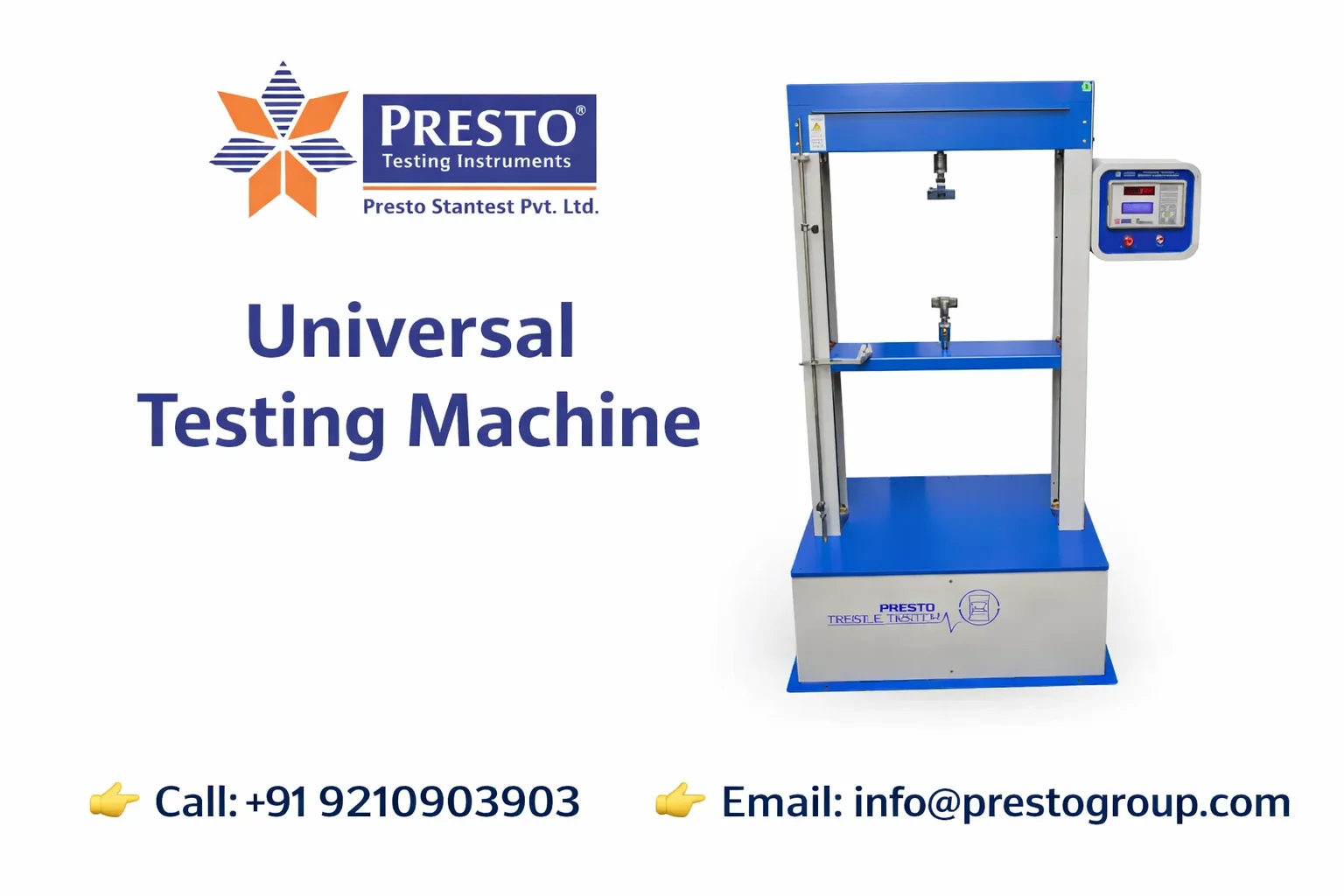
A Universal Testing Machine (UTM) is a laboratory testing instrument used to determine the mechanical properties of materials when subjected to controlled forces. Depending on the machine configuration and fixtures used, it can perform tensile, compression, bending, flexural, and other mechanical tests.
For manufacturers, testing laboratories, and quality-control departments, a UTM machine provides measurable data that helps determine whether a material or finished product meets its specified performance requirements.
Presto Stantest Pvt Ltd offers testing solutions designed for accurate and repeatable material evaluation across different industrial applications.
What Is a UTM Machine?
A UTM machine is an electromechanical or servo-controlled testing system that applies a predetermined load to a specimen and records its response. During testing, the machine measures parameters such as force, displacement, elongation, and breaking load.
The basic concept is simple: a test specimen is securely held between suitable fixtures, and a controlled force is applied until the required test condition is achieved or the specimen fails.
The resulting data can be used to calculate important material properties such as:
- Tensile strength
- Yield strength
- Elongation
- Breaking force
- Compression strength
- Flexural strength
- Modulus of elasticity
The exact parameters depend on the material, test method, specimen dimensions, and selected standard.
Working Principle of a UTM Machine
The working principle of a Universal Testing Machine is based on applying a controlled mechanical force to a test specimen while continuously measuring its response.
For a tensile test, the specimen is placed between the upper and lower grips. The machine moves one grip at a controlled speed while the other grip provides the required reaction force. As the specimen stretches, the load cell measures the applied force and the displacement or extensometer measures deformation.
The machine's control system records the relationship between load and displacement. From these measurements, stress-strain characteristics and other mechanical properties can be determined.
For tensile stress:
Stress = Force / Original Cross-Sectional Area
Engineering strain is generally calculated as:
Strain = Change in Gauge Length / Original Gauge Length
These values help engineers understand how a material behaves under mechanical loading.
For compression testing, the specimen is positioned between compression platens and subjected to a controlled compressive force. The machine records the applied load and corresponding deformation.
Main Components of a UTM Machine
Although construction varies between models, a typical UTM consists of several important components.
1. Load Cell
The load cell measures the force applied to the specimen. Selecting an appropriate load-cell capacity is important because the measurement range should match the expected testing force.
2. Grips and Fixtures
Grips hold tensile specimens securely during testing. Different materials and specimen geometries require different grips. Compression platens and bending fixtures can be installed for other test methods.
3. Crosshead
The crosshead moves along the machine frame according to the selected test speed and applies displacement to the specimen.
4. Drive System
The drive mechanism controls crosshead movement. Depending on the design, UTM machines may use electromechanical or servo-controlled systems.
5. Control and Data Acquisition System
Modern UTM machines use software to control test parameters and collect test data. Results can typically be presented through load-displacement or stress-strain curves.
6. Extensometer
An extensometer measures the change in gauge length of a specimen during a tensile test. It is particularly useful when accurate strain or elongation measurements are required.
Types of UTM Machines
UTMs can be classified according to their construction, control system, capacity, and intended application.
Single-Column UTM
Single-column systems are generally compact and suitable for lower-force applications where laboratory space is limited.
Double-Column UTM
Double-column machines provide a more rigid test frame and are commonly used for a wider range of industrial and laboratory applications.
Electromechanical UTM
These machines use an electric motor and mechanical transmission system to control crosshead movement. They are widely used for routine tensile and compression testing.
Servo-Controlled UTM
Servo-controlled systems provide precise control over speed and testing conditions. They are suitable for applications requiring controlled and repeatable test sequences.
The appropriate configuration depends on the required test force, specimen dimensions, testing standard, speed range, accuracy, and application.
Tests Performed Using a UTM Machine
One of the major advantages of a Universal Testing Machine is its versatility. With suitable grips and fixtures, a single system can perform multiple mechanical tests.
Tensile Test
A tensile test determines how a material behaves when pulled apart. Common results include tensile strength, yield strength, elongation, and breaking force.
Compression Test
Compression testing evaluates the behaviour of a material under compressive loading. It is commonly used for materials and products that primarily experience compression during service.
Flexural Test
Flexural testing measures the response of a specimen to bending forces and can be used to determine flexural strength and related properties.
Bending Test
A bending fixture can be used to evaluate how a material or component behaves when subjected to controlled bending forces.
The actual test configuration should always be selected according to the relevant material specification and test standard.
Important Testing Parameters
Correct test parameters are essential for obtaining meaningful results. Depending on the application, these may include:
- Test speed
- Maximum load
- Specimen dimensions
- Gauge length
- Crosshead displacement
- Elongation
- Load range
- Preload
- Test mode
- Number of specimens
Specimen preparation is equally important. Incorrect dimensions, poor gripping, misalignment, or unsuitable test speed can affect the results.
Standards for UTM Testing
UTM testing is performed according to the applicable international or industry-specific standard. The selected standard depends on the material and test method.
For example, tensile testing of plastics may follow ASTM D638, while metallic materials may be evaluated using standards such as ASTM E8/E8M. Other materials and applications may require ISO or other relevant standards.
It is important to identify the correct standard before configuring the test because specimen dimensions, conditioning, test speed, calculations, and reporting requirements can vary.
Applications of UTM Machines
Universal Testing Machines are used across many industries for material and product evaluation, including:
- Plastics and polymers
- Rubber
- Packaging materials
- Paper and paperboard
- Textiles
- Metals
- Automotive components
- Construction materials
- Wires and cables
- Adhesive materials
- Medical and laboratory products
Manufacturers use UTM testing for incoming material inspection, production quality control, product development, failure analysis, and research applications.
Benefits of Using a UTM Machine
A properly configured UTM provides several benefits for industrial testing:
Versatile testing: Multiple tests can be performed using interchangeable fixtures.
Accurate measurement: Load and displacement measurement systems provide quantitative test data.
Repeatability: Controlled test conditions help produce consistent results between specimens.
Quality control: Test results can help identify variations in raw materials and finished products.
Material evaluation: Engineers can compare materials based on measurable mechanical properties.
Data analysis: Software-based systems can record, calculate, and report test results efficiently.
Choosing the Right UTM Machine
Selecting a UTM should not be based only on maximum load capacity. The machine should be matched to the actual testing requirement.
Important factors include maximum test force, required accuracy, test speed, specimen size, available fixtures, measurement range, software capabilities, and applicable testing standards.
The type of material being tested is also important. A UTM intended for metal testing may require a different capacity and gripping arrangement compared with a system used for plastics, films, rubber, or packaging materials.
Conclusion
A UTM Machine is a versatile instrument for evaluating the mechanical behaviour of materials and products under controlled tensile, compression, and bending forces. By measuring parameters such as force, displacement, elongation, and strength, it provides useful data for quality control, research, and product development.
For reliable testing, the machine configuration, specimen preparation, fixtures, test speed, and applicable standard should all be selected carefully.
Presto Stantest Pvt Ltd provides material testing solutions for laboratories and industries that require dependable, repeatable, and technically sound testing performance.