Sign up with Google
 Sign in with Zoho
On most projects, nobody talks about anchor bolts until something goes wrong. They sit at the very bottom of the structure, usually hidden under a base plate or a layer of grout, and they do one of the most important jobs on the site: they tie everything above to the foundation.
In bridges, power plants, refineries, water treatment facilities, and transmission towers, that connection carries serious loads, including wind, vibration, equipment weight, and sometimes earthquakes. A reliable connection isn’t about the bolt alone. It’s a chain, and it’s only as strong as its weakest link.
Know which type you’re dealing with
Anchor bolts fall into two broad groups.
Cast-in-place anchor bolts are positioned before the concrete is poured. Headed bolts and plate-washer anchors are common, and hooked bolts (J and L shapes) are still around. Hooked bolts depend on the bend for their grip, and in my view they’re the weaker choice for heavy tension. Headed anchors usually perform better, though the final call belongs to the design engineer.
Post-installed anchors go into hardened concrete. These include expansion anchors, undercut anchors, screw anchors, and adhesive (chemical) anchors. They’re essential for retrofits and for fixing mistakes, but they depend heavily on how well they’re installed.
Neither group is “better.” The right choice depends on the load, the concrete condition, and whether the loads are static, vibrating, or seismic.
How anchor connections actually fail
It’s tempting to think a failure means the steel snapped. Often it doesn’t. The common failure modes include:
- Steel failure: the bolt itself breaks in tension or shear.
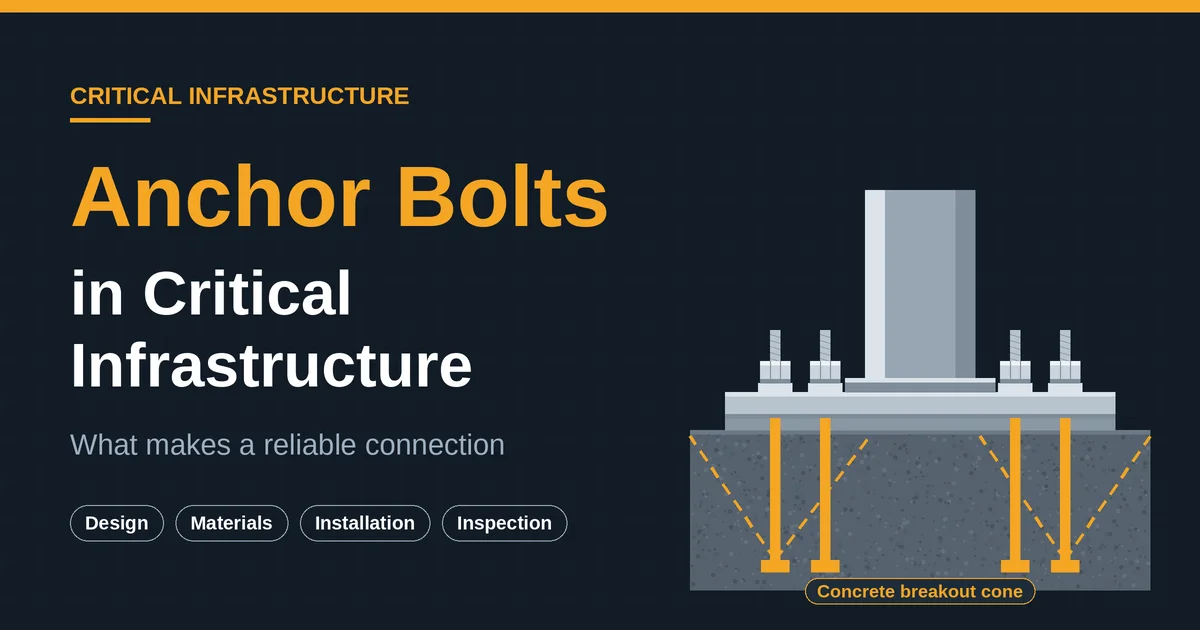
- Concrete breakout: a cone of concrete pulls out around the anchor, which happens when the embedment is too shallow or the anchor sits too close to an edge.
- Pullout: the anchor slips out without breaking the concrete.
- Side-face blowout: the concrete next to a near-edge anchor bursts sideways.
- Splitting: the concrete cracks when anchors are spaced too tightly.
The point is that the surrounding concrete is part of the connection. A strong bolt in weak or poorly placed concrete is still a weak connection.
Material, coating, and where you buy
For structural work, material grade matters. ASTM F1554 is widely used for Anchor bolts and covers several strength grades, and project specifications usually dictate which one applies. Whatever the grade, ask for mill test certificates so you can trace the steel back to its source.
Corrosion deserves equal attention. In coastal, desert, or chemical environments, a bare bolt can lose section over the years, often unnoticed beneath the base plate. Hot-dip galvanizing is a common defense, and stainless steel suits harsher conditions. Very high-strength steels need extra care with galvanizing, so leave that choice to the engineer.
Sourcing is part of reliability, too. Buy from suppliers who can show certifications and test reports, not just a price list. In the Gulf region, one example is Petrofast Middle East FZC, a UAE-based manufacturer that lists stud anchors among its products. Whoever you choose, check the paperwork before the material is delivered, not after it’s installed.
Installation is where most problems start
I’d argue that more connections are compromised on site than on the drawing board. A few errors come up again and again:
- Misplaced bolts. Cast-in anchors shift during the pour, and the base plate holes no longer match. A rigid template, checked before and after pouring, prevents this. Reaming holes or bending bolts to make them fit is a bad habit that damages the connection.
- Insufficient embedment or edge distance. If the design says a given depth and distance, that’s the minimum, not a suggestion.
- Dirty holes in adhesive anchors. Dust and debris left in a drilled hole are one of the best-known causes of poor adhesive anchor performance. Cleaning with a brush and compressed air, exactly as the manufacturer instructs, isn’t optional.
- Wrong tightening. Over-tightening can damage the anchor, and under-tightening leaves it loose. Follow the specified torque or tension procedure.
- Ignoring the base plate. Uneven bearing, poor grouting, or missing washers put uneven stress on the bolts.
Designing for the real conditions
Critical infrastructure rarely sees gentle, steady loads. Vibration from rotating machinery, wind gusts on tall structures, and seismic movement all put repeated stress on the connection. Cracked concrete, which is common in service, reduces the capacity of some post-installed anchors. For these cases, use anchors qualified for the conditions, such as cracked concrete or seismic loading, and consider locking nuts or double nuts where vibration could loosen them.
Inspect it, then inspect it again
A reliable connection should be verified, not assumed. That can include:
- Checking position, projection, and embedment before and after the concrete pour
- Reviewing material certificates against the specification
- Verifying torque or installation records
- Proof-load testing of a sample of post-installed anchors where the specification requires it
- Periodic inspection for corrosion and loosened nuts during the structure’s life
Anchor bolts are inexpensive compared to the structures they hold up. That’s exactly why cutting corners on them is such a poor trade.
The short version
A dependable anchor connection comes down to five things: the right type for the load, correct material and corrosion protection, careful installation, a design that matches real conditions, and inspection that proves it. Get any one of those wrong and the rest can’t compensate. Treat the work at the base of the structure with the same seriousness as everything above it.