Sign up with Google
 Sign in with Zoho

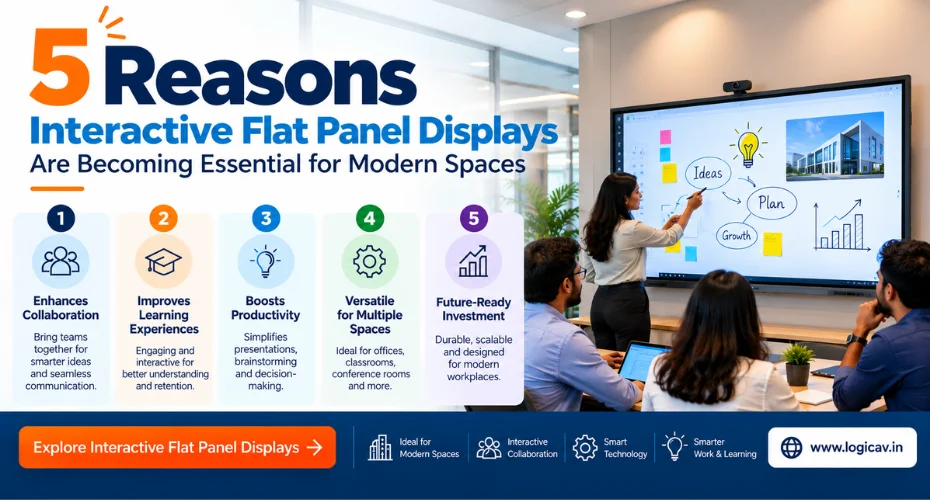
Digital experiences are changing the way people learn, work, communicate, and collaborate. Whether it is a classroom, corporate meeting room, training centre, or creative workspace, people no longer want to look at information on a screen. They want to interact with it.
This is where smart interactive display technology is making a difference.
Modern interactive displays combine large high-resolution screens, touchscreen interaction, digital whiteboarding, wireless sharing, smart software, and collaboration tools into a single solution. Instead of making technology the centre of attention, these displays help people focus on what matters most—ideas, communication, learning, and collaboration.
Logic AV offers interactive display solutions designed to support modern learning and collaboration environments. Its range includes different interactive panel series with features such as 4K Ultra HD resolution, wireless multi-device sharing, Google EDLA certification, device management, split-screen functionality, and AI-powered tools, depending on the model.
But what makes these displays so effective?
Let's explore how smart interactive displays can create more engaging digital experiences.
What Makes a Smart Interactive Display Different?
A traditional display mainly shows information. An interactive display allows users to become part of the experience.
Instead of simply watching a presentation, users can touch the screen, write notes, annotate content, move objects, open applications, browse resources, share content, and collaborate with others.
Modern interactive flat panels combine a touchscreen, digital whiteboard, and computing capabilities in one device. This makes them useful across a wide range of environments, from education and training to business meetings and collaborative workspaces.
The result is a more active and engaging way to use digital content.
1. Turn Passive Viewing into Active Interaction
One of the biggest advantages of interactive technology is that it changes people from passive viewers into active participants.
Imagine a teacher explaining a complex concept using a static presentation. Students can see the information, but their interaction may be limited.
Now imagine the same lesson on an interactive panel.
The teacher can:
- Write directly on the content
- Highlight important points
- Display videos and images
- Draw diagrams
- Move objects around the screen
- Ask students to participate
- Save and share notes
The lesson becomes more dynamic.
Logic's interactive display solutions are designed for schools, colleges, universities, and coaching centres, with features such as multi-touch annotation, built-in learning tools, wireless sharing, and multitasking depending on the series.
This approach can also be valuable in corporate environments.
During a brainstorming session, team members can write ideas on the display, organise them visually, review documents, and make changes in real time.
The screen is no longer just a screen—it becomes a shared digital workspace.
2. Create Better Learning Experiences with an Interactive Panel for Classroom
Classrooms are among the most natural environments for interactive technology.
Students learn in different ways. Some understand concepts better through images, some through videos, some through demonstrations, and others through hands-on activities.
An interactive panel for classroom environments can bring these different learning formats together.
Teachers can combine presentations, videos, diagrams, digital notes, quizzes, and interactive activities within a single lesson.
Logic specifically positions its interactive panels for K-12 education, higher education, and coaching and training centres. Its solutions include features such as Google EDLA-certified apps, multi-touch annotation, wireless multi-device sharing, and AI-powered tools across different models.
Making difficult topics easier to understand
Consider a science lesson.
Instead of explaining a complex process only through words, a teacher can display an animated visual, pause it, annotate important sections, and ask students questions directly around the content.
In mathematics, teachers can draw shapes and equations.
In geography, they can explore maps.
In language classes, they can display text, highlight words, and use multimedia resources.
This makes lessons more visual and participatory.
The goal isn't to replace teachers. It is to give teachers better tools to explain ideas.
3. Make Business Meetings More Collaborative
The workplace has also changed.
Modern businesses increasingly depend on teamwork, presentations, brainstorming, training, and hybrid collaboration. A meeting room therefore needs more than a basic display.
Interactive displays for business can turn a conventional meeting room into a collaborative workspace.
Instead of one person controlling the presentation while everyone else watches, multiple team members can contribute.
For example, during a strategy meeting, employees can:
- Present their ideas.
- Annotate charts and reports.
- Brainstorm on a digital whiteboard.
- Compare different proposals.
- Organise ideas visually.
- Save notes for later.
Logic highlights wireless multi-device sharing, allowing content from up to nine devices to be shared simultaneously on supported panels. This can make collaborative meetings more flexible and reduce the need to repeatedly switch cables or devices.
For organisations with multiple displays, Logic also provides a device management system that allows displays to be monitored and managed centrally.
That can be particularly useful for larger offices, educational institutions, and organisations with multiple meeting or learning spaces.
4. Transform Conference Rooms into Interactive Workspaces
A conference room is often where important decisions are made.
Presentations, project reviews, client discussions, training sessions, and brainstorming meetings all require people to understand and respond to information quickly.
An interactive display for conference room environments can make these conversations more visual and collaborative.
Instead of presenting a slide and moving immediately to the next one, presenters can stop and interact with the information.
They can highlight a specific number in a report, draw attention to a section of a chart, add notes, or compare information side by side.
More than just presentations
A modern conference room display can support different activities during the same meeting.
For example:
Presentation → Discussion → Annotation → Brainstorming → Decision-making
Everything can happen on one interactive screen.
Logic's interactive display range includes features such as 4K Ultra HD displays, wireless sharing, split-screen multitasking, and built-in smart tools, depending on the selected series.
This makes the display useful before, during, and after a meeting.
5. Bring Ideas to Life with an Interactive Wall Display
Large collaborative spaces often need a visual centrepiece.
An interactive wall display can turn an ordinary wall into a digital collaboration surface where people can explore information, present ideas, and interact with content.
Think about a training centre where a large visual diagram is displayed.
Instead of standing in front of the screen and explaining each part, the trainer can directly interact with the diagram.
Similarly, a business team can use a large interactive surface for:
- Strategy planning
- Brainstorming
- Data visualisation
- Project planning
- Training
- Presentations
- Collaborative workshops
The bigger advantage is the shared experience.
Everyone in the room can see the information, while the presenter or team can interact with it in real time.
This makes large-format interactive technology particularly valuable in spaces where collaboration is the priority.
6. Make Digital Content Easier to Share
A good digital experience should not create unnecessary technical barriers.
If users have to spend several minutes connecting cables, switching inputs, or transferring files before a meeting begins, technology becomes a distraction.
Modern interactive displays are designed to simplify content sharing.
Logic's interactive display solutions support wireless multi-device sharing on supported models, allowing multiple devices to contribute content to the display.
This can help classrooms and meeting rooms work more efficiently.
A teacher can quickly move between lesson material and student contributions.
A business team can switch between presentations and reports.
A trainer can bring different resources into the same session.
The result is a smoother digital experience with less interruption.
7. Use AI to Make Interaction Smarter
The next generation of interactive displays is moving beyond simple touchscreen functionality.
AI is becoming part of the experience.
Logic's newer interactive display solutions include NeoAI-powered features, while the CX Series includes capabilities such as AI-assisted visual tools, live subtitles, multilingual translation, smart mapping, AI topics, and AI-assisted assessments.
These features can help users work with information in more intelligent ways.
For example, AI-powered tools can help organise brainstorming ideas into structured topics or turn classroom content into interactive assessment formats.
Why AI matters
The purpose of AI in an interactive display isn't simply to add another technology feature.
The real value comes when AI reduces repetitive work and helps users get more from their content.
For educators, this can mean spending less time preparing certain types of learning material.
For businesses, AI-assisted tools can support brainstorming, content organisation, and collaboration.
This makes the display more than a presentation device—it becomes an intelligent workspace.
8. Improve Visual Clarity with 4K Displays
Engagement starts with visibility.
If people cannot clearly see text, images, diagrams, or videos, even the best interactive features will have limited impact.
Logic's interactive display range includes 4K Ultra HD solutions designed to provide clear visuals for text, videos, and detailed diagrams.
High-resolution displays are particularly valuable in:
- Large classrooms
- Lecture halls
- Training rooms
- Conference rooms
- Corporate meeting spaces
- Collaborative environments
Sharp visuals make it easier for people to follow content from different positions in the room.
When high-quality visuals are combined with touch interaction and smart software, the overall experience becomes much more immersive.
9. Support Multiple Tasks on One Screen
Modern work often involves multitasking.
A presenter may need to show a document while taking notes. A teacher may want to display a lesson while referring to another resource.
This is where split-screen functionality becomes useful.
Logic's product range includes models with split-screen multitasking, allowing users to work with multiple applications or content sources side by side.
For example:
Presentation + Notes
Video + Diagram
Document + Browser
This saves time and reduces the need to repeatedly switch between applications.
The experience feels more natural because users can see and manage related information at the same time.
Why Smart Interactive Displays Are the Future of Digital Experiences
Technology is most valuable when it makes communication easier.
Smart interactive displays are helping organisations move away from one-way communication toward experiences where people can see, touch, share, discuss, and create together.
From an interactive panel for classroom learning to interactive displays for business, the applications continue to grow.
A modern interactive display can support:
- Better collaboration
- More engaging presentations
- Interactive learning
- Faster content sharing
- Digital brainstorming
- Multimedia presentations
- AI-assisted activities
- Remote and hybrid collaboration
- Centralised device management
Logic's interactive display portfolio is built around these kinds of use cases, with solutions covering schools, colleges, universities, coaching centres, and other modern learning and collaboration environments.
Choose the Right Interactive Display for Your Space
Every environment has different requirements.
A school may need an interactive panel with strong classroom tools.
A corporate office may prioritise wireless sharing and conference-room collaboration.
A training centre may need quick content access and reliable daily performance.
A large collaboration space may benefit from a larger interactive wall display.
The important thing is to choose a solution based on how people will actually use the technology.
Consider:
- Screen size
- Resolution
- Touch responsiveness
- Wireless connectivity
- Software compatibility
- Operating system
- AI features
- Device management
- Collaboration requirements
- Room size and layout
Logic offers multiple interactive display series with different feature combinations, allowing organisations to select a solution that fits their specific environment.
The best digital experiences are not necessarily the ones with the most technology. They are the ones that make technology feel simple, useful, and natural.
Smart interactive displays achieve this by bringing people and content closer together.
Teachers can explain concepts more visually. Students can participate more actively. Business teams can collaborate more naturally. Presenters can interact with their content instead of simply showing slides.
Whether you need an interactive panel for classroom learning, interactive displays for business, an interactive wall display, or an interactive display for conference room collaboration, the right solution can transform an ordinary space into a more engaging digital environment.
With its range of interactive display solutions, AI-powered capabilities, 4K visuals, wireless sharing, smart classroom tools, and device management features, Logic AV is helping organisations create spaces where communication becomes more visual, collaborative, and interactive.
Frequently Asked Questions
1. What are smart interactive displays?
Smart interactive displays are touchscreen display systems that combine visual presentation, digital whiteboarding, computing, and collaboration features. Depending on the model, they can also offer wireless sharing, AI-powered tools, app support, and device management.
2. How can an interactive panel for classroom improve learning?
An interactive panel for classroom environments allows teachers to combine videos, images, diagrams, digital notes, quizzes, and interactive activities. Students can also participate directly through touch-based activities and collaboration.
3. What are the benefits of interactive displays for business?
Interactive displays for business can make meetings, brainstorming sessions, presentations, training, and project discussions more collaborative. Users can annotate content, share information, and work with multiple devices on supported models.
4. Can an interactive display be used in a conference room?
Yes. An interactive display for conference room environments can support presentations, brainstorming, document review, annotations, training, and collaborative discussions. Features such as wireless screen sharing and split-screen functionality can make meetings more productive.
5. What is an interactive wall display used for?
An interactive wall display can turn a large visual surface into a collaborative digital workspace. It can be used for presentations, training, brainstorming, digital learning, data visualisation, and other activities where multiple people need to view and interact with content.









.webp)