Sign up with Google
 Sign in with Zoho
Introduction:
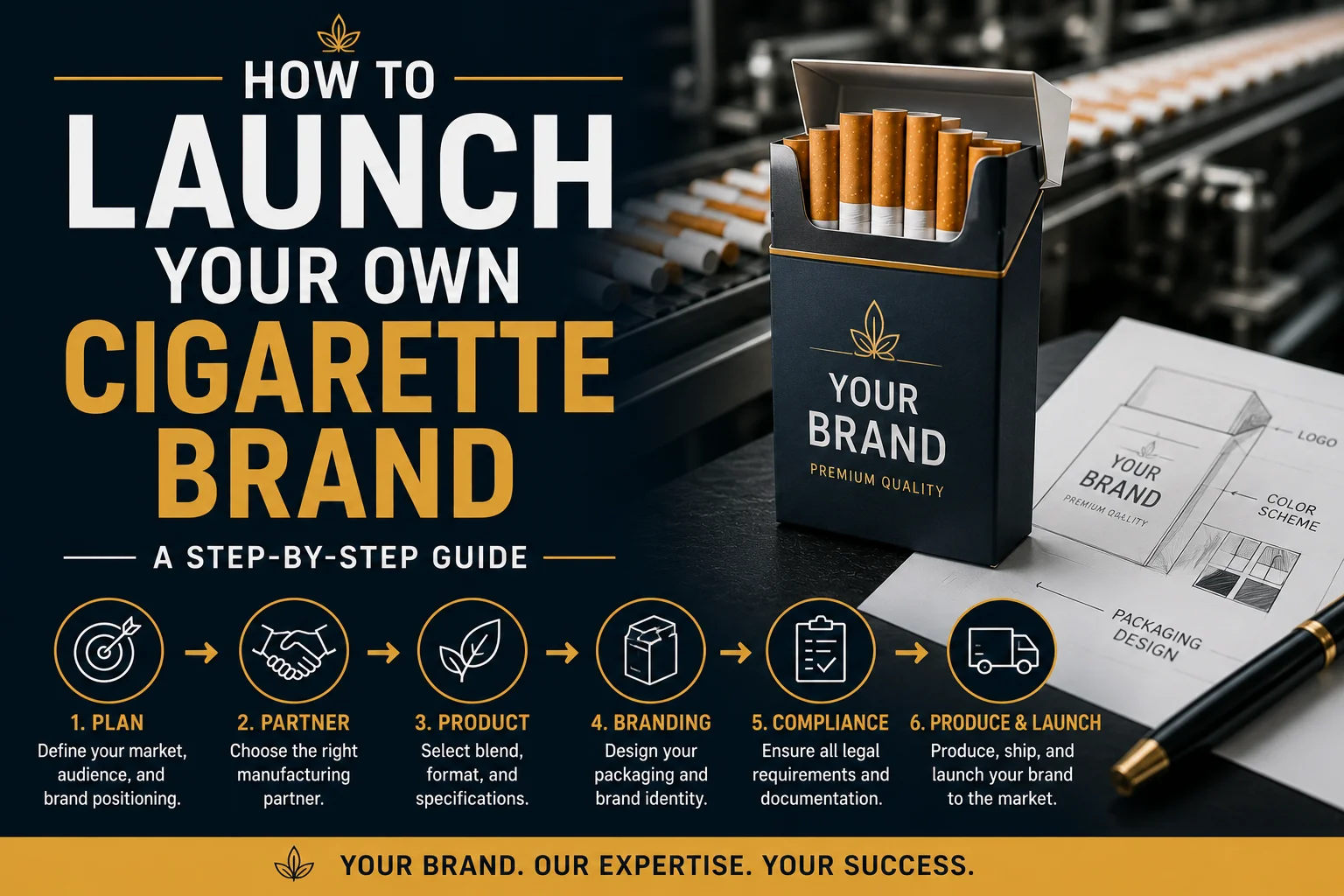
Launching a cigarette brand is more accessible than most first-time brand owners assume — you don't need to own a factory, develop a formulation from scratch, or navigate manufacturing alone. What you do need is a clear sequence of decisions, made in the right order, starting with how the product will actually be made.
This guide walks through the practical steps of taking a cigarette brand from idea to market.
Step 1: Define Your Market and Positioning
Before talking to any manufacturer, get specific about who the brand is for. Target market, price point, and positioning (premium, mid-range, value) shape almost every decision that follows — including which manufacturing route makes sense and what packaging and format choices fit.
Research the regulatory environment in your target market as well. Cigarette advertising, packaging requirements, and permitted product specifications vary significantly by country, and this affects both product design and how the brand can be marketed once it's ready.
Step 2: Choose Your Manufacturing Route
This is the decision that shapes your timeline, budget, and how differentiated your product can be. There are three broad paths:
- Private label manufacturing — start from an existing formulation or format, rebranded under your own packaging. Fastest route to market, lower minimum order quantities, less differentiation.
- OEM cigarettes — a fully custom product, built to your specific blend, tar/nicotine level, and format from scratch. Longer development timeline, but a genuinely distinct product.
- Contract manufacturing — the broader umbrella covering either of the above, structured as a formal production agreement with a manufacturing partner.
Many first-time brand owners start with private label to get a real product to market quickly and validate demand, then move to a custom OEM formulation once the brand is established. There's no wrong answer here — it depends on your budget, timeline, and how much product differentiation matters to your positioning.
Step 3: Find and Vet a Cigarette Manufacturer
Once you know your route, the manufacturer you choose determines everything downstream — quality, lead times, and compliance. At minimum, evaluate:
- Licensing and compliance — valid manufacturing licenses and export registration for your target markets
- Production capacity — realistic output numbers and how they handle order growth
- Quality control process — how consistently they monitor weight, moisture, and filter attachment
- Export experience — a genuine track record shipping to your specific region, not just a general claim of "worldwide export"
- Minimum order quantity — whether it fits your budget and initial launch volume
Ask for documentation, not just verbal assurances, and where possible request samples before committing to a full production run.
Step 4: Develop Your Product Specification
Whether you're going private label or full OEM, you'll need to lock in:
- Blend and strength — tobacco type, tar and nicotine levels
- Format — King Size, Slim, Super Slim, or another size
- Filter type — regular, charcoal, or other options the manufacturer offers
- Packaging format — soft pack or flip-top box, and finish details
For private label, much of this may already be defined by the manufacturer's existing catalog, with room for adjustment. For OEM, this stage is where the product is genuinely built from the ground up.
Step 5: Packaging and Branding
Packaging is where the brand becomes tangible. Beyond design, confirm with your manufacturer what's actually required for legal compliance in your target market — health warnings, labeling requirements, and any restrictions on branding elements vary by country and are non-negotiable for a legal launch.
Some manufacturers handle packaging design and printing in-house; others work with external packaging partners. Either way, this affects both lead time and cost, so confirm it early.
Step 6: Compliance and Documentation
Before any shipment leaves the factory, make sure the paperwork is in order: manufacturing compliance certificates, export documentation, and any product registration required by your destination market's regulatory body. This is an area where an experienced manufacturer's track record genuinely matters — a factory that has exported to your target region before will know exactly what's required.
Step 7: Production, Shipping, and Launch
With specifications locked and compliance handled, production moves forward according to the agreed timeline. Confirm shipping terms, expected delivery windows, and how the manufacturer handles any quality issues discovered after the product arrives, before the first order ships.
Frequently Asked Questions
How much does it cost to launch a private label cigarette brand? Costs vary significantly based on minimum order quantity, packaging complexity, and target market, so get a specific quote from a manufacturer rather than relying on general estimates.
How long does it take to launch a cigarette brand? A private label launch, working from an existing formulation, is typically faster than a fully custom OEM product built from scratch — timelines depend heavily on the manufacturer and packaging requirements.
Do I need my own manufacturing license to launch a brand? Generally no — when working with a contract or private label cigarette manufacturer, the manufacturer holds the production license. You're responsible for brand-related compliance such as labeling and marketing regulations in your target market.
Should I start with private label or go straight to OEM? Most first-time brand owners start with private label to validate demand with lower investment, then move to OEM once the brand has traction and a more differentiated product makes sense.
Conclusion
Launching a cigarette brand comes down to a sequence of decisions made deliberately: define your market, choose the right manufacturing route, vet your manufacturer carefully, and get the compliance details right before you ship. The brands that launch smoothly are the ones that treat manufacturer selection as seriously as their branding and marketing plan — the product itself has to be right before positioning matters.
Orchid Cigarettes Dubai supports brand owners launching private label and custom cigarette brands from its Jebel Ali Free Zone facility, with packaging, blending, and export support built into the process.
Ready to Talk to a Manufacturer?
Tell Orchid Cigarettes Dubai about your brand, your target market, and the format you have in mind. Their team will come back with formats, quantities, and realistic timing — no obligation.
note: This article is intended for informational purposes for brand owners, distributors, and industry professionals evaluating manufacturing options. It does not promote or encourage tobacco use. Tobacco products carry significant health risks, and readers should refer to public health guidance regarding those risks.