Sign up with Google
 Sign in with Zoho

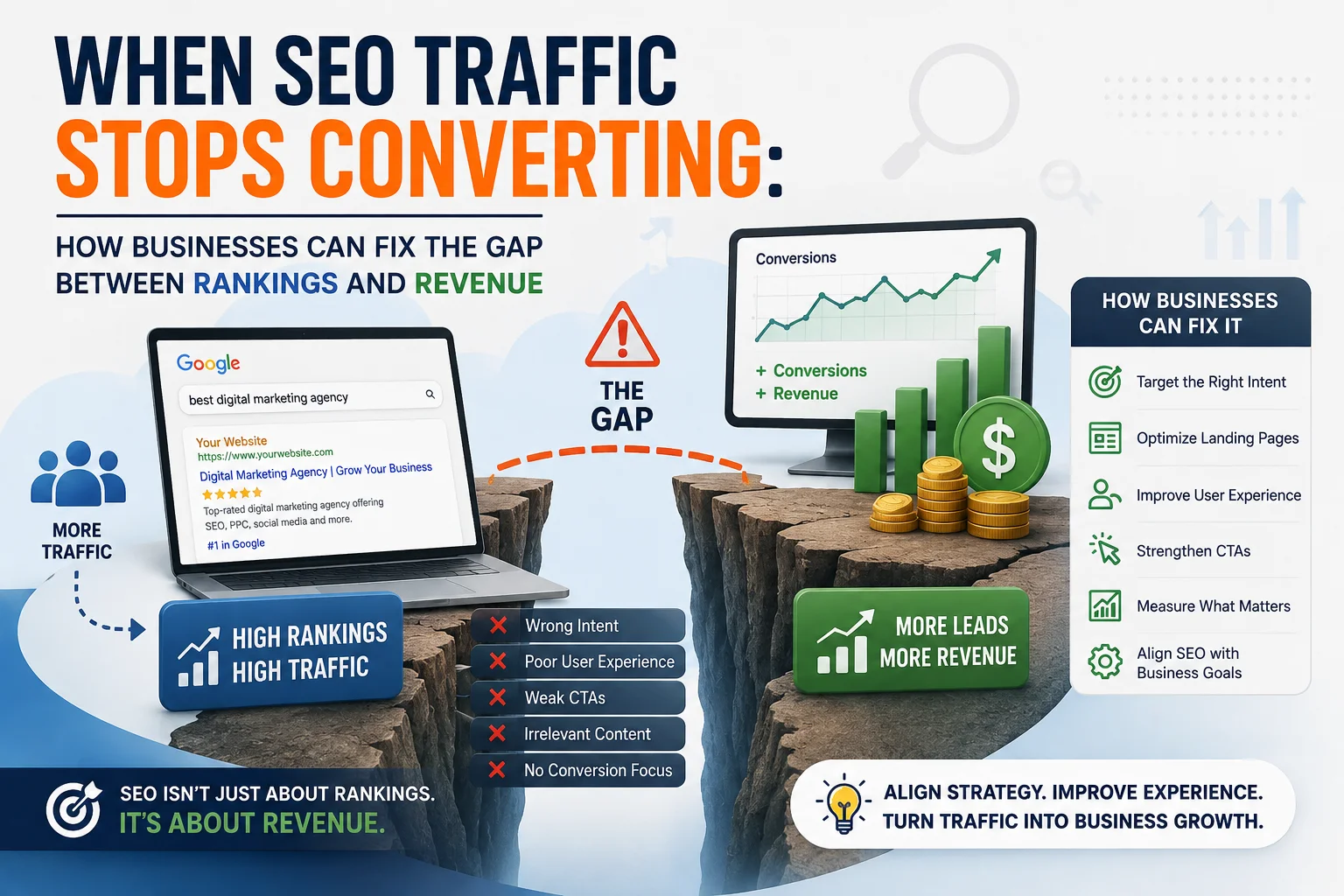
For many businesses, SEO success still starts with a familiar goal: rank higher on Google and bring more organic traffic to the website.
But what happens when rankings improve, traffic increases, and leads or sales stay the same?
This is one of the most common problems businesses face with SEO. A website can attract thousands of visitors from search engines without generating enough revenue. The problem is often not traffic itself. It is the gap between what people search for and what the business offers them after they arrive.
SEO should not be treated as a traffic-generation exercise alone. The real goal is to attract the right audience, meet their search intent, create a strong user experience, and guide qualified visitors toward conversion.
Here is how businesses can identify and fix the gap between SEO rankings and revenue.
Why High SEO Traffic Does Not Always Mean More Revenue
Ranking well for a keyword does not automatically mean that the keyword will generate customers.
For example, a digital marketing company might rank for a high-volume keyword such as “what is SEO?” The page could receive thousands of visitors every month, but most users searching that phrase are looking for information rather than a service provider.
On the other hand, a keyword such as “SEO services for SaaS companies” may have significantly lower search volume but much stronger commercial intent.
This creates an important distinction:
High traffic does not always mean high-value traffic.
Businesses need to evaluate organic traffic based on its ability to contribute to business goals, not simply its volume.
1. Check Whether You Are Targeting the Right Search Intent
Search intent is one of the biggest reasons SEO traffic fails to convert.
Before targeting a keyword, businesses should understand what the searcher actually wants.
Search queries generally fall into different categories:
- Informational: The user wants to learn something.
- Navigational: The user wants to find a specific website or brand.
- Commercial: The user is researching products, services, or solutions.
- Transactional: The user is ready to take an action such as buying, booking, or contacting a business.
Consider the difference between:
“What is social media marketing?”
and
“Social media marketing services for B2B companies.”
The first query is mainly educational. The second suggests that the user may be evaluating service providers.
If a business wants leads, it needs to build visibility for keywords that align with the buyer journey.
2. Stop Chasing Search Volume Alone
Search volume is useful for keyword research, but it should not be the only factor used to prioritize keywords.
A keyword with 10,000 monthly searches may generate less revenue than a keyword with 500 searches if the smaller keyword has stronger purchase intent.
Businesses should evaluate keywords using factors such as:
- Search intent
- Relevance to the product or service
- Buyer stage
- Competition
- Conversion potential
- Customer value
- Geographic relevance
A simple way to think about keyword value is:
Keyword value = Relevance × Intent × Conversion potential
This helps SEO teams move from traffic-focused SEO toward revenue-focused SEO.
3. Analyze Which Pages Are Actually Generating Leads
Not every page on a website has the same role in the conversion journey.
A blog post might attract most of the organic traffic, while a service page generates most of the enquiries.
This is why businesses should connect SEO data with conversion data.
Look at:
- Organic landing pages
- Leads generated by each page
- Conversion rate
- Form submissions
- Calls
- Demo requests
- Purchases
- Revenue from organic visitors
For example, if a blog receives 20,000 organic sessions but generates only five leads, while a service page receives 2,000 sessions and generates 30 leads, the service page may be far more valuable from a business perspective.
The objective is not to eliminate informational content. It is to understand how each page contributes to the customer journey.
4. Improve the Connection Between Content and Commercial Pages
One common SEO problem is that informational content attracts visitors but does not guide them toward the next step.
A user may read a blog post and leave without discovering that the company provides the exact service they need.
Internal linking can help solve this problem.
For example, a blog about “How AI Is Changing SEO” could naturally link to a relevant SEO service page.
Similarly, an article about social media strategy could connect readers to a social media marketing service page.
The link should provide a logical next step rather than feeling like an advertisement.
Good internal linking helps users move from:
Information → Solution → Service → Conversion
5. Make Your Landing Pages Match User Intent
Getting a visitor to your website is only the first step.
The landing page needs to deliver what the searcher expected.
If someone searches for “enterprise SEO services” and lands on a generic page about digital marketing, they may leave immediately.
The landing page should clearly communicate:
- What the business offers
- Who the service is for
- What problem it solves
- Why the company is different
- What results or outcomes customers can expect
- What the user should do next
The headline, content, visuals, proof points, and call to action should all support the same intent.
6. Strengthen Your Calls to Action
Sometimes SEO traffic does not convert because the next step is unclear.
A website visitor should not have to figure out what to do after reading a page.
Depending on the business model, relevant calls to action might include:
- Request a consultation
- Get a free audit
- Book a demo
- Talk to an expert
- Request pricing
- Download a guide
- Start a free trial
- Contact the sales team
The CTA should match the visitor's stage in the buying journey.
For an informational blog visitor, “Talk to Sales Now” may be too aggressive.
A more natural option could be:
“Explore our SEO services”
The key is to reduce friction and offer a relevant next step.
7. Use Conversion Data to Improve SEO Strategy
SEO teams often work with ranking and traffic data while conversion data sits with marketing or sales teams.
This creates a disconnect.
To close the gap between rankings and revenue, SEO teams should regularly review:
- Which keywords generate leads
- Which landing pages convert
- Which traffic sources produce qualified prospects
- Which pages influence conversions
- Which leads become customers
- Which content supports sales conversations
This information can improve future keyword targeting and content planning.
If certain topics consistently generate qualified leads, businesses can create more content around those themes.
8. Improve Website Experience After the Click
Even high-intent organic traffic can fail to convert because of a poor website experience.
Common issues include:
- Slow page loading
- Confusing navigation
- Weak mobile experience
- Too many form fields
- Poorly designed landing pages
- Missing trust signals
- Unclear pricing or service information
- Weak calls to action
- Difficult contact processes
SEO brings the visitor to the door. The website experience determines whether they continue inside.
Businesses should therefore evaluate the complete journey from search result to conversion.
9. Add Trust Signals Where They Matter
A potential customer may find a business through Google but still hesitate to take action.
Trust signals can reduce that hesitation.
Depending on the business, useful trust elements may include:
- Client logos
- Case studies
- Reviews
- Testimonials
- Industry certifications
- Awards
- Results and statistics
- Expert profiles
- Media mentions
- Detailed service information
For B2B businesses especially, proof can play an important role in moving a visitor from research to enquiry.
Instead of simply saying “We deliver great results,” businesses should show evidence wherever possible.
10. Connect SEO With the Sales Funnel
SEO should support the entire customer journey rather than operating as an isolated marketing channel.
A useful SEO funnel could look like this:
Awareness:Informational content helps potential customers discover the brand.
Consideration:Comparison pages, guides, case studies, and solution-focused content help users evaluate options.
Decision:Service pages, product pages, pricing information, testimonials, and strong CTAs encourage conversion.
Retention:Helpful resources, support content, and educational material can strengthen customer relationships.
This approach helps businesses understand why different types of SEO content exist and what role each page plays.
11. Measure SEO With Revenue-Focused KPIs
Rankings and organic sessions should remain part of SEO reporting, but businesses should go further.
Important revenue-focused SEO metrics can include:
- Organic leads
- Qualified leads
- Organic conversion rate
- Revenue from organic search
- Cost per acquisition
- Assisted conversions
- Customer acquisition value
- Lead-to-customer rate
- Revenue per organic visitor
These metrics help answer the question that matters most:
Is SEO contributing to business growth?
A keyword ranking in position one is valuable only when that visibility supports a meaningful business objective.
The Future of SEO Is About Business Impact
SEO has evolved significantly. Search engines are becoming more sophisticated, competition is increasing, and users are becoming more selective about where they spend their time.
As a result, businesses cannot rely on rankings and traffic as their only indicators of success.
The strongest SEO strategies connect search visibility with user intent, content quality, conversion optimization, and revenue.
If traffic is increasing but revenue is not, the answer is not necessarily to generate even more traffic.
Instead, businesses should ask:
Are we attracting the right people?
Are our pages matching their intent?
Are we giving visitors a clear reason to take action?
Can we connect organic performance to leads and revenue?
When these areas work together, SEO becomes more than a source of website visitors. It becomes a measurable growth channel.
The ultimate goal of SEO is not simply to rank higher.
It is to attract the right audience, earn their trust, and turn search visibility into business results.