Sign up with Google
 Sign in with Zoho

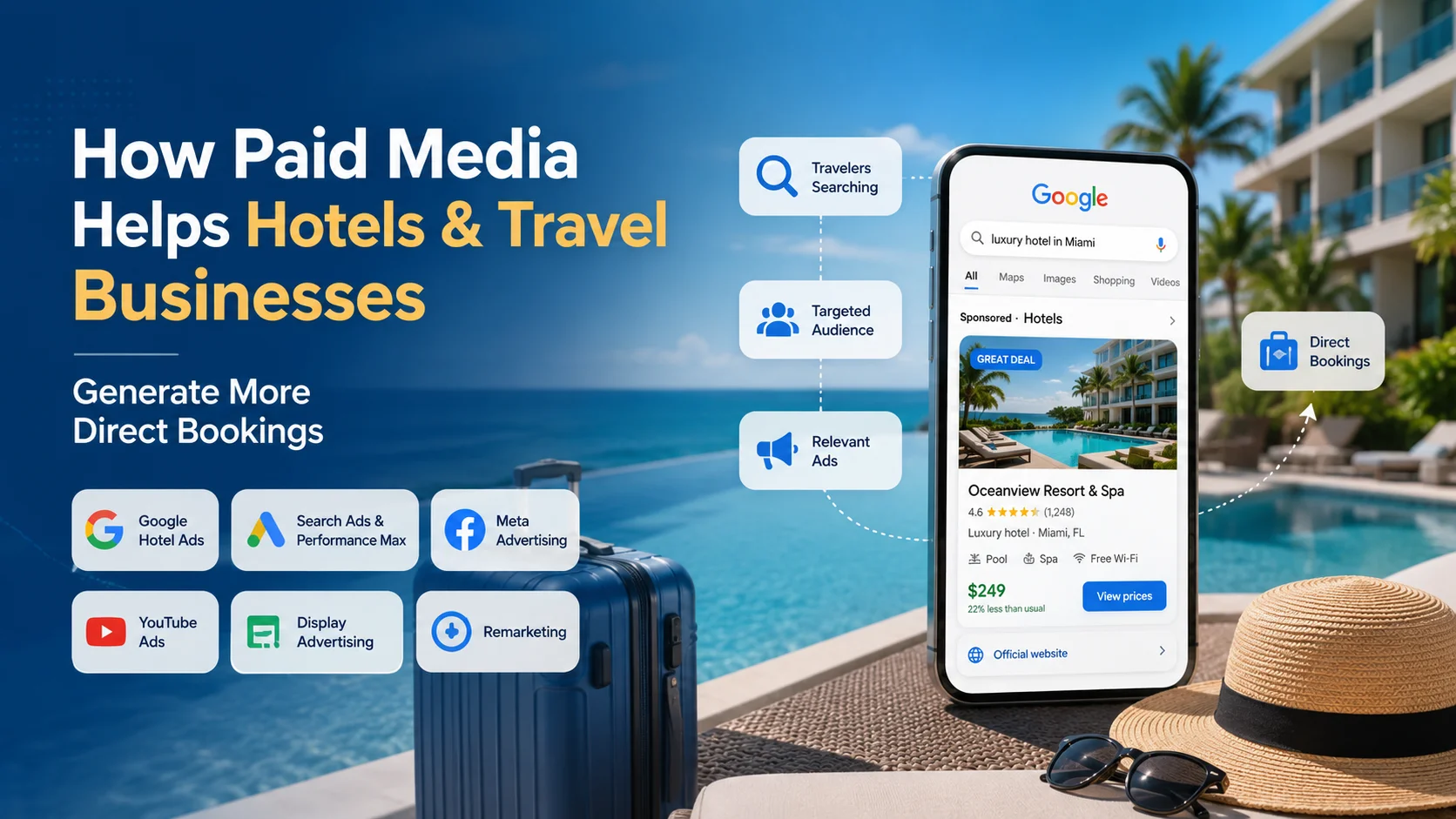
For hotels and travel businesses, attracting travelers online requires more than simply being visible in search results. Guests compare destinations, room types, prices, reviews, amenities, and booking options across multiple platforms before making a reservation.
This makes hotel digital marketing increasingly important. A strong paid media strategy can help hotels reach travelers at different stages of the booking journey, from destination discovery to high-intent searches and remarketing.
The opportunity is significant. SiteMinder's 2026 Hotel Booking Trends data, based on more than 135 million reservations, found that hotel websites generated an average booking value of US$516 in 2025, compared with US$312 through OTAs. Direct bookings also remained among the top three revenue sources in 90% of the markets analyzed.
The objective of paid media for hotels, therefore, should not simply be generating clicks. It should be attracting qualified travelers and creating a measurable path toward direct bookings.
Why Paid Media Matters for Hotels
Hotels compete with online travel agencies (OTAs), independent properties, resorts, and other accommodation providers for the same travelers.
Hotel Advertising allows properties to reach specific audiences based on factors such as search intent, location, interests, previous website activity, and travel behavior.
A traveler searching for “luxury hotel in Miami” has a different intent from someone watching a destination video on Instagram. Effective hotel marketing recognizes these differences and uses the appropriate advertising channel, message, and landing page for each stage.
Paid media can include Google Hotel Ads, Google Search Ads, Performance Max, Meta advertising, Display, YouTube, and remarketing.
Google Hotel Ads vs Google Search Ads
One of the most important opportunities in modern hotel advertising is understanding the difference between standard Google Search Ads and Google Hotel Ads.
Google Hotel Ads
Google Hotel Ads are designed specifically for hotel properties. Hotel campaigns can show hotel information, rates, availability, and booking links to travelers who are comparing accommodation options. Google states that Hotel Ads can appear alongside hotel search results on Google Search and Maps, with booking links directing users toward a booking page.
This makes Google Hotel Ads particularly relevant to travelers who already know where they want to stay and are close to making a reservation.
Google Search Ads
Google Search Ads are broader. Hotels can target relevant searches around destinations, amenities, branded terms, and other commercial-intent keywords.
For example:
- Luxury hotels in New York
- Beachfront hotel in Miami
- Hotels near Times Square
- Hotel with conference facilities
- Boutique hotel in Chicago
Search Ads can therefore help capture demand that may not be limited to a specific hotel property.
Performance Max for Travel Goals
Performance Max for travel goals is designed specifically for hotel advertisers and can reach travelers across Google's ecosystem, including Search, YouTube, Display, Discover, Gmail, Maps, and Travel. Google also provides hotel-specific reporting within these campaigns.
Display and YouTube
Display advertising can support awareness and remarketing, while YouTube advertising can showcase destinations, hotel experiences, rooms, amenities, weddings, events, and other visually compelling experiences.
The right combination depends on the property's objectives, audience, market, seasonality, and available creative assets.
Social Media Advertising for Hotels
Hotels should not rely only on Google. Social media advertising for hotels can be particularly valuable because travel is highly visual and often influenced by inspiration.
Platforms such as Instagram and Facebook can support campaigns using:
- Carousel Ads
- Reels
- Video Ads
- Image Ads
- Seasonal promotions
- Destination campaigns
- Luxury resort experiences
- Wedding packages
- Staycation offers
- Remarketing
For example, a luxury resort might use Instagram Reels to showcase rooms, dining, spa facilities, and the surrounding destination. A city hotel could promote a weekend package to travelers within a specific geographic market.
Meta advertising can also be used for remarketing, allowing hotels to reconnect with people who previously interacted with their website or content, subject to applicable privacy and platform requirements.
The important principle is to match the creative and offer with the audience, rather than showing every traveler the same advertisement.
Audience Segmentation: Hotels Shouldn't Advertise to Everyone
A successful hotel paid advertising strategy starts with understanding who the property wants to attract.
Different traveler groups have different motivations, budgets, and booking behaviors.
Business Travelers
Focus on location, Wi-Fi, meeting facilities, transportation, flexible booking options, and convenience.
Families
Highlight family rooms, pools, activities, breakfast, nearby attractions, and convenient facilities.
Couples
Creative can focus on romantic experiences, dining, spa facilities, scenic locations, and weekend packages.
Luxury Travelers
Luxury campaigns should emphasize premium rooms, service, exclusivity, wellness, dining, and memorable experiences.
Staycation Customers
Target people within practical travel distance with short-break packages, spa offers, dining experiences, and weekend promotions.
International Tourists
Campaigns can be segmented by country or region and adapted to relevant languages, travel periods, destinations, and interests.
Event and Conference Visitors
Hotels near conference centers, stadiums, exhibition venues, or event locations can build campaigns around event-related searches and booking periods.
Destination Wedding Travelers
Resorts and destination properties can promote wedding venues, accommodation packages, group stays, and event facilities through search and visual advertising.
This type of segmentation makes hotel PPC more relevant because campaigns can be built around the actual needs of different traveler groups.
How Paid Media Can Increase Direct Hotel Bookings
The ultimate goal of many hotel advertising campaigns is not traffic—it is revenue.
A strong direct booking journey can look like:
Paid Advertisement → Relevant Landing Page → Clear Offer → Booking Engine → Conversion Tracking
Someone searching for “luxury hotel in Miami with spa” should ideally arrive on a page that immediately addresses that intent.
The page should clearly communicate the hotel's location, rooms, amenities, benefits, pricing or offers, and booking options.
SiteMinder's 2026 research found that 18% of travelers who begin their hotel research on an OTA ultimately book directly with the hotel, an increase of 3.3 percentage points year over year.
This highlights an important point: the booking journey is not always linear. Hotels need to remain visible across multiple touchpoints while making their direct booking experience compelling and easy to complete.
Retargeting Keeps Hotels in the Consideration Journey
Travelers often compare multiple properties before booking.
Someone may visit a hotel's website, view several rooms, check availability, and leave without making a reservation. Retargeting can help reconnect with eligible audiences who previously interacted with the hotel.
For example, a hotel could use remarketing creative to highlight:
- A seasonal offer
- A particular room category
- A destination experience
- A wedding package
- A weekend stay
- A limited-time promotion
Retargeting should complement the overall campaign rather than repeatedly showing the same advertisement to every visitor.
Measure Bookings, Revenue, and Profitability
A hotel advertising campaign should be evaluated using business outcomes rather than clicks alone.
Useful metrics include:
- Direct bookings
- Booking conversion rate
- Cost per booking
- Booking revenue
- Return on ad spend (ROAS)
- Customer acquisition cost
- Revenue by campaign
- Revenue by audience
- Revenue by property or room category
Google provides conversion measurement for Hotel Ads and Performance Max for travel goals, allowing advertisers to connect campaign activity with valuable actions such as bookings.
The more accurately a hotel tracks bookings and revenue, the better it can understand which campaigns and audiences deserve additional investment.
Why Choose Morphiaas for Hotels & Travel Marketing?
Hotels need marketing that understands both the traveler's decision-making process and the digital channels used to reach them.
Morphiaas provides digital marketing services across SEO, Paid Media, Social Media Marketing, Branding, Website Design & Development, UI/UX, and E-commerce. Its US-focused travel and tourism offering combines digital advertising, SEO, social media, website development, and content strategies designed to help travel brands attract and convert travelers.
For hotels and travel businesses, this broader capability can be valuable because paid advertising rarely operates in isolation. A traveler may discover a property through an advertisement, research it through search, visit its website, compare the brand on social media, and eventually return to complete a booking.
Morphiaas can therefore approach hotel marketing as a connected digital journey rather than treating each channel as a separate activity.
Frequently Asked Questions
1. What is paid media for hotels?
Paid media for hotels includes advertising channels where a hotel pays to reach potential travelers. These can include Google Hotel Ads, Google Search Ads, Performance Max, Meta Ads, Display, YouTube, and remarketing campaigns.
2. What is the difference between Google Hotel Ads and Google Search Ads?
Google Hotel Ads are specifically designed for hotel properties and can display hotel rates, availability, and booking links. Google Search Ads are broader and can target searches related to destinations, hotel brands, amenities, and other relevant commercial-intent queries.
3. Can paid media increase direct hotel bookings?
Yes. Paid media can send qualified travelers directly to a hotel's website and booking engine. Results depend on factors such as targeting, campaign structure, creative, landing-page experience, pricing, booking process, and conversion tracking.
4. Which audiences should hotels target with paid advertising?
Hotels can segment campaigns around business travelers, families, couples, luxury travelers, staycation customers, international tourists, weekend travelers, conference visitors, event attendees, and destination wedding customers.
5. What should hotels measure in paid advertising?
Hotels should track business outcomes such as bookings, booking revenue, conversion rate, cost per booking, customer acquisition cost, and ROAS rather than relying only on impressions and clicks.
Final Thoughts
Modern hotel digital marketing requires a multi-channel approach.
Google Hotel Ads can capture travelers close to booking, Search Ads can capture active demand, Performance Max can extend reach across Google's ecosystem, while Meta, Instagram, Display, and YouTube can help hotels inspire travelers and bring previous visitors back into the consideration journey.
The strongest hotel marketing strategy is therefore not about choosing one platform. It is about understanding the audience, matching the channel to the traveler's intent, delivering a relevant experience, and measuring what ultimately contributes to bookings and revenue.
For hotels and travel businesses seeking more direct booking opportunities, Paid media for hotels can become a powerful part of a broader digital strategy when supported by strong SEO, social media, website experience, conversion optimization, and data-driven decision-making.