Sign up with Google
 Sign in with Zoho

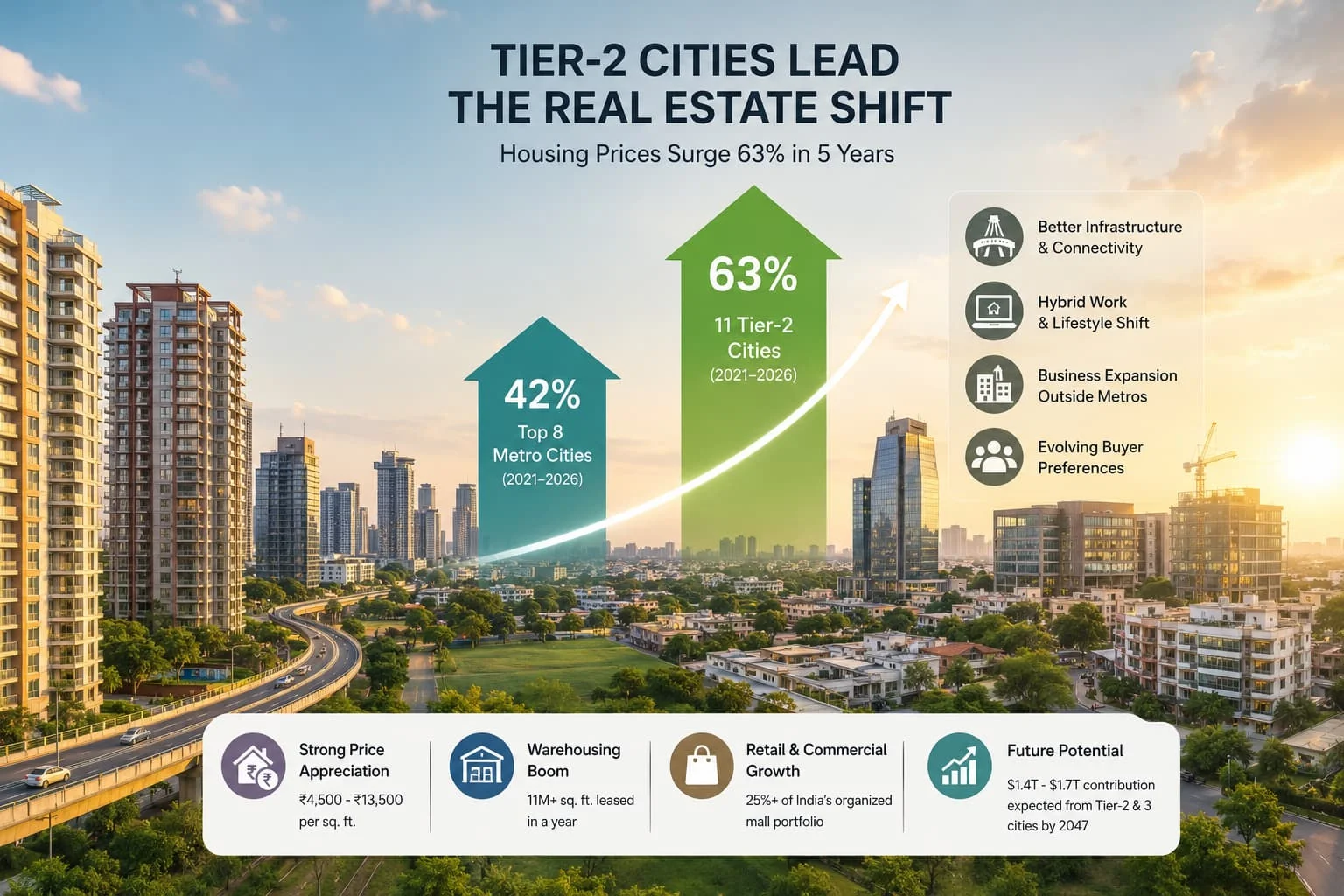
There is a paradigm shift in India’s real estate sector. Over the years, investments in the real estate sector and the increasing value of the properties have been focused on the major metro cities like Mumbai, Bengaluru, Delhi-NCR, and Hyderabad. But as per a groundbreaking CII–Knight Frank India report, the cost of housing in 11 major Tier-2 cities has increased by 63% from 2021 to 2026, while India’s top eight metro cities have seen an increase of 42%.
The rise in price by 63% indicates a major shift in the paradigm. Upcoming cities like Jaipur, Lucknow, Goa, Indore, Coimbatore, Chandigarh Tricity, Bhopal, Bhubaneswar, Kochi, Nagpur, and Visakhapatnam are coming into their own and becoming growth drivers of their own accord.
What Is Driving the Tier-2 Real Estate Boom?
Several factors have aligned to propel residential property values across non-metropolitan urban centres:
1. Decentralized Infrastructure & Connectivity
Through federal schemes such as the Smart Cities Mission and nationwide expansion of expressways, Tier-2 cities have seen infrastructure improvements never witnessed before. Through expressways, new airports, metro services, and upgraded utility infrastructure, the time taken to commute has been reduced, making such cities much more livable.
2. Hybrid Working & Cost of Living Changes
The hybrid working approach adopted by employees enabled people to move out of crowded and costly tier-1 cities. It was understood that more capital could buy more space along with greener environments, in upcoming urban centers.
3. Business Expansion Outside the Metropolis
Leading IT, manufacturing, and Global Capability Center companies are moving towards Tier-2 cities in order to reduce the cost of operations and tap talent locally. Such cities as Coimbatore, Indore, and Kochi saw the rise of Industrial corridors and tech parks at the same time, creating stable white-collar jobs for residents.
4. Development of Buyer Tastes
There is a trend of changing tastes among buyers in residential properties in Tier-2 cities from stand-alone plots to gated communities with various facilities such as clubhouses, security, green spaces, and other amenities. The entry of national builders into these cities has raised benchmark prices for property development.
Market Performance Across Emerging Hubs
Average prices in these 11 emerging cities now range between ₹4,500 and ₹13,500 per square foot, reflecting varied economic drivers:
Expanding Economic Footprint Beyond Housing
The 63% growth in the value of residences is one element of an even larger commercial development taking place in these urban areas:
- Warehousing & Logistics: Tier-2 cities witnessed more than 11 million square feet of warehousing leasing transactions within a year due to the growth of e-commerce and the creation of local manufacturing clusters.
- Retail & Commercial Real Estate: Organized retail shopping malls and offices have been developed to a greater extent in non-metro areas and account for over 25% of India’s total organized mall portfolio.
Estimates show that the real estate market of India can reach up to $5.8 trillion by 2047, out of which 25% to 30% is expected to be contributed by Tier-2 and Tier-3 cities, totaling $1.4 trillion to $1.7 trillion. You can find properties in Tier-2 and Tier-3 cities in Mores, a top real estate agency.
Challenges Faced by Tier-2 Growth
While the rate of price increase is commendable, there are significant challenges in maintaining this growth trend:
- Civic and Utility Services: The quick real estate development is putting a strain on the city’s civic infrastructure, and thus it becomes necessary to provide a reliable supply of power, water, and sewage facilities.
- Employment Creation: Continuous growth in price depends upon job creation. A city lacking commercial businesses can experience an oversupply of property within a specific area.
- Affordability Threats: An increase in the price of the house by 63% within a period of 5 years increases the possibility of making homes unaffordable to the locals.
Conclusion
The 63% increase in the housing prices of Tier-2 areas in India represents a change in the economy of urban cities in India. The emerging market towns are no longer seen as a cheap alternative to major metropolitan areas, but they have developed into independent urban centers due to the development of infrastructure and residential amenities. For investors, the focus has shifted to these tier-2 growth zones.