Sign up with Google
 Sign in with Zoho

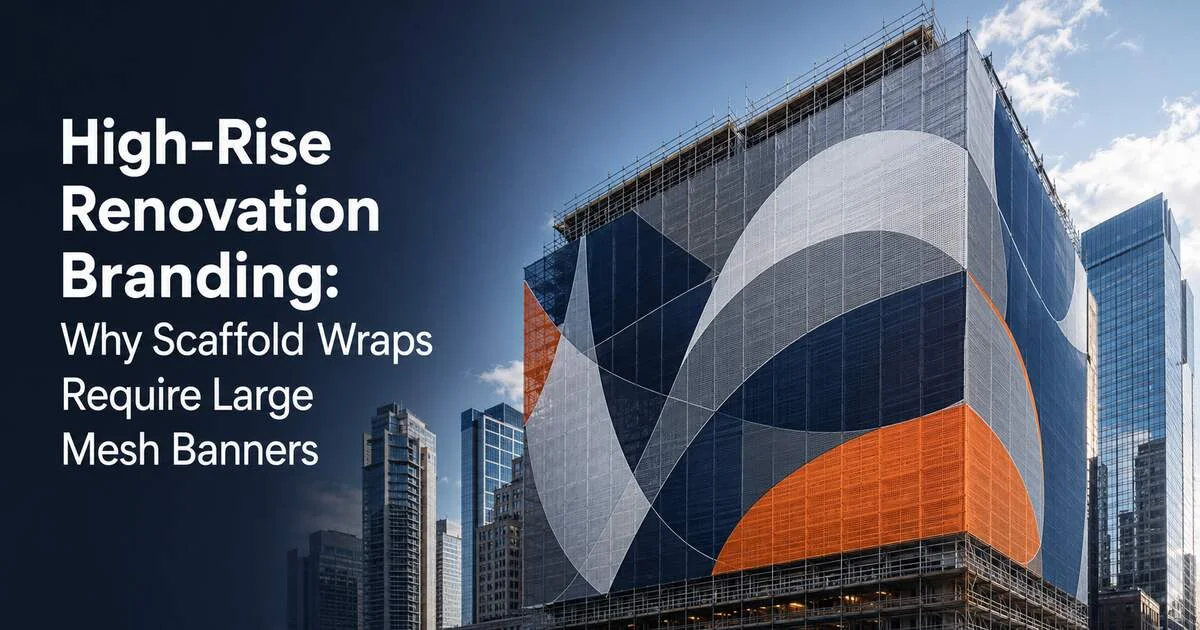
The Unique Challenge of High-Rise Scaffold Coverage
Ground-level construction fencing and high-rise scaffolding face fundamentally different conditions. A fence around a job site deals with street-level wind and pedestrian sightlines. A scaffold wrap climbing twenty, thirty, or fifty stories up a building faces sustained wind loads that intensify significantly with height, along with a much larger, much more visible surface area that's essentially part of the downtown skyline for the duration of the project.
This creates a specific set of requirements that solid vinyl simply can't meet on a scale:
- Wind pressure increases substantially the higher a wrap sits on a structure, which makes solid surfaces a genuine structural liability rather than just a durability concern
- The surface area involved is often the size of an entire building facade, requiring material that can be manufactured and installed in large, continuous sections
- Downtown settings mean the wrap is visible from multiple angles, multiple blocks away, for an extended timeline, often the length of an entire renovation
Solving for all three at once is why mesh has become close to the standard material for this specific application rather than a stylistic choice.
Why Breathability Isn't Optional at This Scale
At ground level, wind resistance is a durability consideration. On a high-rise scaffold, it becomes closer to a structural engineering requirement, which is exactly why large mesh banners Chicago developers use for downtown renovations are engineered differently than standard outdoor mesh banners Chicago businesses might order for a one-day event or storefront promotion. A solid, non-perforated surface covering dozens of floors would create wind load significant enough to stress the scaffolding system itself, not just the banner material.
Custom mesh banners address this through their perforated construction, which allows a meaningful percentage of wind to pass directly through the material rather than pushing against it as a solid barrier would. This single design feature is what makes wrapping an entire high-rise facade structurally feasible in the first place; without it, scaffold companies would need to significantly over-engineer the support structure just to handle wind load from the graphic covering, which adds cost and complexity to a project that already has enough of both.
How Developers Use Mesh Banners on High-Rise Building Scaffolding
For architectural firms and commercial real estate developers, a scaffold wrap isn't just about covering an unfinished building; it's an extended branding opportunity that most projects would otherwise waste.
Common applications include:
- Full building facade banners showing a rendering of the completed project, helping prospective tenants or buyers visualize the finished result long before construction wraps up
- Developer and architectural firm branding, positioning the project as a professional, well-managed renovation rather than an anonymous construction site
- Leasing or sales messaging for commercial space, particularly valuable for projects marketing availability well ahead of completion
- Historic or landmark preservation messaging, in cases where a renovation involves a building with existing civic or architectural significance
Because a scaffold wrap can remain in place for the majority of a renovation timeline, this isn't short-term signage. It's sustained, large-scale visibility in some of the densest, most visible commercial corridors a city has to offer, a level of exposure that would be difficult to replicate through almost any other advertising format at a comparable cost.
Preserving Downtown Aesthetics During Long Renovation Timelines
This is where the branding and civic considerations intersect. Downtown districts, historic corridors, and premium commercial addresses often have real aesthetic expectations, whether formalized through a business improvement district, a landmark commission, or simply the visual standard neighboring properties have set.
A well-designed scaffold wrap does more than hide construction it actively contributes to the streetscape rather than detracting from it. A few considerations architectural firms and developers commonly weigh:
- High-resolution facade renderings that mimic the building's finished appearance, maintaining visual continuity with the surrounding block during construction
- Color palettes and branding that align with the district's existing character rather than clashing with it
- Clear, professional signage identifying the project and firm, which reassures neighboring businesses and residents that the renovation is being handled by an established team
- Coordinated messaging that doesn't overwhelm the facade with promotional content, keeping the design closer to architectural presentation than advertising
Cities with active downtown redevelopment, such as Chicago's Loop and River North corridors, being clear examples, have increasingly come to expect this level of polish from scaffold coverage, particularly on landmark or highly visible properties where a bare, unbranded wrap would stand out for the wrong reasons.
Material Considerations for Building Facade Banners
Not every mesh product is built for the scale and duration a high-rise renovation demands. A few specifications matter more here than they would on a smaller, ground-level application.
Heavier mesh weights hold up better over extended timelines
A wrap staying up for a year or more needs material substantial enough to resist UV degradation and repeated wind exposure without visibly fading or thinning.
Panel sizing and seaming affect the finished appearance
Large facades often require multiple printed sections joined together, and how those seams are handled has a real impact on whether the finished wrap reads as one continuous image or a patchwork of panels.
Installation hardware needs to match scaffold specifications
Reinforced grommets and mounting points suited to the specific scaffold system in use prevent the kind of sagging or shifting that becomes obvious from street level over time.
Color accuracy matters more at architectural scale
A rendering meant to represent a finished building facade needs printing precise enough that the illusion holds up under close inspection as well as from a distance.
On a project this visible and this expensive, the margin for error is small, which is why most firms go with heavy-duty mesh banners from Chicago based printing company experts who've actually handled large-format, long-duration installations before, rather than taking a chance on a supplier used to smaller, short-term event banners.
Planning Ahead: What Architectural Firms Should Confirm Before Ordering
A few practical questions tend to save time once a renovation project reaches the branding stage:
- What's the total facade area, and how will it be divided into printable panels?
- What's the expected duration of the scaffold coverage, and does the material weight match that timeline?
- Are there local aesthetic or landmark requirements the design needs to account for?
- Has the scaffold contractor confirmed mounting specifications compatible with the banner hardware?
Working through these details early, ideally alongside both the scaffold contractor and the print vendor, tends to prevent the kind of last-minute scramble that happens when a wrap is ordered without accounting for the building's actual scale or timeline.
Final Thoughts
Scaffold wraps have become a meaningful part of how architectural firms and developers manage the extended visibility of a high-rise renovation, and mesh remains the material best suited to that job for a straightforward reason: it's the only option that can cover a building at that scale without creating structural wind liability. Done well, a scaffold wrap does more than hide a construction timeline. It maintains the visual continuity of a downtown block, reinforces a developer's professionalism, and turns an otherwise unavoidable inconvenience into sustained, high-visibility branding throughout the project. For firms weighing this kind of investment, large mesh banner Chicago suppliers with high-rise experience remain the safer bet over generic signage vendors unfamiliar with facade-scale installations.