Sign up with Google
 Sign in with Zoho

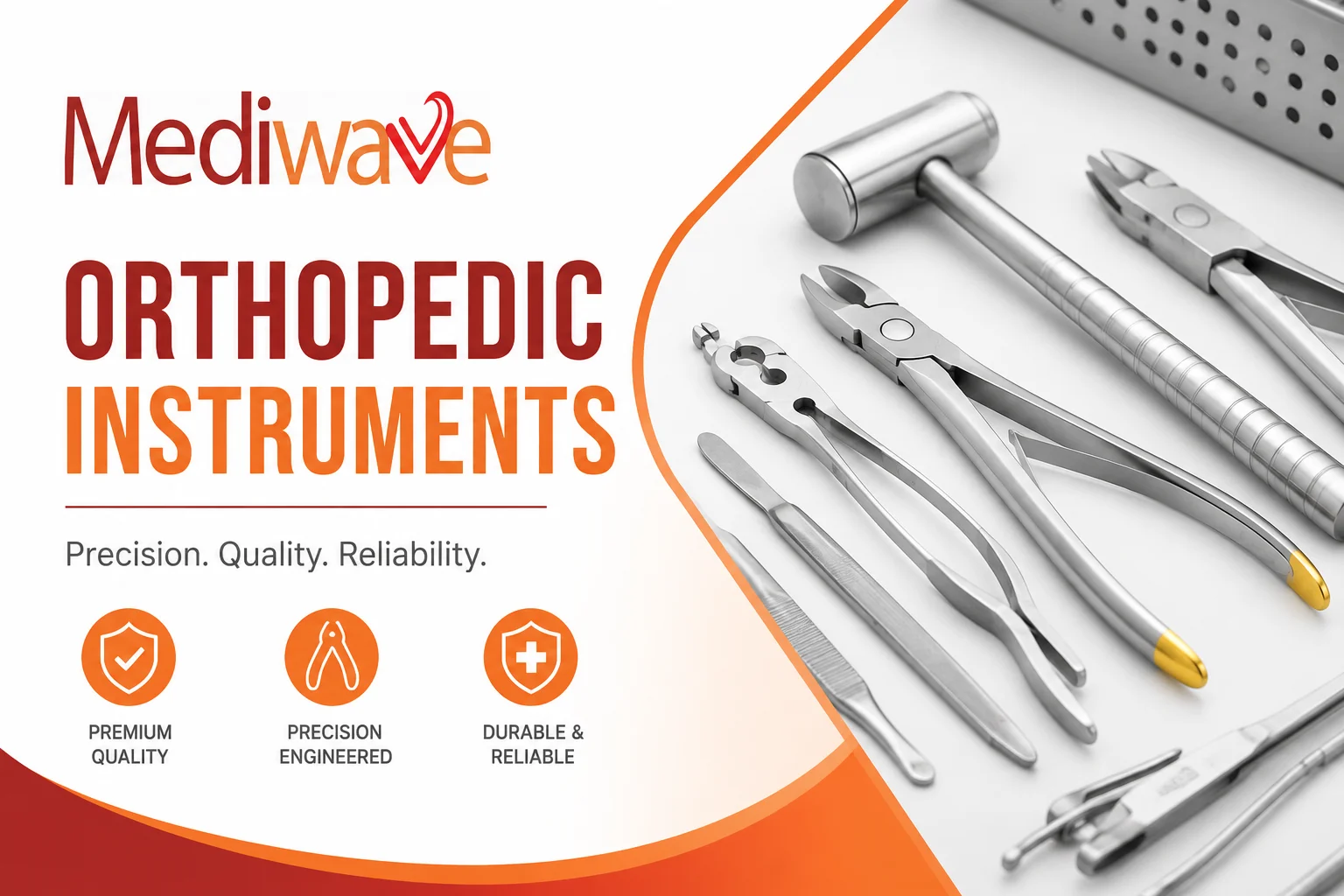
A purchase file looks clean until the first tray reaches the OT and the surgeon says the grip feels wrong. That’s where Orthopedic Instruments stop being a line item and become clinical risk. WHO has reported about 234 million major surgeries worldwide each year, so one weak instrument habit can travel through many procedures.
The problem is blunt: finding Orthopedic Instruments Suppliers is easy. Finding one who repeats the same finish, grip, alignment, packing, and dispatch discipline after the first order is harder.
Orthopedic Instruments: The Spec Detail Most Buyers Skip
Common tools in an orthopedic set
A working orthopedic list may include bone holding forceps, osteotomes, gouges, curettes, retractors, bone levers, plate benders, wire cutters, mallets, and rongeurs. CDSCO-linked classification references list 146 general hospital and orthopaedic medical devices, including forceps, bone cutters, and pliers.
Here’s the overlooked part: polish is not performance. Jaw matching, ratchet bite, edge retention, balance, and repeated sterilization behaviour matter more. A supplier who sends only catalogue photos is avoiding the difficult discussion.
Material, finish, and packing
Most reusable orthopedic tools use medical-grade stainless steel because strength and corrosion resistance matter under repeated cleaning. Finish should be smooth enough for cleaning but not slippery in gloved hands. Packing should protect tips and edges; one careless box can damage 18 good instruments before they reach the store room.
Five Checks Before Approving Orthopedic Instruments Suppliers
1. Repeat-order control
A good answer names inspection points: raw material, machining, finishing, alignment, and packing. A bad answer is, “same as sample, sir.” Most buyers accept that line because they are rushing. That rush becomes a replacement claim later.
2. Certification and traceability
India’s Medical Devices Rules, 2017 follow risk-based classification, so paperwork is not decoration. A bad supplier says certificates will be shared “after billing.” That is backwards.
3. Performance beyond price
One rongeur that loses bite after a few cycles can cost more than the discount on a full order. WHO says medical-device decontamination includes cleaning, disinfection, and/or sterilization, so design and surface finish affect infection-control work.
4. Range depth
Orthopedic Instruments Manufacturers should know connected requirements, not just one product line. A bad supplier says yes to every item, then quietly trades half the list from unknown sources.
5. Dispatch behaviour
Nobody tells you early enough: dispatch discipline is a quality issue. If model codes, quantities, and packing lists are loose on the first order, urgent replenishment will be worse.
Benefits That Protect Hospital Margins, Not Just Purchase Budgets
Better instruments reduce replacement noise. India’s medical devices market was estimated at US$11 billion in 2022 and is projected to reach US$50 billion by 2030, so buying pressure will only increase.
Reliable Orthopedic Instruments reduce case delays caused by missing or poorly matched tools. Consistent finish helps CSSD teams clean and inspect trays faster. Standard product coding makes repeat orders less painful. Consolidated sourcing reduces vendor follow-up. Strong packing reduces transit damage. And fewer rejected pieces mean fewer blocked payments and debit notes.
That is margin protection.
Availability Across India Is a Supply Chain Decision
India is not one delivery market. Jalandhar to Delhi-NCR behaves differently from Jalandhar to Guwahati, Kochi, or a district hospital in Rajasthan. The Union Budget 2025–26 allocated ₹99,858 crore to healthcare, and institutional demand eventually reaches medical suppliers.
Mediwave India works for hospitals, clinics, nursing homes, medical colleges, and diagnostic networks across India. Buyers searching for Orthopedic Instruments Manufacturers in India or Orthopedic Instruments Exporters in India should check lead time by city, not only by state. Courier reach, road handling, packaging strength, and documentation clarity can change the delivery experience even when the product is identical.
About Mediwave India: What We Control Before Dispatch
We build our supply around one practical idea: hospitals should not waste time sourcing connected categories from scattered vendors. Our website shows Mediwave active in surgical, orthopedic, dental, ENT, gynecology, neurosurgery, and cardiovascular instruments, with orthopedic instrument pages showing activity since 2017.
We check the boring parts because boring parts cause expensive complaints. Tip protection, packing count, finish review, and product naming look small on paper, but we’ve seen one wrong label delay a hospital purchase file by 6 working days.
Send the Instrument List Before the Quotation Turns Vague
Send us your instrument list with quantity, preferred size, required grade or finish, delivery location, and whether the purchase is for hospital use, resale, tender supply, or a training institute.
We usually respond to standard enquiries within 24 working hours. Our MOQ starts from 1 piece for many standard catalogue items, while custom or bulk institutional orders depend on size, finish, and packing. For faster pricing, send photos of existing instruments if you are matching a previous purchase.
Conclusion: Orthopedic Instruments Procurement Is Getting Less Forgiving
Orthopedic Instruments need to be bought with the seriousness of a clinical support system. A low quote looks attractive until poor alignment, weak packing, or missing documentation reaches the OT. With India’s medical devices market projected toward US$50 billion by 2030, stronger procurement teams will choose evidence, repeatability, and response speed over catalogue promises.
FAQs: Orthopedic Instruments Questions Buyers Ask Before Ordering
1. How do I choose the right Orthopedic Instruments Suppliers?
Start with product range, sample quality, documentation, repeat-order control, and dispatch clarity. Price matters, but it should not be the first filter. A very low quote usually removes something from the process.
2. Are Orthopedic Instruments Manufacturers different from general surgical suppliers?
Yes, often. Orthopedic tools face higher mechanical stress than many general surgical tools. Some general suppliers can handle them, but ask for exact product knowledge, not just a catalogue.
3. What should I ask Precision Orthopedic Instruments Manufacturers before bulk buying?
Ask about steel grade, hardness control, jaw alignment, edge finishing, polishing method, packing, and replacement policy. Also ask what they will not customise. A supplier who says everything is possible without checking specs is guessing.
4. Do Orthopedic Instruments Manufacturers in India supply medical colleges?
Many do. The caveat is that training institutes may need mixed sets at lower quantities, while hospitals usually need stricter repeatability and documentation.
5. Can Precision Orthopedic Instruments Manufacturers support custom requirements?
Often, yes. But custom work depends on drawing clarity, sample availability, quantity, and usage. If the buyer cannot define size, angle, or working end, the supplier cannot produce predictable output.