Sign up with Google
 Sign in with Zoho

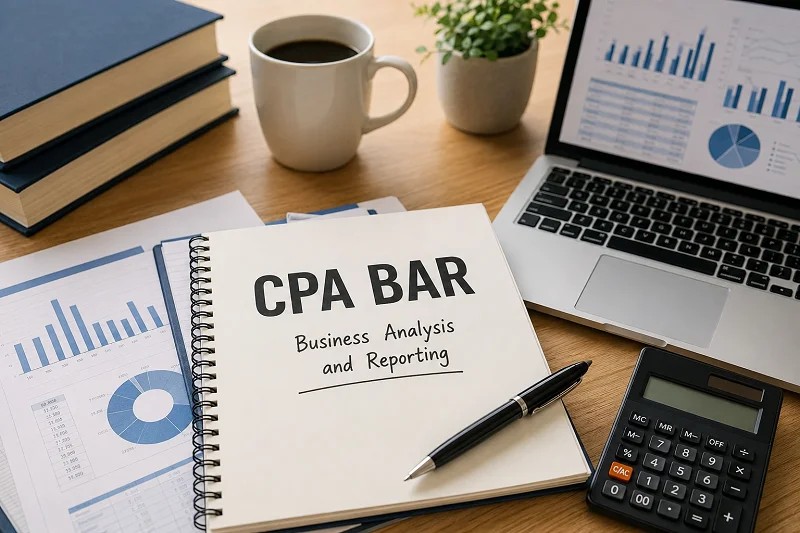
The CPA BAR exam, formally known as Business Analysis and Reporting, is one of the three Discipline sections available under the current CPA Exam structure. Unlike the three Core sections—AUD, FAR, and REG—candidates choose one Discipline: BAR, Information Systems and Controls (ISC), or Tax Compliance and Planning (TCP).
For candidates who enjoy financial analysis, accounting standards, reporting, and interpreting financial information, BAR can be a natural choice. However, it requires more than simply memorizing accounting rules. The section emphasizes applying concepts, analyzing information, and making sound professional judgments.
What Is the CPA BAR Exam?
The CPA BAR exam evaluates knowledge and skills related to financial statement analysis, financial reporting, technical accounting, data analysis, and governmental accounting and reporting.
BAR was introduced as part of the CPA Evolution model, which replaced the former BEC section with three Discipline options: BAR, ISC, and TCP. Candidates who choose BAR still pursue the same full CPA license as candidates who select either of the other Discipline sections.
The BAR Discipline is particularly relevant to candidates interested in areas such as financial reporting, accounting analysis, corporate accounting, controllership, and related professional roles.
What Topics Does CPA BAR Cover?
The BAR content is broad, so having a clear understanding of the major areas is important. According to current CPA Exam guidance, BAR focuses on several important areas, including:
- Financial statement and financial information analysis
- Financial reporting and accounting concepts
- Selected technical accounting and reporting requirements
- Revenue recognition
- Lease accounting
- Business combinations
- Derivatives and hedging
- Stock compensation
- Data and financial analysis
- State and local government accounting and reporting
These topics require candidates to connect accounting concepts rather than study each rule in isolation. NASBA notes that BAR includes higher-order skills involving areas such as revenue recognition and lease accounting, along with financial analysis and data-related knowledge.
Is CPA BAR Difficult?
The difficulty of BAR depends heavily on a candidate's accounting background and familiarity with analytical questions. Someone with strong FAR knowledge may find certain BAR topics easier to approach, while candidates who are less comfortable with detailed financial reporting may need additional preparation.
One important point is that BAR should not be approached as a memorization-only exam. Understanding why an accounting treatment is appropriate can be more useful than memorizing isolated rules.
A good preparation strategy should therefore combine:
- Conceptual learning
- Accounting standard application
- Financial analysis practice
- Multiple-choice questions
- Task-based simulations
- Regular review of weak areas
How Should You Prepare for the CPA BAR Exam?
A structured study plan can make a significant difference. Start by reviewing the official CPA Exam Blueprint so you understand the topics, skills, and representative tasks that may be tested. NASBA specifically recommends reviewing the AICPA Exam Blueprints when developing an exam strategy.
1. Build Your FAR Foundation
BAR overlaps with several financial accounting concepts, so a solid FAR foundation can be valuable. Review areas such as financial statements, accounting principles, revenue, leases, and other reporting concepts before moving into more advanced BAR applications.
2. Focus on Understanding, Not Memorization
When studying a technical accounting topic, ask yourself:
- What accounting issue is being addressed?
- Which rule applies?
- Why does the rule apply?
- How does the treatment affect the financial statements?
- What information would change the conclusion?
This approach can help you handle questions that present unfamiliar scenarios.
3. Practice Data and Financial Analysis
BAR isn't only about knowing accounting standards. Candidates should become comfortable interpreting financial information and identifying what the numbers are communicating.
Practice analyzing relationships between financial statements, trends, ratios, and other relevant information rather than simply calculating answers.
4. Give Task-Based Simulations Serious Attention
The CPA Exam uses both multiple-choice questions (MCQs) and task-based simulations (TBSs). Each section is four hours long, and the exam is designed to assess the knowledge and skills expected of newly licensed CPAs.
For BAR preparation, TBS practice is particularly useful because it encourages you to apply several concepts within a realistic scenario.
5. Use Practice Questions to Identify Weaknesses
Practice questions should do more than measure your score. Review every incorrect answer and determine whether the problem came from:
- A knowledge gap
- Misreading the question
- A calculation error
- Confusion between accounting treatments
- Poor time management
This makes practice sessions more productive.
How Is CPA BAR Scored?
Each CPA Exam section is four hours long. Candidates must achieve a minimum score of 75 on each section to pass, although the reported CPA score is not simply a percentage of questions answered correctly. Scores are reported on a 0–99 scale and are not curved.
The current CPA Exam consists of three Core sections and one selected Discipline section, making BAR one possible route for completing the Discipline requirement.
Who Should Consider Choosing BAR?
BAR may be worth considering if you:
- Enjoy financial accounting and reporting
- Have a strong FAR background
- Like analyzing financial information
- Are comfortable working with accounting standards
- Prefer accounting-focused topics over technology or advanced taxation
- Are interested in financial reporting or analysis
However, the "best" Discipline is not the same for every candidate. Your academic background, professional interests, strengths, and familiarity with the subject matter should all influence the decision.
Final Thoughts
The CPA BAR exam combines accounting knowledge with financial analysis, reporting, and application. Its breadth can make preparation challenging, but a structured approach can make the material much more manageable.
Rather than trying to memorize every detail at once, focus on building a strong conceptual foundation, connecting BAR topics to FAR knowledge, practicing realistic scenarios, and consistently reviewing areas where you struggle.
For additional CPA exam learning resources and study guidance, candidates can explore Learn TAPA Institute as part of their broader preparation strategy. The most important step, however, is to align your preparation with the current official CPA Exam Blueprints and candidate guidance, since exam content and policies can change over time.









.webp)