Sign up with Google
 Sign in with Zoho

What Really Happens Inside a Solvent Recovery Unit
Ask a plant manager what their solvent recovery system does and you'll usually get a shrug and a one-liner. "Dirty solvent goes in, clean solvent comes out."
Fair enough. That's the result. But it skips the interesting part, and it's also the reason so many teams don't fully trust the solvent that comes out the other end. If you don't know what happened to it, why would you put it back into a reactor?
So let's slow down and follow one batch. Say it's 200 liters of acetone that spent the morning rinsing out a reactor. It's a grey-yellow color now, a bit cloudy, and it smells exactly like you'd expect. Here's where it goes next.
First, the One Idea Everything Rests On
Acetone boils at about 56°C. The gunk it picked up in that reactor (bits of product, resin, maybe some salts) doesn't. Some of it needs far higher temperatures, and some of it won't boil at all.
That gap is the whole trick. Warm the mixture to the right temperature and the acetone leaves as vapor while the dirt stays put. Cool the vapor and you've got liquid acetone again, minus the mess.
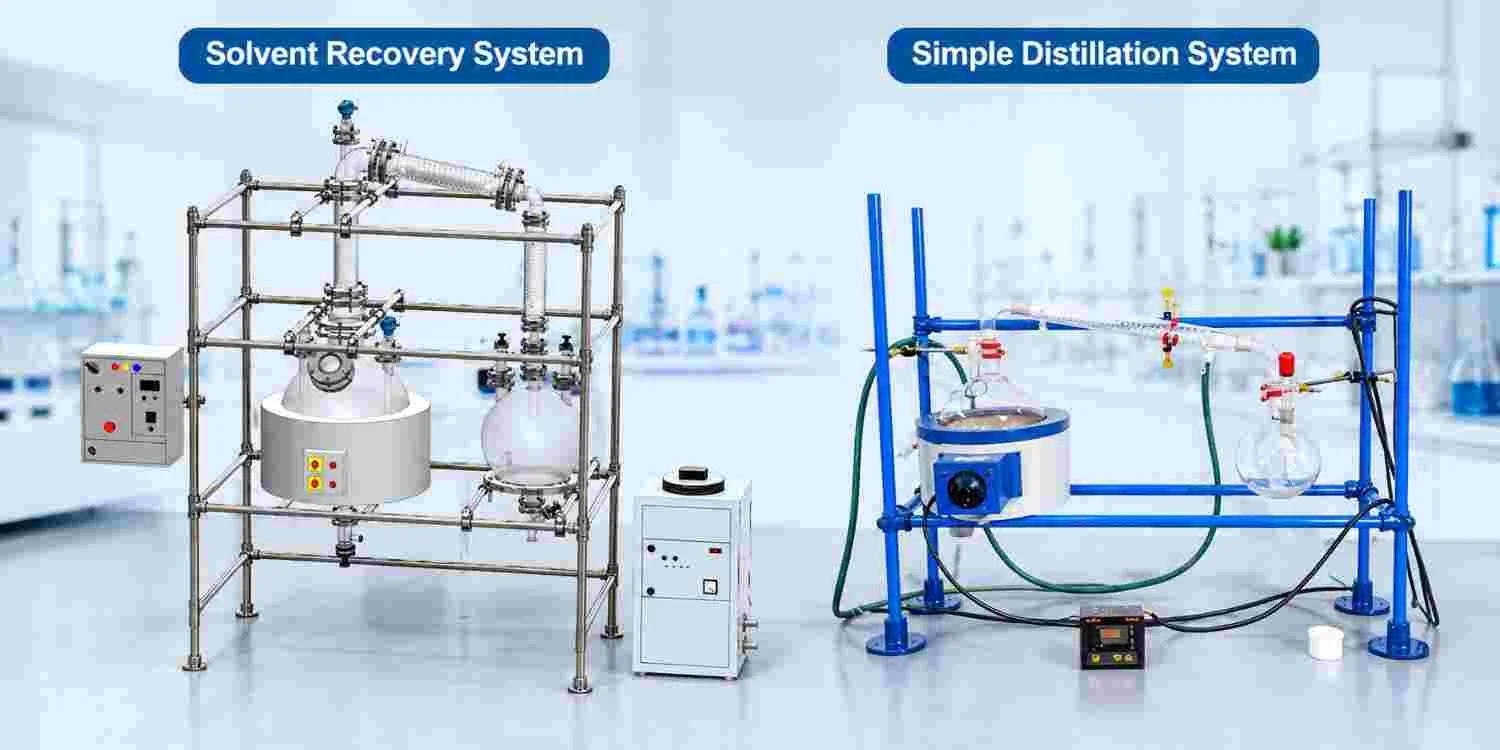
Chemists call this simple distillation, and it has been around for a very long time. It works best when the solvent and whatever is mixed into it boil more than roughly 25°C apart. With most used solvent, they do.
A solvent recovery unit is that same idea, scaled up and wrapped in enough tanks, filters and controls that you can run it every day without babysitting it.
The Feed Tank: Boring, but It Matters
Our acetone doesn't go straight into anything hot. It goes into a feed tank first, and honestly, this is the step people underrate most.
The feed tank is where you win or lose before the process even starts. If someone tips a bucket of used toluene into the acetone tank "just this once", the separation later on gets harder. Not impossible, but harder.
The plants that recover solvent well are almost always the strict ones. One solvent, one tank, clear labels. It sounds fussy until you've had to deal with a mixed tank.
The Filter: Getting the Chunky Stuff Out
From the tank, the acetone passes through a pre-filter. This catches particles, flakes, pigment and anything else solid.
Why bother, if distillation leaves the dirt behind anyway? Because solids that reach a hot vessel tend to bake onto the walls. Over a few weeks, that crust acts like insulation. Heating gets slower, and eventually someone spends a weekend scrubbing the vessel. A filter that gets cleaned regularly is a lot cheaper than that.
The Vessel: Where the Real Separation Happens
Now the filtered acetone goes into the distillation vessel. It's heated either through a jacket around the outside or electrically.
As it gets close to 56°C, things change quickly. The acetone starts to boil off and the vapor heads up and out. What's left in the vessel slowly gets thicker and darker as the batch goes on.
Temperature is the thing to get right here. Run it too cool and you're waiting forever. Push it too hot and you risk dragging higher-boiling junk along with the vapor, which defeats the purpose.
That's why decent systems handle temperature and pressure automatically instead of leaving it to someone watching a dial. And since IPA, toluene, ethyl acetate and methylene chloride all boil at different points, the controls have to be set for whatever solvent you're running that day.
The Condenser: Vapor Back to Liquid
The hot acetone vapor flows into the condenser, hits cold surfaces and turns back into liquid. That clear liquid is the distillate. It's the first time in this whole journey the acetone actually looks clean again.
A condenser only does its job if it has enough cooling. Weak water flow, or water that's too warm on a hot afternoon, and some vapor slips past without condensing. You lose solvent, and the whole area smells of it. It's one of the first things worth checking when recovery numbers drop for no obvious reason.
Some systems also offer vapor recompression, which reuses heat from the vapor to help boil the next lot of solvent. It's optional, but on a unit that runs long hours, the energy savings add up.
The Product Tank: The Part People Actually Care About
The clean acetone ends up in a product tank. Before it goes anywhere near production, it gets tested.
This is where trust comes from. When the QC team signs off on recovered solvent batch after batch, people stop calling it "second-hand" and start treating it as plain acetone. High-purity distillation can produce solvent good enough to go straight back into sensitive processes. Still, it's the test result that convinces people, not the brochure.
And back in the vessel? A thick residue. That still has to be disposed of properly. But compare it with where we started. A full drum of waste has turned into a much smaller amount of sludge, plus a tank of acetone you didn't have to buy.
Same Steps, Different Sizes
What surprises people is that the journey is basically the same at every scale. A lab unit does it on a benchtop with manual controls. A pilot system adds PLC control and data logging. A full industrial plant runs it continuously, with automation, and nobody has to carry drums around.
At industrial scale, the vessels and piping are usually stainless steel or glass-lined steel. They have to survive hot, aggressive solvents and acidic contaminants, day in and day out.
A Few Questions That Come Up a Lot
Does the recovered solvent really come out clean? Usually, yes, as long as the dirt boils well above the solvent or doesn't boil at all. That's the normal situation with used cleaning and process solvents. It's still tested before reuse.
Why not skip the filter? You can, but solids tend to bake onto the hot vessel and slow down heating. Filtering first keeps the system cleaner and running longer between cleanings.
What happens to the leftover sludge? It's disposed of as waste, just in a much smaller volume than the drum you started with.
So, Is It Worth Knowing All This?
If you're the one deciding whether to trust recovered solvent, yes. Once you've followed a batch from the drum to the product tank, the process stops feeling like a mystery. It's a tank, a filter, a heated vessel, a condenser and another tank, each doing one fairly simple job. Get each step right, and the solvent you used this morning can go back to work this afternoon.