Sign up with Google
 Sign in with Zoho
Galbanum and Oakmoss: Sourcing the Green and Mossy Heart of Chypre Perfumery
Ask a perfumer what makes a chypre a chypre, and the answer usually starts with contrast. A bright, almost bitter green note at the top. A cool, damp, woodland feel at the bottom. And a warm resinous glow holding the two together. Two natural materials are responsible for much of that character: galbanum for the green, and oakmoss for the moss.
Both belong to the resinoid family, and both reward a careful buyer. Galbanum is so potent that small batch differences show up in the finished scent. Oakmoss is regulated more tightly than almost any other resinoid. This article looks at each one through a buyer's eyes. It draws on a detailed guide by Piyush Gupta, Founder and CEO of Kanha Nature Oils, an Indian manufacturer and exporter of essential oils and resinoids based in Bahadurgarh.
👉 Read the complete resinoid guide on kanhanatureoils.com
Resinoids in one paragraph
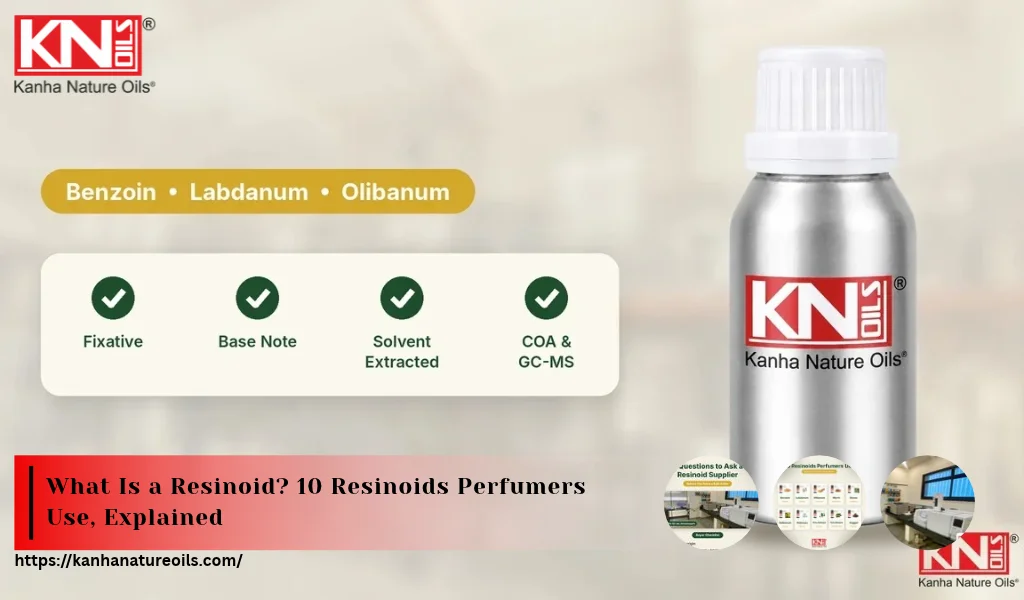
Think of a resinoid as the whole resin, concentrated. Producers take a dried plant exudate, or in oakmoss's case a dried lichen, dissolve its aromatic and resinous parts in a solvent, and then strip the solvent away. What remains is dark, heavy and slow to evaporate. That slowness is the point: it anchors the lighter notes of a perfume and stretches its life on skin. Because the raw extract is often too viscous to handle, it usually reaches buyers thinned with a carrier solvent such as DPG, DEP or benzyl benzoate. ISO 9235, the vocabulary standard for natural aromatic raw materials, is where the formal definition lives.
Galbanum: a little goes a very long way
Plant: Ferula gummosa Character: piercingly green, with an earthy undertone Where perfumers use it: to add green lift to floral blends and to the opening of chypres
Few materials in a perfumer's palette are as forceful as galbanum. One drop can turn a soft floral leafy and alive, or give a chypre its unmistakable green snap. That strength is exactly what makes sourcing tricky. If one delivery smells noticeably stronger or weaker than the previous one, a carefully balanced formula can drift off course.
The fix is to ask the right question up front. Find out which carrier solvent the material is diluted in, and ask how strong this particular batch smells. Then make two habits routine. Only compare prices between offers diluted the same way, since a lower price can simply mean a weaker product. And whenever you reorder, get a sample from the new lot and smell it against your reference before you approve the shipment.
Product page: Galbanum Resinoid
Oakmoss: the forest floor in a bottle
Source: Evernia prunastri, which is a lichen rather than a tree Character: damp moss, earth and wood Where perfumers use it: as the foundation of traditional chypres, and in many fougère compositions
Oakmoss is what gives a classic chypre its shadowy, forest-floor depth. It also stands apart from other resinoid raw materials in how it is gathered. Benzoin, olibanum and most others begin as a sticky exudate that hardens on a cut tree. Oakmoss does not. Producers simply collect and dry the entire lichen, then extract it.
How IFRA treats oakmoss
IFRA treats oakmoss extracts differently from most resinoids. Its dedicated Standard caps how much can be used in each product category, puts ceilings on three specific constituents (atranol, chloroatranol and dehydroabietic acid), and rules out any blending with treemoss, a separate lichen known botanically as Evernia furfuracea.
Two cautions apply. Permitted levels change from one product category to another, and IFRA revises its Standards from time to time through amendments. So always work from the version currently in force, and check the cosmetic regulations of each market you sell into. The precise limits are set out, with links to the official document, in the full guide.
What to request from your supplier: batch figures for atranol, chloroatranol and dehydroabietic acid, plus a written statement that the extract contains no added treemoss.
Product page: Oakmoss Resinoid
Why the treemoss question matters
Treemoss and oakmoss are related lichens, but they are not interchangeable under IFRA rules for oakmoss extracts. A reliable supplier will put "no added treemoss" in writing without hesitation. If a quote for oakmoss is noticeably below the market, this is one of the first things worth confirming. The complete guide explains four common reasons why an unusually low resinoid price should make a buyer pause.
Completing the chypre: where labdanum comes in
Green and moss alone do not make a chypre. The structure also needs warmth, and that is traditionally supplied by labdanum, the resinous material obtained from the rockrose, Cistus ladanifer. Its ambery, smoky, slightly leathery tone is the third pillar of the accord.
For a buyer, this means chypre work often involves sourcing three resinoids side by side. Keeping all three with one supplier, under one set of documents, can simplify batch tracking and make future reformulation easier.
Paperwork to request with every lot
Whichever of these materials you order, insist on the following for the specific batch being shipped:
- Certificate of Analysis (COA): physical data such as appearance, specific gravity and refractive index, where relevant
- GC-MS report: a breakdown of the main constituents, which also feeds your own IFRA and allergen calculations (a buyer's guide to reading GC-MS reports)
- Safety Data Sheet (SDS): handling and transport information, often still called an MSDS
- Pre-shipment sample: drawn from the exact lot you will receive, so you can check it against your standard
Want the rest of the picture?
This article stops at the green and mossy pair. The complete guide on Kanha's website goes on to set resinoids side by side with essential oils and absolutes, walk through all ten materials perfumers order most often, give the precise IFRA numbers for oakmoss, styrax and Peru balsam, and finish with the questions worth putting to any resinoid supplier before money changes hands.
👉 Continue to the full guide
Explore the full resinoid catalogue.
About Kanha Nature Oils
From two manufacturing units in Bahadurgarh, Haryana, Kanha Nature Oils produces and ships more than 700 natural aromatic products, over 250 of them essential oils, to customers across 60+ countries. Alongside essential oils, its catalogue covers resinoids, absolutes, attars, oleoresins, hydrosols and carrier oils. The company holds ISO 9001:2015, ISO 14001:2015, WHO-GMP, HACCP, KOSHER and HALAL certification, and provides batch-specific COA, GC-MS and SDS documents on request. It is led by founder and CEO Piyush Gupta, who has spent 27 years in the fragrance and essential oils trade.
Request a free sample:
We don’t ask you to trust us. We ask you to test us.
Email: [email protected]
Phone: +91 92549 73446
WhatsApp: +91 92549 73447
Unit-1: Adjoining HUDA Plot No. 682, M.I.E. Part-A, Bahadurgarh, Haryana – 124507
Unit-2: 677, M.I.E., Part-A, Bahadurgarh, Haryana – 124507