Sign up with Google
 Sign in with Zoho

A Month-by-Month Calendar for Buying Essential Oils from India
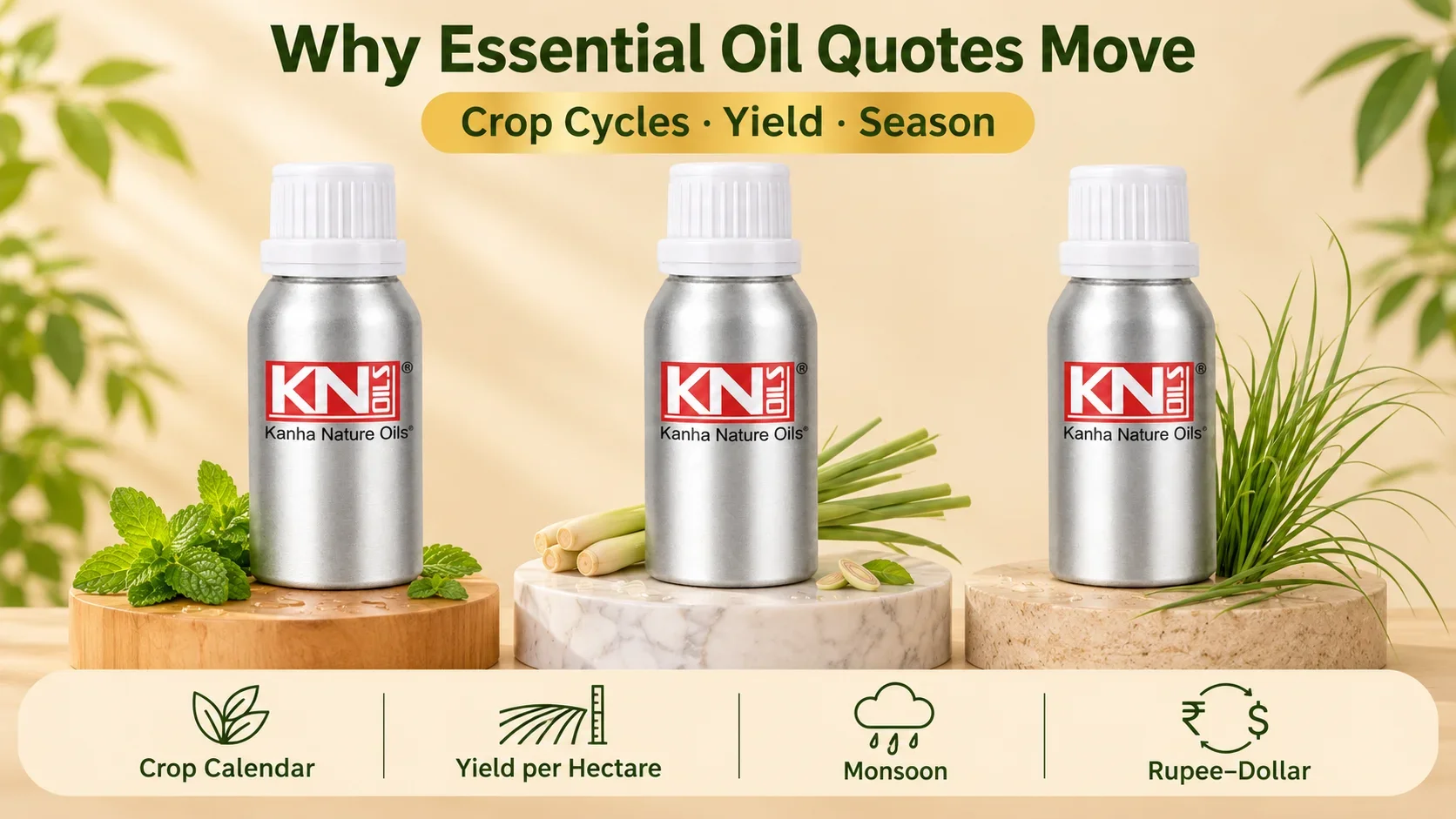
Why essential oil quotes move – Kanha Nature Oils
Most buyers plan essential oil purchases around their own production calendar. Indian growers work to a different one, set by planting dates, harvest windows and the monsoon. When the two calendars do not line up, buyers see quotes rise at the worst moment, or miss the time when new-crop oil is easiest to find.
This guide walks through a typical Indian growing year, month by month, and shows what each stage means for a bulk buyer of mint, lemongrass and palmarosa oil. It does not predict prices. It shows when to ask which question.
For the full background, data and sources, read the original guide: Why Essential Oil Quotes Move: Crop Cycles, Yield and Season in India.
January–February: mint goes into the ground
Menthol mint (Mentha arvensis) is an annual crop, replanted every year. Planting usually starts around January–February. Uttar Pradesh grows around 80% of India's mint, so decisions taken on farms there in these weeks shape the next season's supply. Because farmers choose their acreage again every year, a small change in sown area can be felt quickly in the market.
Buyer question for this period: What is the planting outlook for this season?
March–April: the second planting window
Some mint is planted after the rabi (winter crop) harvest in April. CSIR-CIMAP puts mint at 85 to 90 days to harvest when transplanted and 110 to 115 days when planted from suckers. Oil sold in these months still comes largely from the previous season.
Buyer question: Which harvest year is this batch from?
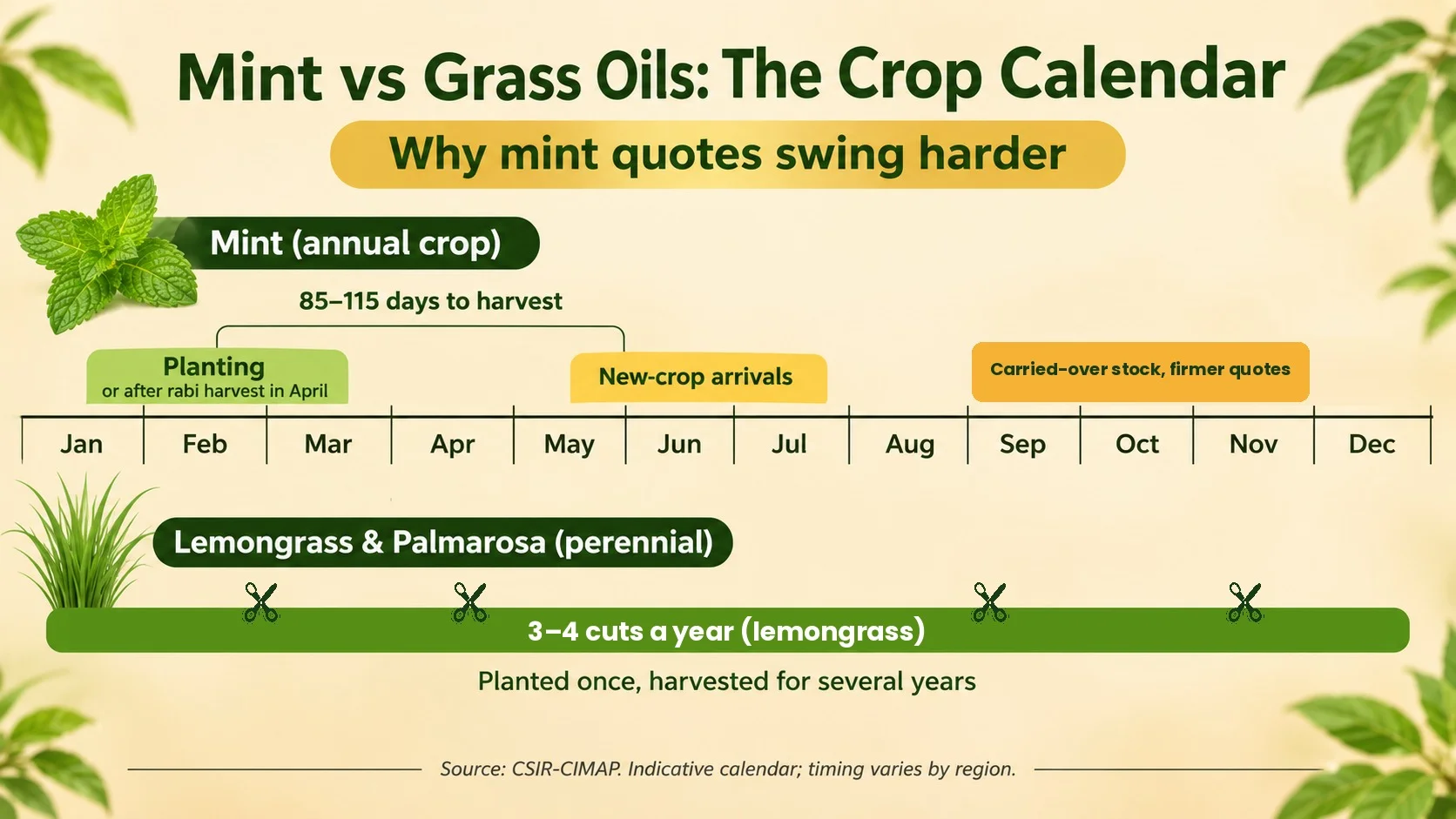
Mint vs lemongrass and palmarosa crop calendar in India
May–June: new-crop mint oil arrives
With 85 to 115 days to harvest, the main arrivals of new-crop mint oil begin from about May. For many buyers, this is the moment to ask about availability and validity rather than waiting for the end of the year. Mint is also the only Indian essential oil with a public benchmark, MCX Mentha Oil futures, which gives useful context on direction.
Buyer question: When is new-crop oil expected, and how long is this quote valid?
Product page: Mentha arvensis oil
June–September: watch the monsoon
The monsoon decides how much oil a field will give. CIMAP research data show irrigated lemongrass producing about 200 to 250 kg of oil per hectare a year, against 100 to 120 kg in rain-fed trials. In 2026, IMD data reported by Down To Earth put all-India rainfall for 1 June to 29 September at 12% below normal, with the southern peninsula 24% short and Uttar Pradesh 8% above normal.
Buyer question: Which region was this oil grown in, and was it irrigated or rain-fed?
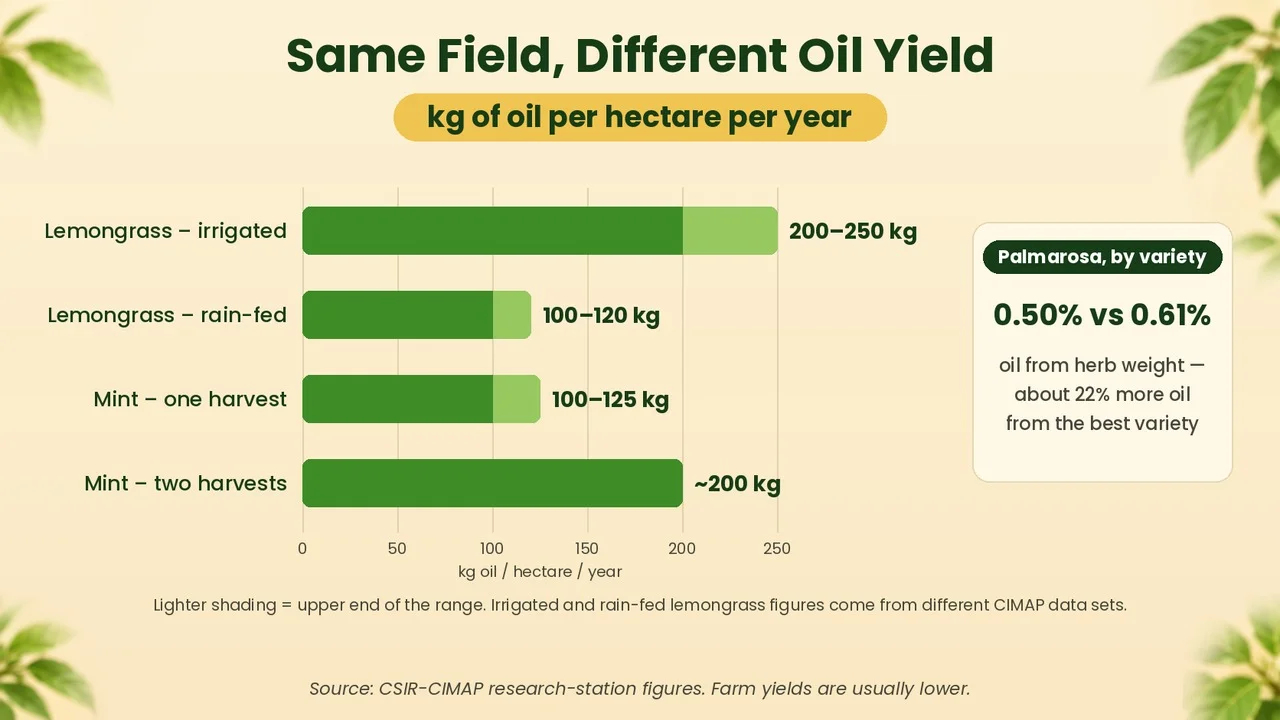
Essential oil yield per hectare – lemongrass and mint, CSIR-CIMAP data
September–November: carried-over stock
By autumn, most mint trade runs on carried-over stock rather than fresh arrivals, which is consistent with firmer quotes late in the season. In 2026, MCX Mentha Oil futures were reported near ₹1,220/kg on 10 September and about ₹1,346/kg on 13 November. This is a domestic price before GST and export costs, so use it for direction only. The rupee also matters: the FBIL reference rate moved from about ₹95.98 per US dollar at the end of September to ₹93.765 on 12 November.
Buyer question: Is this a spot or forward price, and in which currency?
All year: lemongrass and palmarosa
Lemongrass and palmarosa do not follow a single annual harvest. They are perennial grasses, cut several times a year for several years; CIMAP describes 3 to 4 cuts a year for lemongrass. Their prices usually move more slowly than mint, but a planting shortfall can last longer, because a new plantation takes time to mature.
Buyer question: What is the region and variety of this batch?
Product pages: Lemongrass oil · Palmarosa oil
Whatever the month: check the basics
- Fix the basis, FOB or CIF, before comparing offers. See our FOB vs CIF guide.
- Ask for the batch COA and GC-MS before paying. Here is how to read a GC-MS report.
- Treat a quote far below the market in a difficult season as a reason to check, not to celebrate.
👉 Read the complete guide, with the 2026 season snapshot and a six-step quote checklist
FAQ
When does new-crop mint oil arrive in India? Usually from about May, 85 to 115 days after planting.
Do lemongrass oil prices follow a season? Less than mint, because lemongrass is cut several times a year. Rain and irrigation still affect yield.
Is there a best month to buy? No single month is always best. Match your order to the harvest window, confirm the quote's validity and check the batch documents.
Where can you buy mint, lemongrass or palmarosa oil in bulk from India? Kanha Nature Oils manufactures and exports these oils from Bahadurgarh, Haryana, with batch documents on request. Request a quote or a free sample.
About Kanha Nature Oils
Kanha Nature Oils, based in Bahadurgarh, Haryana, manufactures and exports 700+ products, including 250+ essential oils, to buyers in 60+ countries. The company is a member of IFEAT, FAFAI and EOAI and is certified to ISO 9001:2015, ISO 14001:2015, WHO-GMP, HACCP, KOSHER and HALAL. COA, GC-MS report and SDS are issued on request for the specific product and batch.
🌐 Visit kanhanatureoils.com · 📖 Read the original guide · 💬 WhatsApp us
Request a free sample:
We don’t ask you to trust us. We ask you to test us.
Email: [email protected]
Phone: +91 92549 73446
WhatsApp: +91 92549 73447
Unit-1: Adjoining HUDA Plot No. 682, M.I.E. Part-A, Bahadurgarh, Haryana – 124507
Unit-2: 677, M.I.E., Part-A, Bahadurgarh, Haryana – 124507
Sources: CSIR-CIMAP, IMD (via Down To Earth), MCX, FBIL. Written by Piyush Gupta, Founder & CEO, Kanha Nature Oils.