Sign up with Google
 Sign in with Zoho
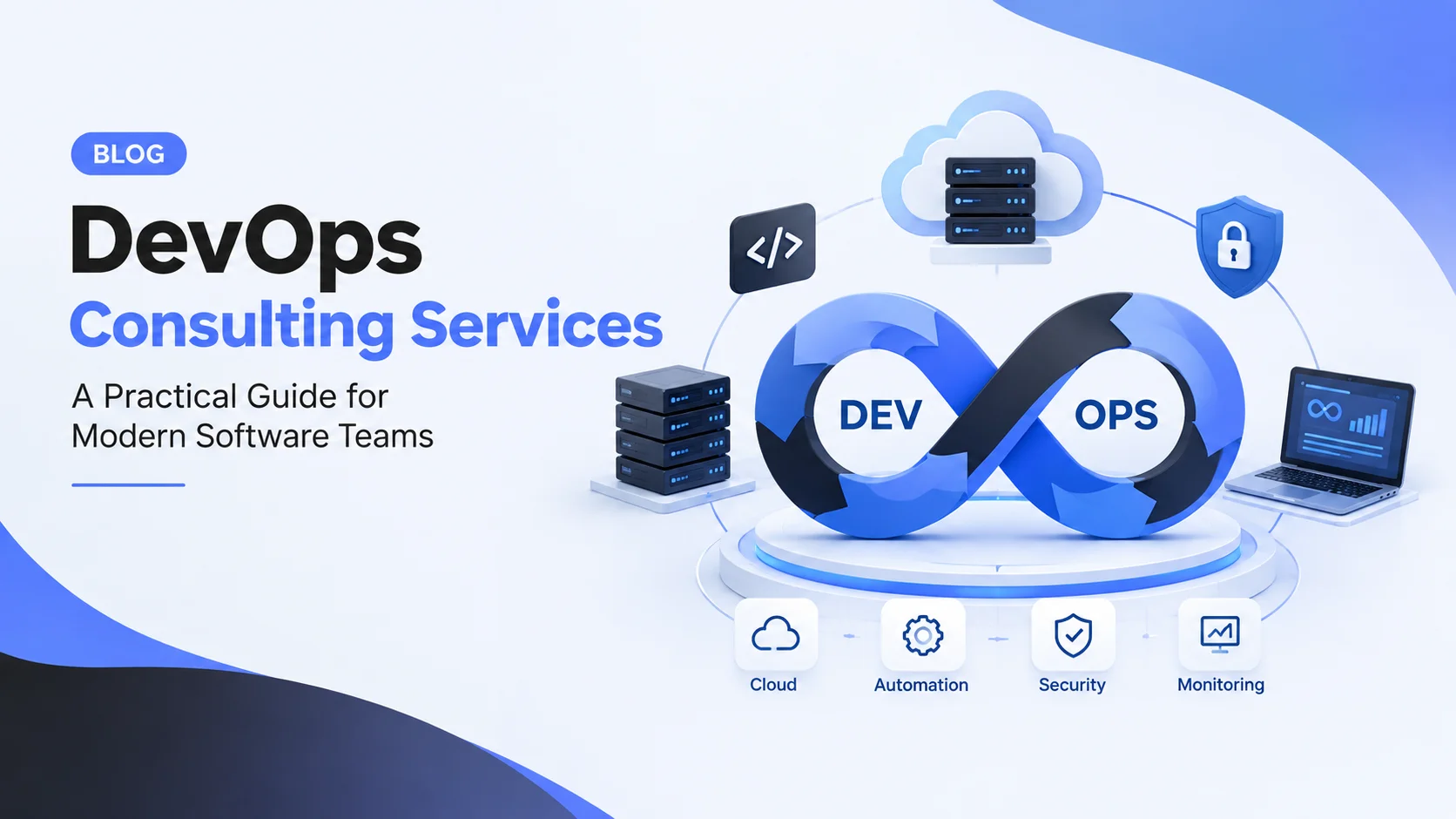
Managing software after development can become complicated as a business grows. Deployments take longer, infrastructure needs constant attention, and small configuration changes can sometimes create unexpected problems. When development and operations teams rely heavily on manual processes, releasing software can become slower and harder to control.
This is where DevOps consulting services can help. A DevOps consultant looks at how your teams build, test, deploy, secure, and monitor applications, then helps create a more reliable process around those activities.
The goal is not to add more tools to your technology stack. It is to make software delivery easier to manage and better suited to your business.
What Are DevOps Consulting Services?
DevOps consulting services help businesses improve the connection between software development and IT operations.
A consultant may review your existing infrastructure, development workflow, deployment process, cloud setup, security practices, and monitoring. Based on that assessment, they can recommend and implement changes that reduce unnecessary manual work and improve the way applications move from development to production.
Depending on your needs, DevOps consulting may include:
- CI/CD pipeline development
- Cloud infrastructure management
- Infrastructure as Code
- Docker and Kubernetes
- Deployment automation
- DevSecOps practices
- Monitoring and logging
- Cloud migration
- Infrastructure security
- Performance and reliability improvements
The requirements are different for every business. A startup launching its first SaaS product may need a completely different DevOps setup than an established company managing several production applications.
Why Do Businesses Invest in DevOps Consulting?
Many businesses do not have a DevOps problem at the beginning. Their development process simply grows over time.
A team might start by deploying an application manually. As the product gains users, more developers join, additional environments are created, and deployments become more frequent. Eventually, the original process becomes difficult to maintain.
You may start noticing issues such as:
- Deployments taking too much time
- Developers manually handling infrastructure tasks
- Differences between development and production environments
- Frequent deployment failures
- Limited visibility into application performance
- Difficulty managing cloud resources
- Security checks happening too late
- Too much time spent troubleshooting production issues
DevOps consulting can help identify where these problems are coming from and determine which processes should be automated or redesigned.
What Does a DevOps Consultant Do?
A good DevOps engagement starts with understanding the current environment.
Instead of immediately recommending a particular platform or tool, a consultant should first look at how your application is built and delivered.
This may involve reviewing your source-control process, deployment workflow, cloud infrastructure, testing practices, access permissions, monitoring setup, and production environment.
For example, imagine that your development team deploys a Node.js application manually to a cloud server. Every release requires someone to connect to the server, update the application, install dependencies, restart services, and check whether everything is working.
A DevOps consultant could help introduce an automated pipeline that builds the application, runs tests, prepares the deployment, and releases the approved version through a controlled process.
The technology is important, but the process comes first.
CI/CD Automation for Faster Releases
One of the most common areas covered by DevOps consulting is CI/CD.
Continuous Integration and Continuous Delivery or Deployment allow teams to automate many steps involved in releasing software.
A typical pipeline might look like this:
Code Commit → Build → Automated Tests → Security Checks → Approval → Deployment → Monitoring
Without automation, several of these steps may need to be completed manually.
A properly designed CI/CD pipeline can help development teams release changes more consistently while reducing repetitive deployment work.
Tools such as GitHub Actions, GitLab CI/CD, Jenkins, and Azure DevOps can be used depending on the project's requirements.
The right choice depends on your existing development environment, application architecture, team skills, and deployment model.
Infrastructure as Code
Managing cloud infrastructure manually can become difficult when an application has multiple environments or services.
Infrastructure as Code, commonly known as IaC, allows infrastructure configurations to be defined in files that can be version-controlled and reviewed like application code.
Terraform is one example of an IaC tool commonly used for cloud infrastructure.
Instead of manually creating resources through a cloud provider's dashboard, teams can define infrastructure configurations and use automation to provision or update environments.
This can make it easier to maintain consistent environments and understand what infrastructure changes have been made over time.
It is particularly useful when businesses need separate development, staging, and production environments.
Cloud and Containerization
Many businesses use cloud platforms such as AWS, Microsoft Azure, or Google Cloud to host their applications. As infrastructure grows, managing servers, networking, databases, storage, permissions, and application services can become increasingly involved.
DevOps consulting can help businesses organize their cloud infrastructure around the needs of their applications.
Containerization is another area where DevOps can improve application delivery. Docker allows applications and their dependencies to be packaged into containers, making them easier to move between environments.
For larger containerized environments, Kubernetes can help manage workloads, deployments, scaling, and service availability.
However, every business does not need Kubernetes. Introducing a complex platform when a simpler architecture would work can create unnecessary operational work. A practical DevOps strategy should consider the actual application requirements before selecting the technology.
Security with DevSecOps
Security should be considered throughout the development and deployment process.
DevSecOps brings security checks into the software delivery workflow instead of leaving them until the application is ready for production.
Depending on the project, this may include:
- Dependency vulnerability scanning
- Static code analysis
- Container security checks
- Secret management
- Access control
- Infrastructure security checks
- Security testing within CI/CD pipelines
For example, automated dependency scanning can identify known vulnerabilities before a new version is deployed.
This gives development teams an opportunity to address security issues earlier in the development lifecycle.
Monitoring and Observability
A successful deployment is only one part of running an application.
Once software is in production, your team needs to know how it is performing. Monitoring and observability provide information about application behavior, infrastructure health, errors, traffic, resource usage, and other operational conditions.
A well-planned monitoring setup can help answer practical questions:
- When did an error begin?
- Which service is affected?
- Did the problem start after a deployment?
- Is the issue affecting the entire application?
- Is a server or cloud resource reaching its limits?
Centralized logs, metrics, alerts, and tracing can give development and operations teams better information when investigating production problems.
How to Choose a DevOps Consulting Company
Choosing a DevOps consulting company should involve more than checking which technologies they list on their website.
Start by looking at whether the provider understands your type of application and can work with your existing technology stack.
Ask potential consultants how they approach the project before any implementation begins.
Useful questions include:
- Will you assess our current infrastructure first?
- Can you work with our existing cloud platform?
- How will deployment changes be tested?
- What will be automated?
- How will access and security be handled?
- Will documentation be provided?
- Will our internal team receive knowledge transfer?
- How will monitoring and alerts be configured?
- What happens after implementation?
These questions can help you understand whether the engagement is focused on your actual operational needs or simply on introducing a collection of tools.
When Should You Consider DevOps Consulting?
DevOps consulting may be useful if your team is spending too much time dealing with deployments, infrastructure, or production issues.
You may also benefit from consulting when you are:
- Moving an application to the cloud
- Building a new SaaS product
- Modernizing legacy infrastructure
- Introducing CI/CD
- Adopting Docker or Kubernetes
- Managing multiple deployment environments
- Improving application security
- Dealing with frequent deployment problems
- Setting up production monitoring
- Preparing infrastructure for application growth
You do not need to wait until your infrastructure becomes difficult to manage. Reviewing the delivery process earlier can help prevent manual processes from becoming deeply embedded in the way your team works.
Build a DevOps Process That Fits Your Application
DevOps is often discussed in terms of tools, but the real focus should be how your team delivers and operates software.
The right DevOps consulting services can help you understand where your current process is slowing the team down, which tasks can be automated, how infrastructure should be managed, and what visibility your developers need once an application is running in production.
At Code Cyper, we help businesses with DevOps requirements including CI/CD automation, cloud infrastructure, Infrastructure as Code, containerization, Kubernetes, DevSecOps, and monitoring. Our approach can be aligned with your existing application, technology stack, and operational requirements.
If deployments are becoming difficult to manage or your team is spending too much time on infrastructure and production issues, it may be time to review your DevOps setup.
Looking for DevOps consulting services for your business? Visit Code Cyper to discuss your application, infrastructure, and DevOps requirements with our team.