Sign up with Google
 Sign in with Zoho

Market Overview:
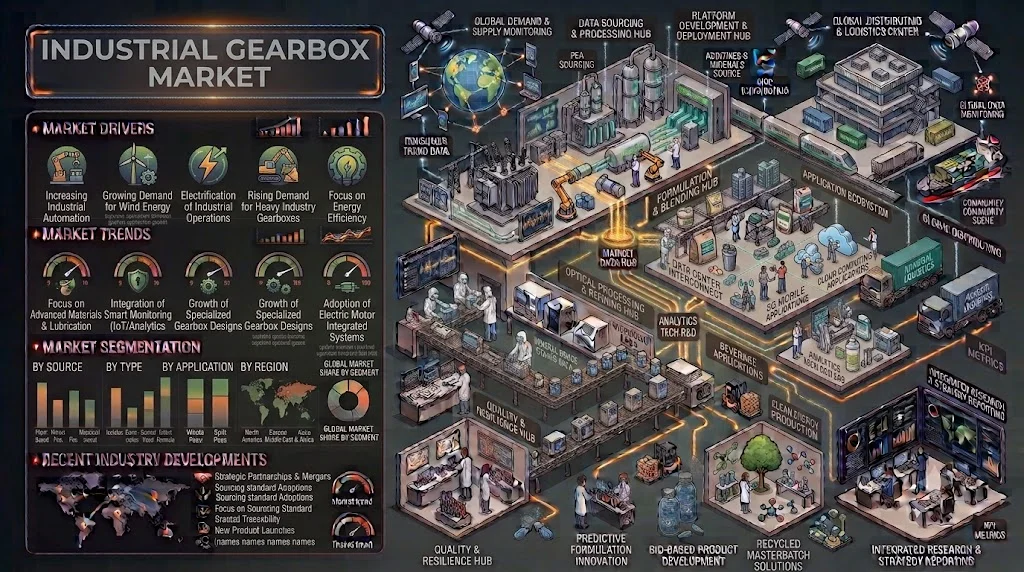
According to IMARC Group's latest research publication, "Industrial Gearbox Market: Global Industry Trends, Share, Size, Growth, Opportunity and Forecast 2026-2034", The global industrial gearbox market reached USD 32.44 Billion in 2025 and is projected to reach USD 46.27 Billion by 2034, growing at a CAGR of 3.90% during 2026-2034.
This detailed analysis primarily encompasses industry size, business trends, market share, key growth factors, and regional forecasts. The report offers a comprehensive overview and integrates research findings, market assessments, and data from different sources. It also includes pivotal market dynamics like drivers and challenges, while also highlighting growth opportunities, financial insights, technological improvements, emerging trends, and innovations. Besides this, the report provides regional market evaluation, along with a competitive landscape analysis.
How Automation and Energy Transition Are Reshaping the Industrial Gearbox Market
- The latest World Robotics statistics reported that 542,000 industrial robots were installed globally in 2024, more than twice the number recorded a decade ago, with annual robot installations exceeding 500,000 units for four consecutive years, directly increasing demand for precision gearboxes used in motion control and torque transmission.
- Helical gearboxes lead the type segment with a 28.5% share in 2025, owing to their superior efficiency, smooth meshing, low noise, and broad torque range applicability across sectors including cement, mining, steel, water, food, and automotive manufacturing.
- Parallel axis design dominates with 46.0% of the design segment in 2025, driven by cost-effective high-torque industrial drive economics and widespread use in conveyor systems, manufacturing equipment, and heavy industrial machinery.
- Asia Pacific commands 36.0% of the global market in 2025, underpinned by China's manufacturing output, India's industrial expansion, Japan's precision automation sector, and rising investments in renewable energy across Southeast Asia.
- In March 2026, Flender opened India's largest wind turbine gearbox test rig at its Walajabad facility near Chennai, with a 13.5 MW testing capacity, capable of handling torque of up to 18,000 kNm and tensile and compressive forces of up to 500 tonnes, strengthening next-generation testing for high-capacity wind turbine gearboxes.
Our report provides a deep dive into the industrial gearbox market analysis, outlining the current trends, underlying market demand, and growth trajectories.
Key Trends in the Industrial Gearbox Market
- Industrial Automation and Industry 4.0 Integration: Manufacturers are investing heavily in automated production lines, robotic systems, and smart manufacturing equipment, all of which rely on high-performance gearboxes for precise speed and torque control. As factories adopt Industry 4.0 technologies, the demand for precision and durable gearbox solutions is rising steadily. The consistent growth of global robot installations above 500,000 units annually for four consecutive years reflects the structural depth of this demand driver.
- Wind Energy Expansion Driving Planetary Gearbox Demand: In 2025, wind turbines produced enough power to meet over 11% of worldwide electricity demand, a record contribution. Wind turbines rely on gearboxes to convert low-speed rotor movement into high-speed generator rotation, creating sustained procurement demand for high-torque, durable planetary gearboxes that can withstand variable loads, harsh weather, and continuous operation across onshore and offshore installations.
- Gearbox Remanufacturing and Circular Economy Adoption: Industries are increasingly adopting gearbox remanufacturing as a cost-effective and sustainable alternative to new procurement. Scania's milestone remanufacturing project demonstrated that this approach uses around 50% less material and generates nearly 45% fewer carbon emissions compared to producing a new gearbox, while also reducing lead times and creating recurring revenue streams for OEMs through lifecycle support services.
- IoT-Connected Smart Gearboxes for Predictive Maintenance: Smart sensors are being integrated into gearboxes to continuously monitor parameters such as vibration, temperature, load, and lubrication levels in real time. This shift from reactive to predictive maintenance is reducing unplanned downtime and repair costs across cement, mining, and power generation sectors. As Industry 4.0 adoption accelerates, intelligent gearboxes are evolving from optional add-ons to standard procurement specifications.
- Lightweight Composite and Additive-Manufactured Components: Manufacturers are adopting 3D printing and composite materials to produce complex gear designs with reduced weight, improved energy efficiency, and greater design flexibility. These technologies are particularly relevant in robotics, wind energy, aerospace, and compact industrial machinery, where performance, sustainability, and space constraints demand advanced engineering solutions beyond conventional gearbox manufacturing methods.
Growth Factors in the Industrial Gearbox Market
- Rising Mining and Construction Equipment Demand: Heavy machinery used in mining and construction, including crushers, excavators, conveyors, loaders, and drilling systems, requires robust gearboxes for torque transmission and speed control under high-load and harsh conditions. Ongoing urbanization, infrastructure development, and critical mineral extraction activities globally are sustaining long-term procurement demand for durable, high-performance industrial gearbox solutions across the mining, aggregates, and construction sectors.
- Asia Pacific Manufacturing and Renewable Energy Investment: Asia Pacific's regional dominance at 36.0% of global market share reflects the combined impact of China's manufacturing capacity, India's industrial growth ambitions, Japan's precision automation ecosystem, and Southeast Asia's rising infrastructure investment. Renewable energy deployment across the region, particularly in wind power, is creating above-trend gearbox procurement that supplements the region's already substantial industrial base demand.
- Government Investments in Renewable Energy Infrastructure: Government-led renewable energy targets are driving large-scale wind energy installations that require precision gearboxes for turbine operation. Saudi Arabia's Vision 2030 industrial diversification program, Sub-Saharan Africa's critical mineral mining development, and Brazil's mining and agricultural processing expansion are among the policy-driven demand catalysts generating structured gearbox procurement across the Middle East, Africa, and Latin America.
- Aging Industrial Installed Base Creating Replacement Demand: A significant portion of industrial gearbox demand is driven by the replacement cycle of aging equipment across mature industrial economies in Europe and North America. Europe's 25.0% market share is partly underpinned by wind energy repowering programs, while North America's 22.5% share reflects manufacturing reshoring, oil and gas, mining, and logistics sector modernization, all generating above-historical-trend replacement procurement.
- Innovation in Worm Gearbox Applications: Advanced worm gearboxes with high torque output, compact design, and self-locking capabilities are finding expanding applications in solar trackers, conveyor systems, packaging machines, and material handling equipment. In March 2025, Stagnoli introduced Spinyx, an advanced worm gearbox made from technopolymer, a high-performance composite material, designed to enhance power transmission performance while reducing maintenance costs, reflecting the continued innovation investment across niche gearbox types.
Leading Companies Operating in the Global Industrial Gearbox Industry:
- SEW-EURODRIVE
- Siemens
- Bonfiglioli S.P.A
- NORD
- Sumitomo Heavy Industries, Ltd.
Industrial Gearbox Market Report Segmentation:
Breakup By Type:
- Helical Gearbox
- Planetary Gearbox
- Bevel Gearbox
- Spur Gearbox
- Worm Gearbox
- Others
Helical gearbox accounts for the largest share of 28.5% in 2025, owing to its superior commercial characteristics, smooth meshing, mechanical efficiency, and broad torque range applicability across virtually every industrial sector.
Breakup By Design:
- Parallel Axis
- Angled Axis
- Others
Parallel axis design dominates with 46.0% of the market in 2025, driven by its optimal commercial economics for industrial drive applications, manufacturing simplicity, and widespread use in conveyor, material handling, and heavy machinery systems.
Breakup By Application:
- Construction and Mining Equipment
- Automotive
- Chemicals, Rubber and Plastic
- Wind Power
- Material Handling
- Power Generation
- Agriculture
- Others
Breakup By Region:
- North America (United States, Canada)
- Asia Pacific (China, Japan, India, South Korea, Australia, Indonesia, Others)
- Europe (Germany, France, United Kingdom, Italy, Spain, Russia, Others)
- Latin America (Brazil, Mexico, Others)
- Middle East and Africa
Asia Pacific holds the leading regional position with 36.0% market share in 2025, driven by rapid industrialization, expanding manufacturing output, and strong growth in automation and renewable energy investment across China, India, Japan, and Southeast Asia.
Recent News and Developments in the Industrial Gearbox Market
- January 2025: Sumitomo Heavy Industries launched its new easy-to-install, zero-backlash DA Series gear head for servo motors under its Fine CYCLO high-precision gearbox portfolio, designed for precision positioning applications in machine tools, semiconductor manufacturing equipment, and other advanced industrial machinery.
- March 2025: Stagnoli introduced Spinyx, an advanced worm gearbox made from technopolymer, a high-performance composite material, designed to enhance power transmission performance and reduce maintenance costs across conveyor, packaging, and material handling applications.
- March 2026: Flender opened India's largest wind turbine gearbox test rig at its Walajabad facility near Chennai, Tamil Nadu, with a 13.5 MW testing capacity. The advanced back-to-back electric test rig handles torque of up to 18,000 kNm and tensile and compressive forces of up to 500 tonnes, supporting next-generation wind turbine gearbox validation under challenging operating conditions.
Note: If you require specific details, data, or insights that are not currently included in the scope of this report, we are happy to accommodate your request. As part of our customization service, we will gather and provide the additional information you need, tailored to your specific requirements. Please let us know your exact needs, and we will ensure the report is updated accordingly to meet your expectations.
About Us:
IMARC Group is a global management consulting firm that helps the world's most ambitious changemakers to create a lasting impact. The company provides a comprehensive suite of market entry and expansion services. IMARC offerings include thorough market assessment, feasibility studies, company incorporation assistance, factory setup support, regulatory approvals and licensing navigation, branding, marketing and sales strategies, competitive landscape and benchmarking analyses, pricing and cost research, and procurement research.
Contact Us:
IMARC Group
134 N 4th St. Brooklyn, NY 11249, USA
Email: [email protected]
Tel No: (D) +91 120 433 0800
United States: +1-201-971-6302