Sign up with Google
 Sign in with Zoho

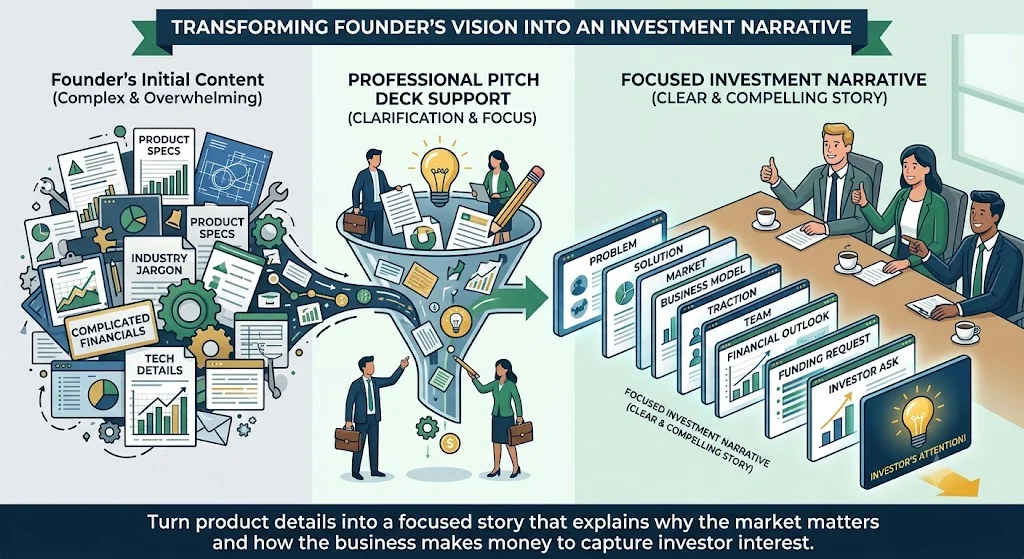
A startup pitch deck has a difficult job. In a few slides, it needs to explain what a company does, why the market matters, how the business makes money, and why an investor should pay attention.
For founders, creating that story can be challenging because they know the business too well. Important information can easily become buried beneath product details, industry terminology, or complicated financial figures. Professional pitch deck support can help turn that information into a focused investment narrative.
What does a pitch deck consultant actually do?
A pitch deck consultant helps founders structure and refine their investor presentation so that the business opportunity is clear, credible, and easy to understand. Their work can involve reviewing the company's story, financial information, market evidence, competitive positioning, and funding objectives.
A consultant may help with:
- Pitch structure and storytelling
- Investor-focused messaging
- Market opportunity analysis
- Business model presentation
- Traction and validation
- Competitive positioning
- Financial information
- Funding requirements
- Use of funds
- Investor questions and objections
The purpose is not simply to create attractive slides. Design can improve readability, but investors ultimately need to understand the commercial opportunity and the reasoning behind the investment case.
Why does a startup need a strong pitch deck?
A strong pitch deck gives investors a quick but meaningful understanding of the company. It can help them determine whether the opportunity is relevant to their investment strategy and whether they want to learn more.
A useful deck should answer several fundamental questions:
- What problem does the company solve?
- Who experiences that problem?
- Why is the solution valuable?
- How large is the potential market?
- What evidence shows that customers want it?
- How does the company make money?
- Why can it compete successfully?
- Why is the team capable of execution?
- How much funding is required?
- What will the investment achieve?
When these questions are answered clearly, the investor does not have to work hard to understand the opportunity.
What should an investor pitch deck include?
A typical startup deck includes around 10 to 15 core sections, although the exact structure should reflect the company and funding stage.
The problem
Start with a genuine customer problem. Explain who experiences it and why existing alternatives are insufficient.
The solution
Show how the product or service addresses that problem. Keep the explanation simple and focus on customer value.
Market opportunity
Explain the size of the market and where the startup fits within it. Avoid relying solely on impressive industry-wide figures.
Business model
Explain how revenue is generated, who pays, and what drives future growth.
Traction
Present the strongest evidence of progress. Depending on the business, this could include revenue, customers, user growth, retention, partnerships, pilots, or other meaningful indicators.
Competition
Explain the alternatives available to customers and identify what gives the startup an advantage.
Team
Highlight the experience and capabilities most relevant to executing the business plan.
Financial outlook
Present key financial projections and explain the assumptions behind them.
Funding request
Clearly state how much capital is being raised and how it will be used.
How does pitch deck consulting service help founders?
A pitch deck consulting service can provide an outside perspective on how investors may interpret the business story. This is particularly useful when founders have strong knowledge of their product but find it difficult to communicate the opportunity concisely.
Professional consulting may identify issues such as:
- A confusing storyline
- Weak differentiation
- Unsupported market claims
- Missing financial information
- Unclear traction
- An unrealistic funding request
- Too much technical information
- A weak explanation of the growth strategy
An experienced consultant can help prioritise what belongs in the main presentation and what should be kept for follow-up discussions or supporting documents.
The result should be a deck that feels focused rather than crowded.
What do investors want to see in a pitch deck?
Investors typically want evidence that the company has a meaningful opportunity and a credible route to capturing it. The precise criteria vary between angel investors, venture capital firms, family offices, and other funding sources.
However, investors commonly examine:
- Market size and growth
- Customer demand
- Revenue or traction
- Business economics
- Competitive advantage
- Scalability
- Founder and team capability
- Financial projections
- Capital requirements
- Potential risks
Investors may also look for consistency. If the pitch claims that a company can grow rapidly, the financial model should provide a reasonable explanation for how that growth will happen.
Numbers should not simply decorate the presentation. They should support the business argument.
How important are financial projections?
Financial projections give investors a view of how the company expects to develop and how much capital may be required along the way. They can also reveal whether the proposed growth strategy is financially realistic.
Key information may include:
- Revenue forecasts
- Gross margin
- Operating expenses
- Cash flow
- Burn rate
- Runway
- Customer acquisition costs
- Break-even expectations
- Funding requirements
Founders should know the assumptions behind their forecasts. Investors may ask why revenue is expected to increase, what will drive customer acquisition, or how additional investment will affect operating costs.
A defensible forecast is more useful than an impressive-looking forecast that cannot withstand basic questions.
What are the biggest pitch deck mistakes?
Several mistakes can make a promising startup harder to understand.
Too much text
A pitch deck should support a conversation, not function as a full business plan.
Weak opening
If the problem and opportunity are unclear, investors may lose interest before reaching the strongest parts of the presentation.
Generic market claims
Broad market statistics are less convincing when the connection to the startup is unclear.
No clear funding request
Investors should not have to search through the deck to find out how much the company is raising.
Overcomplicated language
Industry jargon can make a presentation harder to follow, especially when the investor is unfamiliar with the specific sector.
Ignoring competition
Almost every business competes with something, whether that is another company, an internal process, or simply the customer's decision to do nothing.
Who should consider professional pitch deck support?
Professional support can be useful for founders preparing for a first funding round, companies seeking larger investment, or teams that have already presented to investors without achieving the desired results.
It may be particularly helpful when:
- The business is difficult to explain simply.
- The existing deck feels too long.
- Investor feedback is inconsistent.
- The funding requirement is unclear.
- Financial projections need stronger presentation.
- The company has traction but struggles to communicate it.
- Founders are unsure what investors actually want to see.
An external perspective can often reveal gaps that are difficult for an internal team to spot.
How can founders prepare before working on a pitch deck?
Before designing slides, collect the information that supports the investment story.
Start with:
- Customer and market evidence
- Business model information
- Traction metrics
- Competitive research
- Team experience
- Financial projections
- Funding requirement
- Planned use of funds
- Key growth milestones
- Major business risks
Once this information is organised, the deck becomes easier to build. The presentation should then be structured around the most important investment questions rather than simply following the order in which the company developed.
What should a founder expect from a professional pitch process?
A professional process should begin with understanding the company and its fundraising objectives. From there, the investment story can be developed, the supporting evidence reviewed, and the presentation refined.
The process may include:
- Initial business assessment
- Pitch strategy
- Content development
- Financial information review
- Investor-focused messaging
- Presentation refinement
- Feedback and revisions
- Investor meeting preparation
The final result should give the founder more than a polished document. They should understand the story behind every slide and feel prepared to discuss the business beyond what appears on screen.
Final thoughts
A pitch deck is often the first detailed introduction an investor has to a startup. It needs to communicate the opportunity quickly without sacrificing credibility.
The strongest presentations combine a clear problem, compelling solution, attractive market, genuine traction, sensible financial expectations, capable founders, and a specific funding plan.
Professional pitch support can help founders bring these elements together and remove distractions that weaken the investment story.
Ultimately, the best pitch deck does not try to impress investors with complexity. It makes the opportunity easy to understand, gives them reasons to believe the business can execute, and creates enough interest to start the next conversation.
FAQs
1. What is a pitch deck consultant?
A pitch deck consultant helps founders develop and refine investor presentations by improving the structure, messaging, financial presentation, and overall investment narrative.
2. How many slides should a startup pitch deck have?
There is no fixed number, but most startup decks work best when they are concise and focused. Each slide should communicate one important part of the investment story.
3. Should a pitch deck include financial projections?
Yes. Financial projections can help investors understand the company's growth expectations, capital requirements, and underlying business economics.