Sign up with Google
 Sign in with Zoho

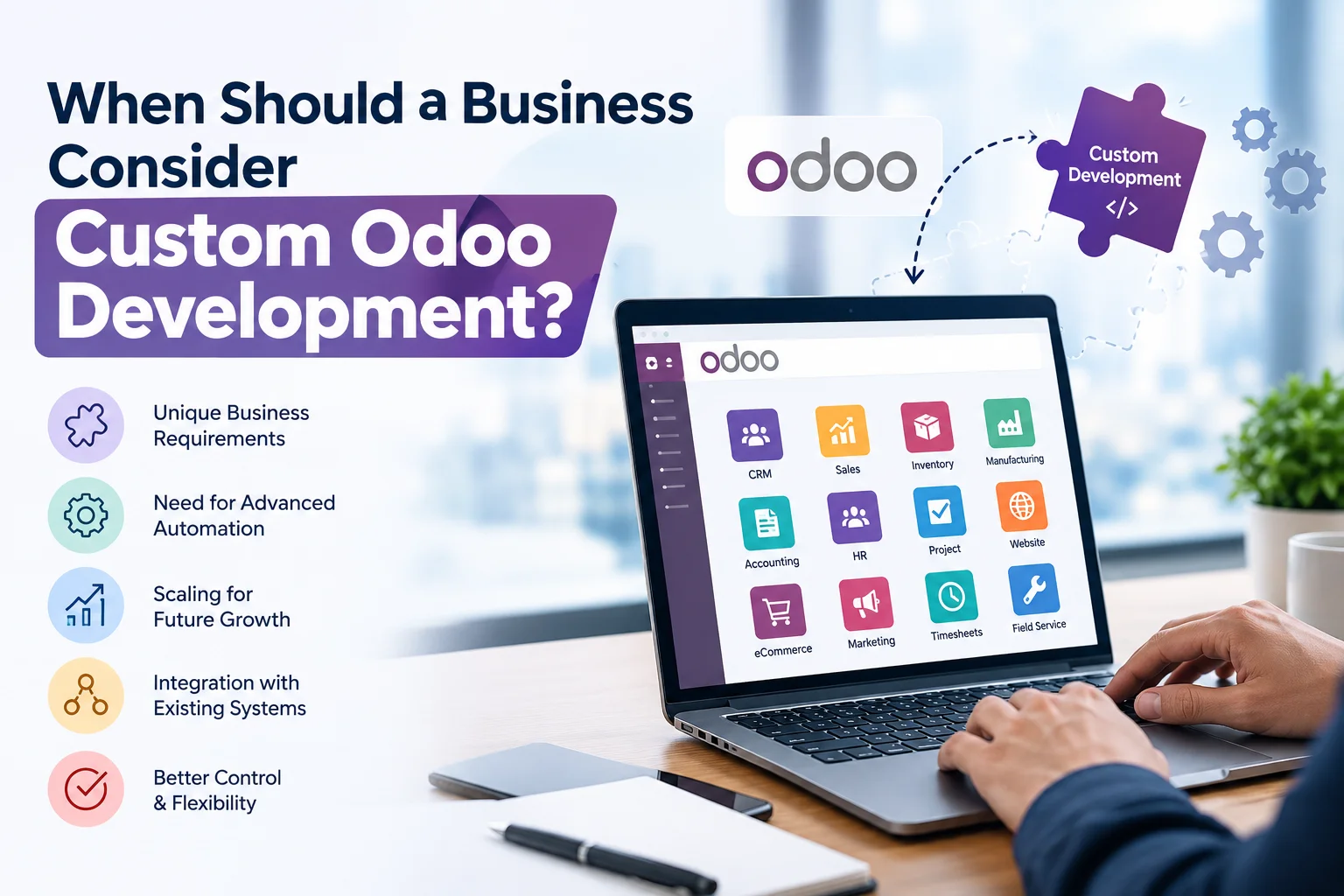
Odoo is designed to help businesses manage different operations through one connected ERP platform. Its modular structure allows companies to start with the applications they need and add more as their requirements grow. For many businesses, standard Odoo features are enough to improve efficiency and bring different departments onto a common system.
However, not every business operates in the same way.
Some companies have unique workflows, industry-specific requirements, complex approval processes, or legacy systems that cannot be handled effectively with standard configurations alone. This is where custom Odoo development becomes worth considering.
The important question is not whether a business can customize Odoo, but whether customization is actually necessary. Understanding when custom development makes sense can help businesses avoid unnecessary costs while still getting an ERP system that fits their operations.
When Standard Odoo Features Are Not Enough
The first sign that custom development may be required is when standard Odoo functionality cannot properly support an important business process.
Odoo provides a wide range of applications for areas such as sales, CRM, inventory, accounting, manufacturing, purchasing, and project management. Businesses can configure many of these features without changing the underlying system.
But imagine a company with a specialized order-processing workflow. Its sales team may need several internal approvals before an order can move to production. If the standard workflow does not provide the required level of control, a custom module or workflow may be a practical solution.
Custom Odoo development can extend the platform without forcing the business to completely change the way it operates.
When Your Business Has Unique Workflows
Every organization develops its own processes over time. These processes may depend on the industry, company structure, customers, suppliers, or internal policies.
For example, a manufacturing company may require a specialized production workflow, while a logistics business may need customized shipment tracking and approval processes.
Trying to force these workflows into a standard ERP structure can result in workarounds, spreadsheets, manual data entry, and disconnected processes.
In such cases, Odoo development services can be used to build workflows that match the company's actual requirements.
The goal should not be to customize everything. Instead, customization should focus on processes where the difference can create measurable operational value.
When You Need Integration With Other Systems
Many businesses already use multiple software platforms before implementing Odoo. These might include payment gateways, e-commerce platforms, warehouse systems, CRM tools, payroll applications, shipping platforms, or industry-specific software.
If these systems cannot communicate effectively, employees may have to enter the same information into multiple platforms. This increases manual work and creates opportunities for errors.
Custom Odoo development can help connect Odoo with external systems through APIs and other integration methods.
For example, an online retailer may want orders from its e-commerce platform to automatically reach Odoo, update inventory, generate customer information, and support the fulfillment process.
The result is a more connected technology environment with less repetitive work.
When Reporting Requirements Are More Complex
Standard Odoo reporting can provide useful visibility into business operations. However, some organizations need reports based on their own metrics, calculations, departments, locations, products, or operational rules.
If important management decisions depend on information that is not available through standard reports, custom reporting can be considered.
A custom dashboard could combine information from sales, inventory, finance, and operations into a single view. Instead of collecting data manually from different reports, management can access the information needed for decision-making in one place.
This type of customization is particularly useful when a business has complex reporting structures or operates across multiple departments or locations.
When Manual Work Is Slowing Down Operations
Another strong reason to consider customization is excessive manual work.
Employees may spend hours copying information, checking records, sending internal notifications, creating repetitive documents, or moving data between different systems.
Before building a custom solution, businesses should first check whether Odoo's existing automation and configuration options can solve the problem. If they cannot, custom automation may be appropriate.
For example, a business could create a customized workflow that automatically sends notifications when an approval is pending, updates records after a specific action, or triggers another process when defined conditions are met.
The objective is simple: reduce repetitive tasks and allow employees to focus on work that requires human attention.
When Industry-Specific Requirements Matter
Certain industries have processes that are difficult to manage through a generic setup.
Manufacturing companies may require specialized production controls. Logistics businesses may need customized shipment workflows. Retail organizations may require specific inventory and pricing processes. Service companies may need unique project, billing, or customer-management workflows.
In these situations, an experienced Odoo development company can analyze the existing process and determine where standard Odoo functionality ends and customization becomes useful.
Industry-specific customization can help businesses create an ERP environment that reflects how their operations actually work.
Customization Should Not Be the First Option
Although custom development can solve important business problems, it should not automatically be the first choice.
Too much customization can increase development costs, maintenance requirements, testing needs, and future upgrade complexity.
A better approach is to follow a simple decision process:
- Check whether standard Odoo features can solve the requirement.
- Review available configuration and automation options.
- Identify the exact limitation.
- Estimate the business value of solving that limitation.
- Consider integration or customization only when it provides clear value.
- Build the simplest solution that meets the actual requirement.
This approach helps businesses avoid customizing features simply because they prefer a different workflow.
How to Decide If Custom Odoo Development Is Worth It
A business should consider custom Odoo development when the requirement is important, recurring, and difficult to solve through standard functionality.
The strongest indicators include:
- A critical workflow cannot be supported properly.
- Employees perform large amounts of repetitive manual work.
- Existing systems need deeper integration with Odoo.
- Standard reports do not provide essential business information.
- Industry-specific processes require additional functionality.
- The business needs a unique customer or employee experience.
- The expected efficiency or revenue improvement justifies the development cost.
The decision should always be based on business value rather than customization for its own sake.
Final Thoughts
Custom Odoo development can be a powerful way to adapt an ERP system to a company's unique requirements. But successful customization starts with understanding the business problem rather than immediately changing the software.
For some organizations, standard Odoo configuration will be enough. For others, custom workflows, integrations, automation, dashboards, or modules may provide significant advantages.
The right approach is to identify the limitations, measure their impact, and then determine whether customization offers a practical solution.
When planned carefully, custom Odoo development can help businesses create a more efficient, connected, and scalable ERP environment without compromising the advantages of the Odoo platform.