Sign up with Google
 Sign in with Zoho

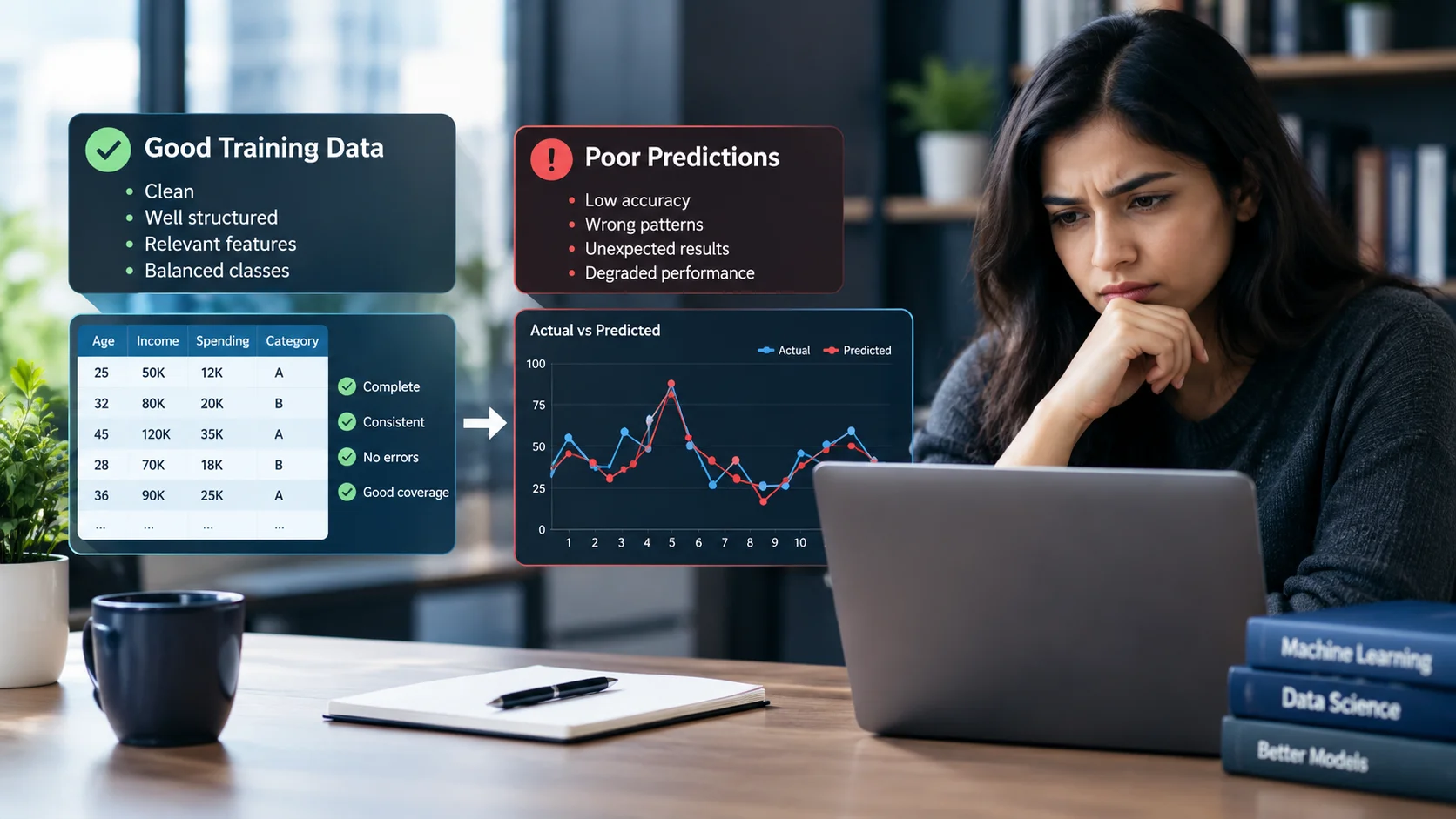
You cleaned the dataset. You removed duplicates, handled missing values and balanced the columns. The model scores 94% on your test set. Then you deploy it, or submit it, and the predictions fall apart.
This is common, and it rarely means your data was "bad." Usually, the data was good for one purpose and the model was asked to do another. This article walks through the most frequent reasons, with examples, and ends with an order of checks you can follow when debugging.
"Good data" and "data that fits the problem" are different things
Clean data means few errors, few gaps and consistent formats. That is about quality.
Predictive data needs more than that. It must also be:
- Representative: it looks like the data the model will see later.
- Correctly labelled: the label measures what you actually want to predict.
- Available at prediction time: every feature exists when the real decision is made.
- Evaluated honestly: the test setup mimics real use.
A dataset can pass the first test and fail all four of these. Most poor predictions come from one of them.
1. Data leakage: the model saw the answer
Data leakage means information from outside the training situation sneaks into your features. The model learns a shortcut, and your test score looks excellent for the wrong reason.
Example (illustrative scenario): You build a model to predict whether a customer will cancel a subscription. One column is "cancellation_reason," filled in only after a customer cancels. The model learns that a filled-in reason means "cancelled." It scores almost perfectly in testing, but is useless on live customers, because for them that column is always empty.
Leakage is often subtler than this:
- Scaling or imputing missing values on the full dataset before splitting into train and test.
- Including an ID or timestamp that indirectly reveals the outcome.
- Having the same customer, patient or product appear in both train and test sets.
Quick check: For each feature, ask, "Will I truly know this value at the moment I need the prediction?" If the answer is no or unsure, remove it. Also look at feature importance. If one feature dominates suspiciously, investigate it.
2. The real world is different from your training data
Models assume future data resembles past data. When it doesn't, accuracy drops. This is called distribution shift or data drift.
Example (illustrative): A model trained on house prices from a period of stable interest rates may struggle when borrowing costs change sharply. Buyer behaviour shifts, but the model still reasons from the old pattern.
Shift shows up in a few forms:
- Covariate shift: input data changes (new customer types, a new sensor, a new city).
- Concept drift: the relationship between inputs and outcome changes (what counted as "spam" five years ago may not count today).
- Sampling bias: your training data was never a fair sample to begin with, such as survey responses from only the people who chose to reply.
Quick check: Compare basic statistics of your training features against recent real-world data. Look at ranges, averages and category counts. Large gaps are a warning.
3. A random split can hide the problem
The default train-test split shuffles rows randomly. For many problems this is fine. For time-based or grouped data, it quietly cheats.
If you are forecasting sales, a random split lets the model train on next Thursday's data and "predict" last Wednesday's. That never happens in real life.
A safer approach for time-ordered data is to train on the past and test on the future:
python
# Split the data chronologically: first 80% for training, remaining 20% for testing split_point = int(len(df) * 0.8)
train_data = df.iloc [:split_point]
test_data = df.iloc[split_point:]
For grouped data (multiple rows per customer or patient), keep each group entirely in train or test. Scikit-learn offers tools such as GroupKFold and TimeSeriesSplit for this.
4. The label isn't what you think it is
Models learn from labels. If the label is a rough stand-in for the real goal, the model optimises the stand-in.
Example (illustrative): A company wants to predict which job candidates will perform well. Its training label is "was hired in the past." The model then learns to predict past hiring decisions, including any human bias or habits in them, not job performance.
Other label problems include:
- Inconsistent labelling when several people tag the data with different standards.
- Labels that are delayed or incomplete (a customer who hasn't churned yet is labelled "stayed").
- Noisy labels in subjective tasks, such as sentiment or content moderation.
Quick check: Manually review 50 to 100 random labelled rows. If you disagree with many labels, the model has no chance of agreeing with reality.
5. Accuracy can look great on an unbalanced problem
Suppose only 5 out of 100 transactions are fraud. A model that always predicts "not fraud" is 95% accurate and catches zero fraud.
This is simple arithmetic, but it catches many beginners. When classes are uneven, accuracy alone misleads. Look at:
- Precision: of the cases flagged, how many were truly positive?
- Recall: Of all actual positives, how many did the model correctly identify?
- Confusion matrix: the raw counts of right and wrong predictions per class.
- Precision-recall curves instead of only ROC curves, when the positive class is rare.
Which metric matters depends on cost. Missing a fraud case and wrongly flagging a good customer carry different costs, and your metric should reflect that.
6. The model fits noise, not signal (overfitting)
An overfit model memorises quirks of the training set. It performs well on data it has seen and poorly on new data.
Common signs:
- Training score much higher than validation score.
- Performance changing wildly between cross-validation folds.
- A very complex model on a small dataset.
Practical fixes include simpler models, regularisation, fewer features, more data and cross-validation. A useful habit is to start with a simple baseline, such as logistic regression or a basic decision tree, before trying complex models. If a complex model barely beats the baseline, the extra complexity isn't earning its place.
7. Your features don't contain enough signal
Sometimes the data is clean, the split is fair and the model is sound, yet predictions are still weak. The inputs may simply not contain enough information about the outcome.
No algorithm can predict well from features that don't relate to the target. If you are predicting student exam results using only age and city, even perfect modelling has a ceiling.
What to do: Talk to someone who understands the domain and ask what drives the outcome. Then ask whether you can collect that information. Better features usually beat a fancier algorithm.
8. The model changes the world it predicts
In some systems, predictions influence future data. A recommendation model shows certain products, users click those, and the next version trains on clicks that the previous model caused. This is a feedback loop. The model's blind spots reinforce themselves.
This is harder to detect, so it helps to keep a small holdout group that sees non-model-driven results, where that is practical and ethical.
A practical debugging order
When predictions disappoint, work through these checks in sequence. The early ones are the cheapest and the most often responsible.
- Check for leakage. Review every feature against "available at prediction time?"
- Check your split. Does it match how the model will really be used (time, group, random)?
- Check the metric. Is it appropriate for class balance and business cost?
- Compare train vs validation scores. A large gap points to overfitting.
- Inspect the labels. Sample and read them yourself.
- Compare training data to live data. Look for shift.
- Look at the errors. Group wrong predictions by category, region or time. Patterns in the mistakes often reveal the cause.
- Revisit features. Ask whether the inputs can plausibly predict the target.
Step 7 is underrated. Instead of looking only at an overall score, ask where the model fails. If it is poor only for new customers, or only for one region, you have found something concrete to fix.
A short worked scenario
A learner builds a model to predict loan default. Test accuracy is 96%. In review, three things surface:
- Default is rare, so a "no default" guess already scores about 96%. The model has learned almost nothing. Recall on actual defaulters is very low.
- A column called "recovery_amount" is only filled in for loans that defaulted. That is leakage.
- The data was split randomly, though the lender's policies changed over time.
After removing the leaky column, splitting by date and judging the model with recall and precision, the headline score falls sharply. But the result is now honest, and the learner can start improving the real model.
A drop in score after fixing these issues is a good sign. It means you are measuring the true problem.
Key takeaways
- Clean data doesn't guarantee useful predictions. Representativeness, correct labels and honest evaluation matter just as much.
- Leakage and unrealistic splits are the most common reasons for scores that look too good.
- Pick metrics that match the real cost of mistakes, especially with imbalanced classes.
- Compare against a simple baseline before trusting a complex model.
- Study the errors, not only the overall score.
Conclusion
Poor predictions from good data usually come from a mismatch between how a model was trained and tested and how it will be used. Before you change the algorithm, ask three questions: what was the model allowed to see, how was it tested, and what does the label really mean?
These habits separate a model that scores well in a notebook from one that holds up on real data. If you are learning data science in Bengaluru, practise them early. Build projects where you split data by time, hunt for leakage and judge models with precision and recall instead of accuracy alone. Reviewing your own mistakes this way teaches more than finishing another tutorial.
If you are comparing a data science course in Bengaluru, check whether it gives you hands-on practice with model evaluation and debugging, not just algorithms. At Innomatics Research Labs, you can learn more about our data science and AI training at the HSR Layout branch.