Sign up with Google
 Sign in with Zoho

Growing a legal practice is usually a positive sign.
More clients, larger matters, increased document volumes, and a stronger reputation can all indicate that a firm is moving in the right direction. However, growth also creates operational pressure.
A support structure that worked perfectly when a firm handled a smaller number of matters may become increasingly difficult to manage as workloads expand.
The problem is not always a lack of talented employees.
Sometimes, the real issue is that the existing support team is being asked to handle a volume and complexity of work beyond what the original structure was designed to support.
Administrative staff become overwhelmed. Document turnaround slows down. Attorneys begin handling tasks that could otherwise be delegated. Important deadlines become harder to manage.
If these challenges sound familiar, your legal practice may have reached an important operational turning point.
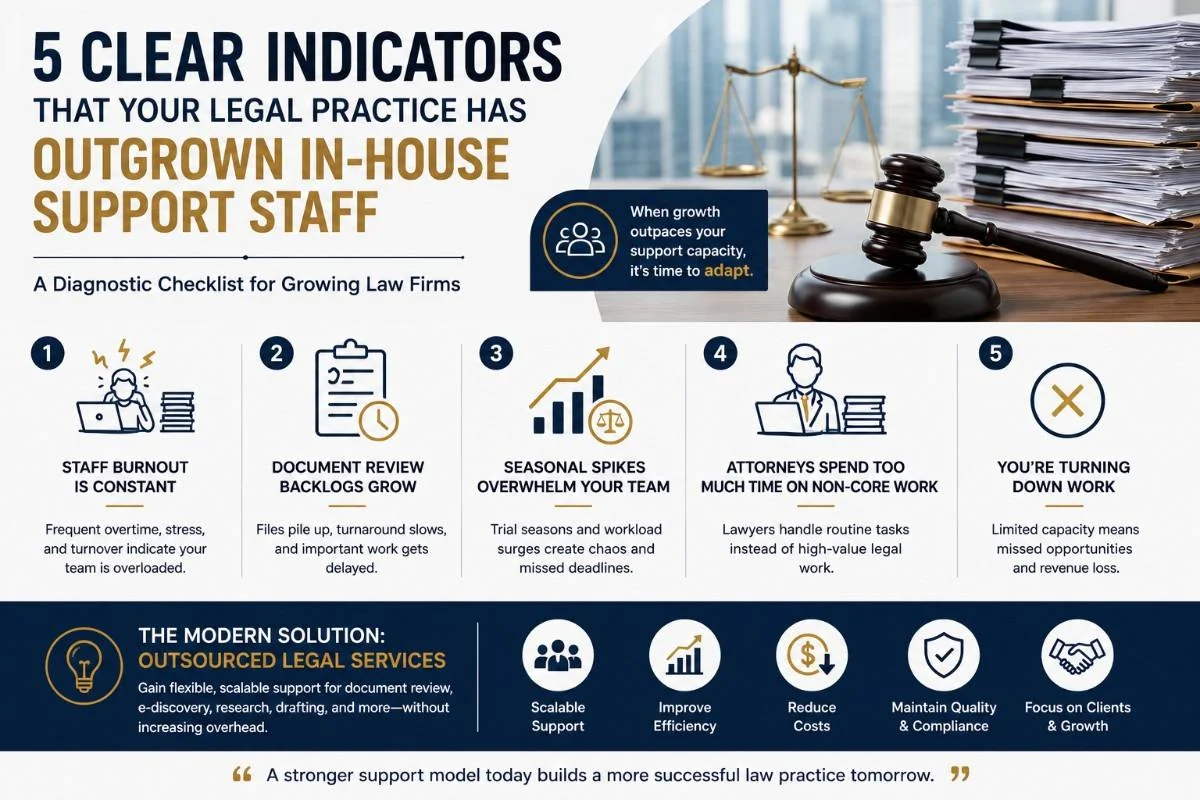
Here are five clear indicators that your practice may have outgrown its current in-house support capacity.
1. Your Support Team Is Constantly Experiencing Burnout
Every legal practice has busy periods.
A major case, transaction, regulatory deadline, or trial can temporarily increase pressure on the entire team. Occasional periods of intense work are normal.
The warning sign appears when extreme workloads become permanent.
If your support staff regularly work late, struggle to take time off, or constantly move from one urgent assignment to another, the problem may not be employee performance.
It may be a capacity problem.
Common signs include:
- Frequent overtime
- Increasing employee stress
- Missed internal deadlines
- Higher staff turnover
- Declining attention to detail
- Difficulty managing routine requests
- A growing number of urgent tasks
Burnout can eventually become expensive.
Replacing experienced legal support professionals requires recruitment, training, and time. New employees also need to understand internal systems, client requirements, and firm workflows.
Instead of continually pushing the existing team harder, firms may need to reconsider how work is distributed.
A growing workload often requires a more flexible operating structure rather than simply expecting the same number of people to do more work.
2. Document Review Backlogs Are Becoming Normal
Legal work depends heavily on documents.
Contracts, discovery materials, case files, compliance records, correspondence, research materials, and supporting evidence can quickly create significant volumes of information.
When document backlogs become routine, they can affect the entire practice.
Attorneys may wait longer for files to be organized. Client responses may slow down. Case preparation can become more difficult.
A temporary backlog is not necessarily a major concern.
However, recurring backlogs may indicate that internal capacity is no longer sufficient.
Ask yourself:
- Are documents regularly waiting to be reviewed or organized?
- Are attorneys spending time sorting information instead of practicing law?
- Are urgent assignments constantly disrupting routine workflows?
- Is the support team struggling to keep up with incoming files?
- Are turnaround times becoming longer?
If the answer to several of these questions is yes, your practice may need additional operational capacity.
The key issue is not simply the number of documents.
It is whether your existing structure can process them efficiently without creating bottlenecks elsewhere in the firm.
3. Seasonal Trial and Litigation Spikes Are Overwhelming Your Team
Legal workloads are rarely consistent throughout the year.
A firm may experience relatively stable activity for several months before suddenly entering an intense period of litigation, trial preparation, discovery, or transactional work.
These spikes create a difficult staffing challenge.
Hiring permanent employees to prepare for every possible busy period can significantly increase fixed costs.
However, maintaining a smaller team may leave the practice struggling when workloads suddenly increase.
This is one of the clearest signs that a traditional staffing structure may no longer be enough.
For example, a litigation practice may suddenly require additional capacity for:
- Document collection
- File organization
- Discovery preparation
- Research support
- Case documentation
- Trial preparation
- Administrative coordination
Once the case reaches a different stage, that additional workload may decrease again.
A flexible approach can help firms manage these fluctuations without permanently expanding internal headcount.
This is where outsourced legal services can provide a practical modern solution for selected process-driven and support activities.
The objective is not to replace the legal judgment of attorneys.
Instead, firms can explore additional execution capacity for appropriate tasks while maintaining professional oversight and control.
4. Attorneys Are Spending Too Much Time on Non-Core Work
One of the most expensive operational problems inside a growing legal practice is the misuse of highly skilled professional time.
Attorneys should primarily focus on work requiring legal judgment, strategic thinking, client advice, negotiation, and advocacy.
However, when support capacity becomes limited, lawyers often begin absorbing operational responsibilities.
This may include spending excessive time on:
- Organizing documents
- Reviewing routine information
- Formatting files
- Managing administrative workflows
- Tracking documents
- Conducting repetitive research
- Preparing basic supporting materials
These activities may be necessary, but they can reduce the time available for higher-value legal work.
This creates two separate problems.
First, attorneys become less productive because their time is divided across too many responsibilities.
Second, clients may experience slower service because experienced professionals are managing tasks that could potentially be handled through more efficient support processes.
A growing practice should regularly examine how attorneys spend their time.
If senior legal professionals are consistently acting as an extension of the administrative team, the current support structure may no longer match the firm's workload.
5. You Are Turning Down Work Because You Lack Capacity
Perhaps the clearest indicator that a legal practice has outgrown its internal support structure is lost opportunity.
A firm may have qualified attorneys and strong client demand but still hesitate to accept additional matters because the operational team cannot manage the workload.
This creates a frustrating situation.
The business has the expertise.
The market opportunity exists.
But internal capacity becomes the limiting factor.
Warning signs may include:
- Delaying new client onboarding
- Refusing additional matters
- Extending client turnaround times
- Limiting marketing because the team is already overloaded
- Avoiding larger cases due to operational concerns
- Struggling to scale after winning new business
At this stage, the issue is no longer simply an internal staffing problem.
It becomes a growth problem.
A legal practice should not consistently lose valuable opportunities because its operational structure cannot adapt.
The Modern Alternative: Building Flexible Support Capacity
Recognizing that your practice has outgrown its in-house support team does not automatically mean hiring a large number of permanent employees.
The modern legal environment provides additional options.
Many firms are building more flexible operating models that combine:
- Internal legal expertise
- Permanent core support teams
- Legal technology
- Automated workflows
- Specialized external support
This approach allows firms to maintain control over their most important legal functions while creating additional capacity when workloads increase.
The goal should always be proper resource allocation.
Complex legal decisions should remain with appropriately qualified professionals.
Strategic client relationships require direct attention.
However, repetitive and process-driven activities can often be managed through more scalable workflows.
A Diagnostic Checklist for Your Practice
Your legal practice may have outgrown its existing support structure if you regularly experience three or more of the following:
- Your support staff frequently work beyond normal capacity.
- Burnout and employee turnover are increasing.
- Document review backlogs continue to grow.
- Seasonal workload spikes create operational disruption.
- Attorneys regularly perform routine support tasks.
- Client turnaround times are getting longer.
- Important work is delayed because of capacity limitations.
- You are hesitant to accept new matters.
- Hiring permanent staff feels too expensive for temporary workload increases.
If several of these issues are present, it may be time to evaluate how your practice manages legal operations.
Growth Requires a Different Support Model
A legal practice does not necessarily fail because it lacks talented lawyers.
Sometimes, growth becomes difficult because the operational infrastructure supporting those lawyers has not evolved at the same pace.
The solution is not always bigger.
Often, the solution is smarter and more flexible.
By identifying repetitive workflows, reducing unnecessary bottlenecks, using technology effectively, and accessing scalable support when appropriate, firms can build an operating model that grows alongside the business.
The most successful legal practices will increasingly be those that understand when their internal teams have reached capacity—and take action before burnout, delays, and missed opportunities become permanent problems.
The right support structure does more than keep a legal practice running. It creates the capacity needed for the practice to grow.