Sign up with Google
 Sign in with Zoho

Introduction
A wardrobe back panel usually gives you a hint before it gives up. Maybe a corner has lifted a little, or a nail is sticking out and snagging your clothes. Most people shrug it off because the wardrobe still works fine. A few months later the gap is wider, the doors rub, and dust is blowing in from behind. If you have ever searched for a handyman near me because of this, you already know how annoying it gets. At Handyman Near Me, we repair loose back panels regularly, and the causes are fairly easy to spot once you know where to look. This blog explains why the panel comes away, what you can fix yourself, and when it’s time to ask for help.
What a Handyman Near Me Looks at First
The back panel is a thin board, usually hardboard, MDF or thin plywood, somewhere between 3 and 6 mm thick. It is nailed or stapled on, and sometimes it slides into a groove cut in the frame. People tend to think it only hides the wall. It does more than that. It keeps the wardrobe square, so the frame doesn’t lean sideways every time you pull a door open.
Before touching anything, we check three things. How far the panel has lifted and where. Whether the board has swollen or gone soft. Whether the frame itself has twisted. Those three answers usually tell us which repair the wardrobe needs.
Why the Panel Pulls Away
Damp and Humidity
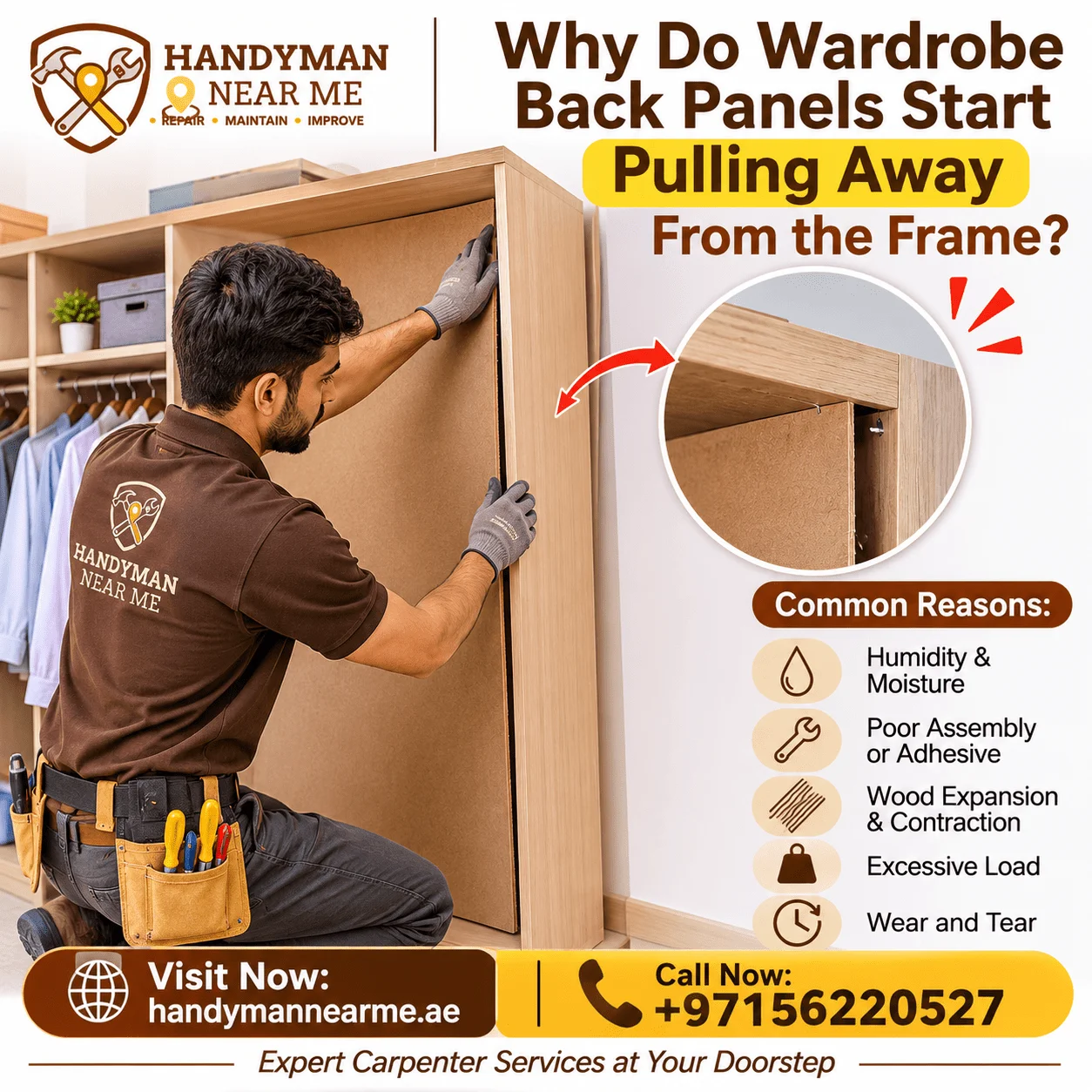
Damp is the number one reason. MDF and hardboard take in moisture from the air and swell. When the weather dries out, they shrink again. Do that for a few monsoons and the nails lose their hold on the board. A wardrobe pushed flat against an outside wall is the classic case, because the bottom of the panel stays damp and slowly lifts away. Walls shared with a bathroom cause the same thing.
Thin or Few Fixings
A lot of ready-made wardrobes are put together fast. The back usually has thin pins or staples placed far apart, and often no glue at all. Those held by friction and nothing else, so daily use loosens them. After a few years, the panel may be hanging on by a handful of nails.
Weight and Moving House
Blankets, suitcases and piles of books push outward on the back. Moving makes it worse. If the wardrobe gets dragged instead of lifted, the frame twists a little, and the thin panel is the first part to show it.
Uneven Floors and Walls
A floor that isn’t level leaves the wardrobe slightly twisted, and the back panel has to absorb that. A wall that bulges outward can also press on the panel and push it away from the frame.
Fixing It at Home
If the panel is dry and still in good shape, you can refix it yourself. Empty the wardrobe first. If there’s any damp, let it dry out completely before you do anything else. Then pull out the old nails and staples. Don’t hammer them back into the same holes, because they won’t hold a second time.
Spread wood glue along the groove or the rear edge and press the panel into place. Fix it with short screws, around 16 to 20 mm, and put a small washer under each one so the head doesn’t sink into the soft board. One screw every few inches is about right. Leave it overnight. For a long gap, a thin strip of wood along the edge gives the panel extra grip, and a few heavy books will hold things in place while the glue sets. Wipe off any glue that squeezes out before it dries.
When to Call a Carpenter Near Me
Some jobs go beyond a refix. If the panel feels soft, crumbles at the edges or has fine termite dust around it, it needs replacing. The same goes for a twisted frame or joints that have opened up, and built-in wardrobes fixed to the wall are better left to a woodworker too. For these, searching for a carpenter near me makes sense. The work needs accurate measuring and cutting, and most homes don’t have the tools for it.
How We Handle the Repair
When you book Handyman Near Me for this job, we check the panel, the frame and the wall behind it for damp. We remove the old fixings, glue the panel and screw it down. If the board is too far gone, we tell you straight away and explain the cost before starting. We’d rather do it once, properly, than leave you with a patch that fails in a few months.
Keeping It From Happening Again
A few habits go a long way. Leave a small gap between the wardrobe and the wall so air can move behind it. Keep moisture absorbers inside during humid months. Put heavier items on the lower shelves and spread the load out. Look at the back edges once a year, ideally before the rains begin.
If you’re buying a new wardrobe, ask for a thicker back panel and make sure it’s glued as well as screwed. It costs a little extra, but it saves you this repair later.
FAQs
1. Why is my wardrobe back panel coming off? Most often it’s moisture, weak nails or staples, or heavy items pushing against it. Usually it’s a mix of these.
2. Can I fix a loose wardrobe back panel myself? Yes, if the panel is dry and undamaged. Remove the old fixings, apply wood glue and fix it with short screws and washers.
3. Do damp walls affect wardrobe back panels? Yes. MDF and hardboard absorb moisture and swell, and that loosens the fixings over time.
4. When should I look for a carpenter near me instead of a handyman? Go for a carpenter if the panel is crumbling, the frame is twisted or the wardrobe is built into the wall.
5. How can I stop the back panel from separating again? Keep a small gap from the wall, control humidity, avoid overloading the shelves and check the fixings once a year.
Conclusion
A back panel that pulls away from the frame is usually down to damp, weak fixing or too much weight. The earlier you deal with it, the smaller the repair. If you’d rather not do it yourself, Handyman Near Me can come over, find the cause and fix the panel properly. Book a visit with us today and get your wardrobe sorted.