Sign up with Google
 Sign in with Zoho

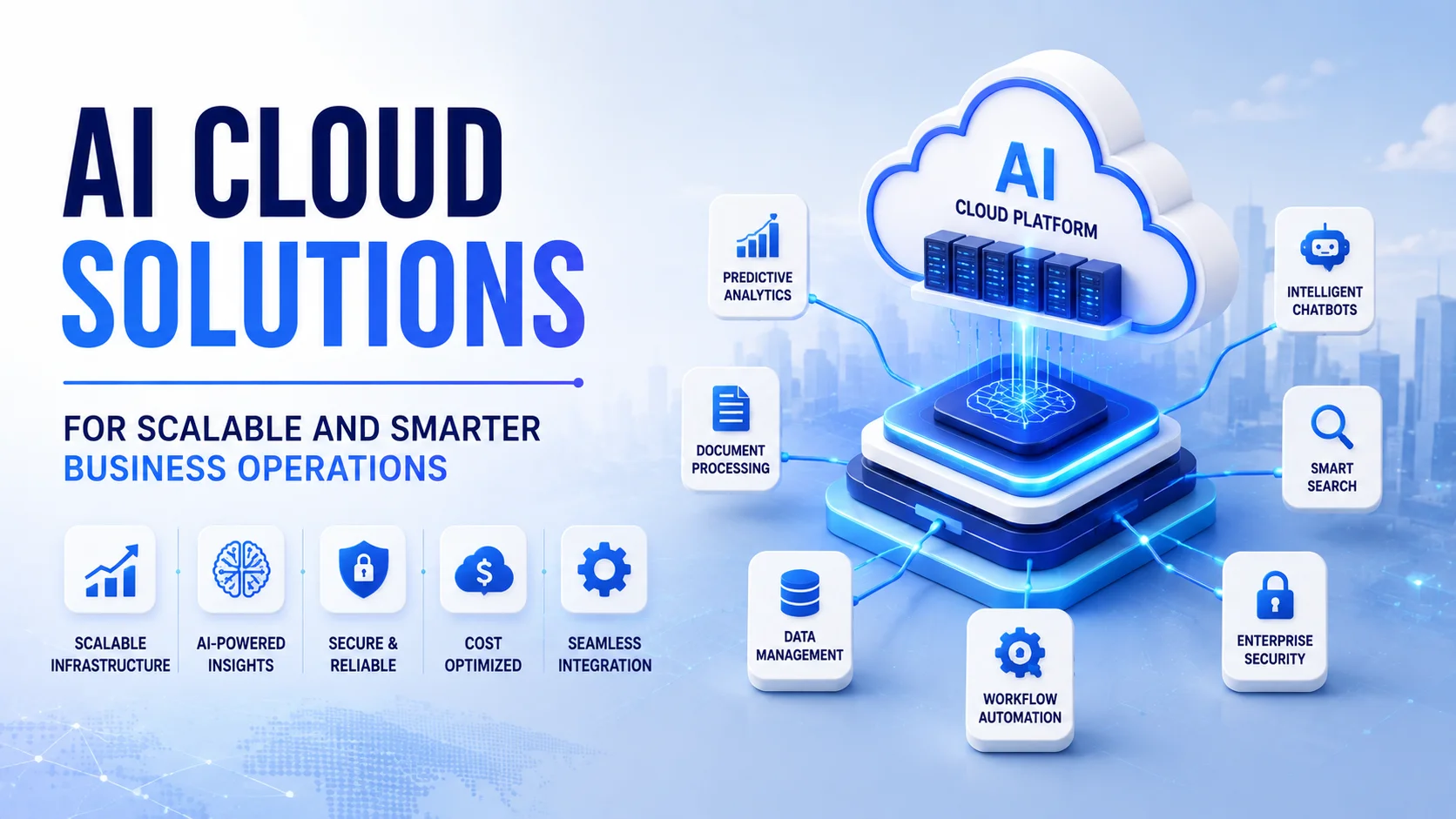
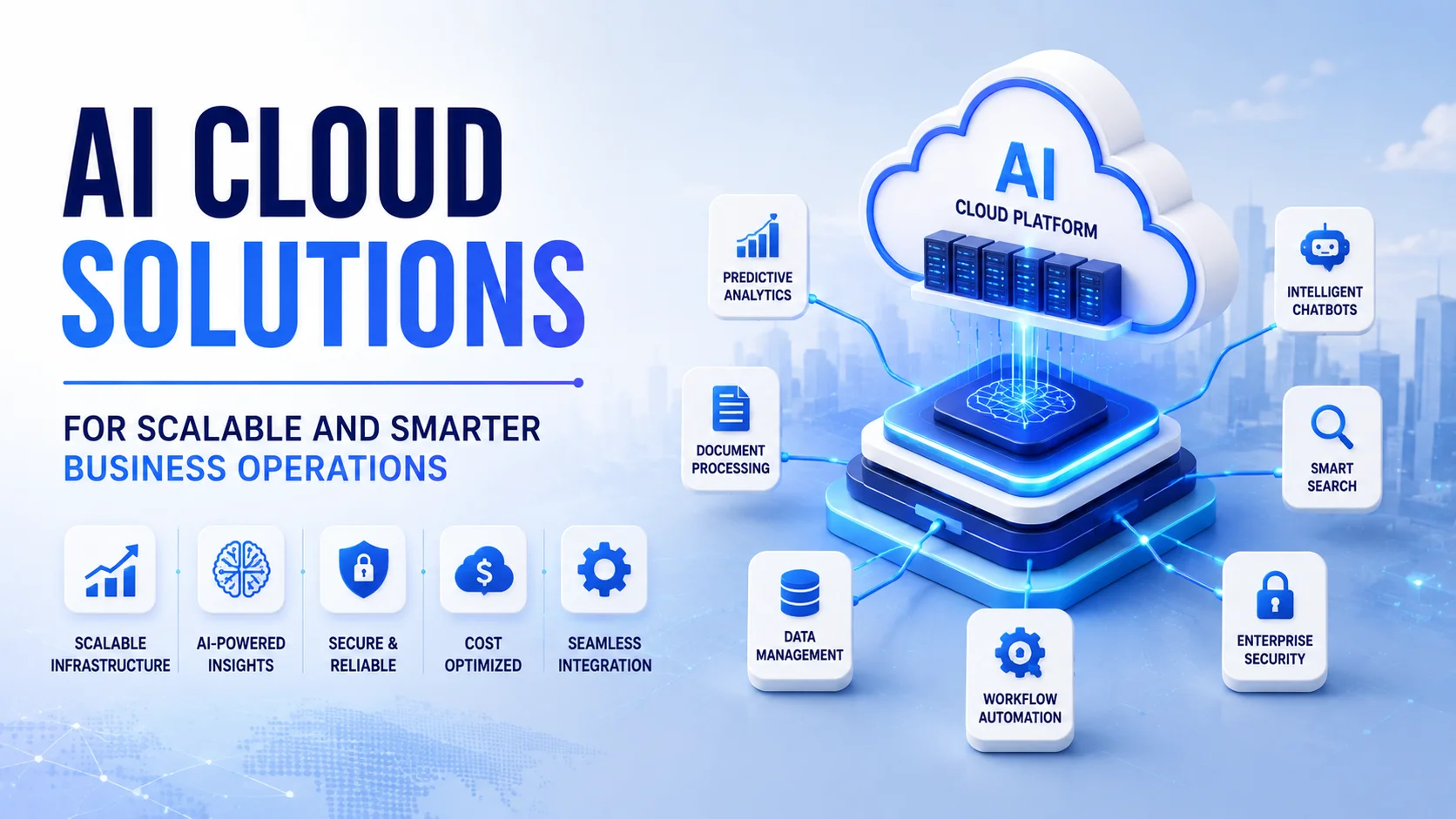
Companies are handling more information and digital tasks every year. AI cloud solutions offer a practical way to bring artificial intelligence into these everyday operations. Instead of maintaining all the required computing infrastructure, businesses can use cloud resources for AI workloads.
This approach can support many types of projects. A company might use AI to study customer behavior, forecast demand, process documents, or automate routine tasks. Another business may need a conversational system that works with its internal information.
The important part is choosing technology around an actual business need. Cloud adoption alone does not make an AI project useful. The model, data, infrastructure, and workflow all need to work together.
What Makes AI Cloud Solutions Different?
AI cloud solutions bring two areas of technology together. Artificial intelligence handles tasks that involve learning, prediction, language, or content generation. Cloud computing provides the environment where those tasks can run.
This setup gives businesses access to computing resources without purchasing every piece of hardware themselves. It can also make it easier to store and process information from different systems.
The architecture can look very different from one project to another. A small company may only need an AI API connected to an existing website. A larger organization may require private databases, custom models, multiple integrations, and monitoring tools.
There is no universal architecture for every AI project. The right setup depends on the data, workload, security requirements, and expected number of users.
Why Are Businesses Moving AI Workloads to the Cloud?
Running AI locally can require considerable computing capacity. This becomes more difficult when models need frequent updates or handle large amounts of information.
Cloud infrastructure offers another option. Businesses can access computing resources when they need them instead of maintaining everything internally.
This can be particularly useful for companies testing a new AI idea. They can begin with a limited workload and increase resources if the project proves useful.
Cost management still matters, though. A poorly planned cloud environment can become expensive as usage increases.
Businesses should monitor computing, storage, and model usage from the beginning. Choosing the right architecture can prevent unnecessary spending later.
How Do AI Cloud Solutions Work?
An AI cloud system usually connects several different components. Data enters the system from business applications or external sources.
That information is stored and prepared for processing. An AI model then analyzes the data and produces an output.
The output might be a prediction, recommendation, classification, or generated response. The application can display that result to a user or send it to another system.
For example, consider an online retailer with thousands of products. Sales information can move into a cloud environment for analysis.
A forecasting model can then estimate upcoming demand. The resulting forecast can reach the inventory team through an existing dashboard.
The process can be summarized as:
Business Data → Cloud Infrastructure → AI Processing → Result → Business Action
The individual components can change based on the project. Some systems need real-time processing, while others work with scheduled data.
Technologies Used in AI Cloud Solutions
Different AI technologies serve different business purposes. A project should use the technology that fits its particular problem.
Machine Learning
Machine learning is useful when software needs to identify patterns in data. It can support forecasting, classification, recommendations, and anomaly detection.
A retailer might use machine learning to estimate future product demand. A financial company could use it to identify unusual transaction behavior.
The model becomes more useful when it receives relevant and reliable information. Data preparation is therefore an important part of the development process.
Businesses requiring customized predictive models can consider Machine Learning Development Services for specialized requirements.
Generative AI
Generative AI has become useful for tasks involving text and other forms of content. It can create summaries, draft responses, analyze information, and assist employees.
A company could build an internal assistant around its own documents. Employees could then ask questions without manually searching through multiple files.
Generative AI also needs appropriate controls. The system should know which information it can access and how that information should be used.
Natural Language Processing
Natural Language Processing focuses on working with human language. It can process emails, reviews, documents, support tickets, and other text.
For example, a support system can classify incoming messages by topic. It can also identify customer sentiment or extract important details.
NLP becomes particularly useful when businesses deal with large volumes of unstructured text.
Computer Vision
Computer vision allows software to work with images and video. Manufacturing companies can use it for quality inspection.
Retailers can apply it to selected store operations. Logistics companies may use it to analyze packages or warehouse activity.
The computing requirements vary according to image quality and processing volume. Cloud infrastructure can provide additional capacity when required.
Where Can Businesses Use AI Cloud Solutions?
The technology has applications across many business functions. However, companies should focus on use cases where AI can provide measurable value.
Customer Service
Support departments often receive similar questions repeatedly. An AI system can classify those questions and provide relevant information.
It can also summarize previous conversations for support agents. This gives employees useful context before they respond.
A human agent can remain responsible for complex cases. This approach keeps automation from becoming the only part of customer support.
Sales and Marketing
Sales teams work with large amounts of customer information. AI can help identify patterns across leads, interactions, and previous purchases.
Marketing teams can also use AI for customer segmentation. Generative AI can assist with drafts, summaries, and content variations.
The final material can still go through human review. This is especially important for customer-facing communication.
Inventory Planning
Inventory decisions depend on several variables. These include sales history, product demand, supplier lead times, and seasonal changes.
AI can examine these factors and produce forecasts. Businesses can use those forecasts when planning purchases and stock levels.
This is one area where AI Inventory Management Software can connect predictive models with practical inventory workflows.
Document Management
Many organizations receive large numbers of invoices, forms, contracts, and reports. Reading every document manually takes considerable time.
AI can extract selected information from these files. The extracted data can then move into a database or business application.
This can reduce repetitive entry work. It can also make large document collections easier to search.
Fraud Monitoring
Financial businesses need to identify unusual activity quickly. Machine learning models can examine transaction patterns and highlight possible anomalies.
The system does not always need to make the final decision. A flagged transaction can move to an employee for further investigation.
This combination can be useful when automated analysis needs human judgment.
AI Cloud Solutions in Different Industries
Different industries have different reasons for adopting AI.
Fintech
Fintech companies can use AI for fraud monitoring and customer support. They can also apply it to document analysis and risk-related workflows.
These systems may handle sensitive financial information. Strong access controls and data protection are therefore important.
Healthcare
Healthcare organizations can use AI for administrative processes and information management. Document processing is one possible application.
AI can also support research and knowledge retrieval. Sensitive information needs careful handling throughout the system.
Ecommerce
Online stores can use AI to understand customer activity. Recommendations, demand forecasting, and review analysis are possible applications.
AI can also support shopping assistants. These systems can answer product questions using approved information.
Manufacturing
Manufacturers can use AI to examine production data. Predictive maintenance can help identify patterns linked with equipment problems.
Computer vision can also assist with quality checks. These applications can reduce some manual inspection work.
Logistics
Logistics businesses manage information from vehicles, warehouses, deliveries, and customers. AI can analyze this information for planning purposes.
Route analysis and demand forecasting are two possible examples. The usefulness depends on the quality and timeliness of the available data.
Benefits of Using AI in the Cloud
The combination of AI and cloud computing offers several practical advantages.
One advantage is flexibility. Businesses can adjust computing resources as their workloads change.
Another benefit is access to managed infrastructure. Development teams do not have to build every database, storage system, or monitoring component themselves.
Cloud systems can also support applications that grow over time. Additional resources can be added when usage increases.
Integration is another important factor. Cloud-based AI systems can connect with existing business software through APIs.
This means companies do not necessarily need to replace their current systems. AI can become another layer within an existing workflow.
What About AI Cloud Costs?
The cost depends heavily on the project. There is no standard price that applies to every AI cloud solution.
Model usage can affect monthly expenses. Data storage, computing resources, and API requests can also add to the bill.
A small AI feature may need limited resources. An enterprise system with thousands of users will have very different requirements.
Development costs are another consideration. Custom models, dashboards, integrations, security controls, and testing can increase the initial investment.
Businesses should define the required features before estimating costs. A clear scope makes financial planning more realistic.
AI Cloud vs On-Premises Deployment
Cloud deployment is not always the best choice. Some businesses may prefer to keep AI workloads on their own infrastructure.
On-premises systems provide greater control over hardware and data. They can be useful for organizations with strict internal requirements.
The downside is the responsibility for hardware and maintenance. Companies also need to manage upgrades and computing capacity themselves.
A hybrid approach offers another possibility. Sensitive workloads can remain within private infrastructure while other processes use cloud services.
The best option depends on the specific business situation. Security, cost, performance, and compliance should all be considered.
Security Considerations for AI Cloud Projects
Security needs to be considered before development begins. AI systems can process customer records, internal documents, financial information, and other sensitive data.
User permissions should control access to this information. Authentication can also help prevent unauthorized use.
Encryption can protect data during storage and transmission. Businesses should also understand how external AI providers handle submitted information.
Monitoring is equally important. Unusual access patterns or unexpected system behavior should be investigated.
Security is not something that should be added only after deployment. It should form part of the architecture from the start.
Challenges Businesses Should Expect
AI cloud projects can look simple from the outside. The actual implementation can involve several technical challenges.
Data quality is one common issue. Models cannot provide dependable results when the underlying information is incomplete or inconsistent.
Integration can create another challenge. Existing systems may use different data formats and authentication methods.
Cloud costs can also become difficult to predict. High usage or inefficient architecture can increase monthly expenses.
Model performance needs continuous attention as well. Business conditions can change, which may affect the usefulness of an existing model.
For these reasons, AI projects need ongoing monitoring rather than a one-time deployment.
How to Start an AI Cloud Project
The first step should be identifying a business problem. Avoid choosing a technology simply because it is popular.
Next, identify the data required to solve that problem. Check where the data exists and whether it is reliable enough for the intended use.
The next decision involves selecting an AI approach. An existing model may be sufficient for one project, while another may need custom machine learning.
Cloud infrastructure can then be selected according to the workload. Security and expected usage should be part of this decision.
After development, the solution should be tested using realistic scenarios. Performance should be measured against the original business objective.
Once deployed, the system should continue to be monitored. Usage patterns and business requirements can change over time.
Choosing an AI Cloud Development Partner
The development partner should understand both AI and cloud technology. Experience with integrations is also useful because AI rarely works in isolation.
Look at previous projects and the technologies used. Ask how the team approaches data security and model testing.
It is also worth discussing scalability before development begins. A system should be designed around expected growth.
Communication matters as well. The development team should be able to explain technical decisions in terms of business requirements.
Post-launch support should not be overlooked. AI systems may need adjustments as new data and requirements emerge.
Talentelgia Technologies and AI Cloud Development
Talentelgia Technologies works on AI and software development projects for different business requirements.
Its capabilities include AI development, machine learning, web development, mobile development, and software integration.
An AI cloud project can involve several connected components. These may include databases, APIs, dashboards, authentication, and cloud infrastructure.
The technical approach should depend on the business problem. Data requirements, security needs, and existing software also influence the architecture.
A focused implementation can provide a useful starting point. Additional features can be introduced after the initial system has been evaluated.
Final Thoughts
AI cloud solutions give businesses a flexible way to use artificial intelligence. They can support forecasting, automation, document processing, customer service, and data analysis.
Cloud infrastructure can make computing resources easier to access. It can also support applications as their workloads change.
Still, AI should not be added without a clear purpose. Businesses need to understand the problem before selecting models or infrastructure.
Cloud deployment also comes with its own considerations. Costs, security, data quality, and integrations all deserve attention.
Some organizations may find cloud deployment suitable. Others may benefit from on-premises or hybrid infrastructure.
The strongest starting point is usually a focused business use case. Once the results are measured, the solution can be expanded with greater confidence.
FAQs
1. What are AI cloud solutions?
AI cloud solutions combine artificial intelligence with cloud-based infrastructure. They can support prediction, automation, language processing, and data analysis.
2. Why do businesses use AI in the cloud?
Cloud infrastructure provides access to computing resources and managed services. It can also make scaling easier when workloads increase.
3. Can small businesses use AI cloud solutions?
Yes. A small company can begin with a focused AI use case. It can increase resources as the solution becomes more useful.
4. Are AI cloud solutions secure?
They can be secure when designed properly. Access controls, encryption, authentication, and monitoring all contribute to better protection.
5. Can AI connect with existing business software?
Yes. AI systems can connect with CRM, ERP, ecommerce, accounting, and support platforms through APIs and other integration methods.
6. Are cloud AI solutions better than on-premises systems?
Not necessarily. Each approach has different advantages. The decision should consider security, cost, performance, and compliance requirements.
7. What affects the cost of an AI cloud solution?
Model usage, computing resources, storage, integrations, security, and application complexity can all affect the cost.
8. Can generative AI run on cloud infrastructure?
Yes. Businesses can access generative AI through cloud APIs or deploy selected models within cloud environments.
9. How should a business begin an AI cloud project?
Start with a specific business problem and identify the required data. Then choose an appropriate AI approach and infrastructure based on that requirement.