Sign up with Google
 Sign in with Zoho

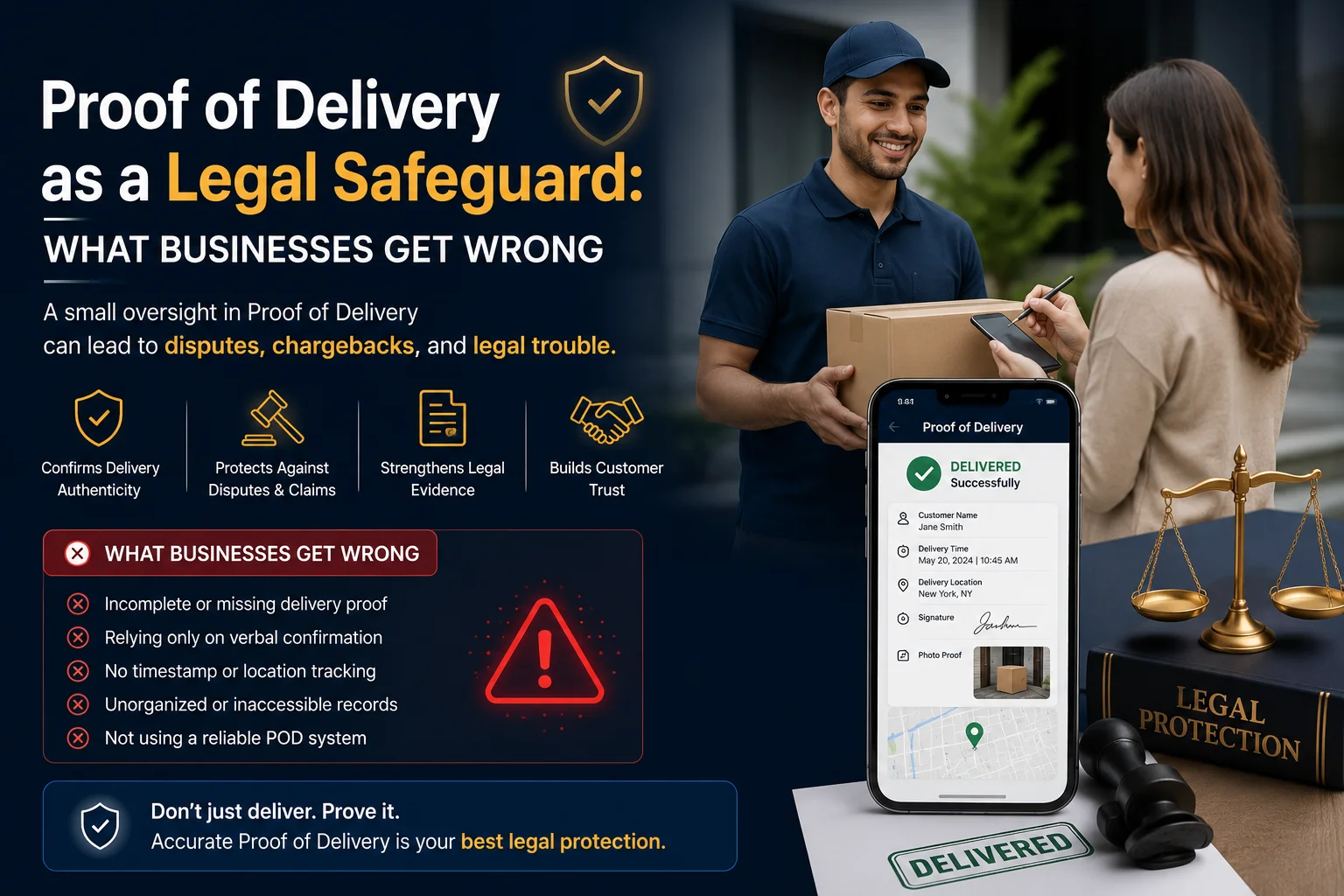
When a package arrives at the customer’s door, things seem to be going smoothly for businesses. But when it comes to delivery operations and logistics, a completed delivery is only as good as the evidence that a business has that the delivery actually occurred.
This evidence is referred to as proof of delivery (POD).
A signature, picture, OTP, GPS location, or timestamp may seem like a minor step in the delivery process, but having proper POD can protect businesses from customer disputes and serve as evidence that a company fulfilled its end of the bargain. At the same time, though, businesses get many things wrong when collecting and managing POD, which can cause problems during a customer dispute.
What Is Proof of Delivery?
Proof of delivery refers to documentation that shows that an item has been delivered to a specific person, location, or address.
Depending on the company and the delivery process, there are several types of POD, including
- customer signatures,
- photos,
- OTP,
- GPS coordinates,
- timestamps,
- recipient names,
and
- digital delivery notes.
Thanks to business delivery apps, companies can collect the information listed above and more when the delivery person completes the delivery directly from their device.
This way, an electronic proof of delivery will be generated, which should offer a good summary of the event. Below are some of the most common mistakes companies make when collecting POD.
Mistake #1: Believing the Only Necessary Information Is the Customer’s Signature
While a signature can be a good indicator that the delivery was completed, a customer’s signature can often say very little on its own. Sometimes it can be illegible or unclear, provide no information about the delivery, or not even identify the correct recipient. Besides, paper POD (proof of delivery) can be misplaced or even lost.
The digital equivalent, on the other hand, has much more information to it. A signature with a timestamp and GPS location, for instance, can give a good operational understanding of what happened. Instead of simply asking “did someone sign for the delivery?”, the business should ask “can we prove what happened during this delivery?”
Mistake #2: Relying Too Heavily on Paper-Based POD
Using paper-based proof of delivery can be fine so long as the company only makes a few deliveries. However, if there are a large number of deliveries to process, this method quickly becomes unwieldy.
Documents get misplaced, the handwriting is hard to read, and finding the correct delivery becomes significantly more challenging, especially if the business needs to look back on a delivery from months ago. A delivery tracking app for small business, on the other hand, can store digital copies of all the delivery information safely and, rather than searching through papers or disparate digital files, the manager can find the relevant delivery and information much faster.
Mistake #3: Not Paying Enough Attention to Timestamps
An incomplete record of a delivery might have a clear time that the delivery was made, but the information is rarely very useful. If a customer complains that the delivery was late and the business cannot clearly state when the delivery was completed, it creates an opening for customer service issues.
Besides, the timestamp can tell the business when exactly the customer received the delivery, as well as when they acknowledged it. While it may not be sufficient on its own, it can provide much-needed context when there is a dispute, which is why companies should always try to capture the time of delivery.
Mistake #4: Failing to Store the Delivery Address or Location
The delivery location is another piece of information that businesses fail to capture too often.
Thanks to GPS-enabled delivery systems, companies can use location data to provide more information about the delivery.
For example, if a customer accuses the business of not completing the delivery, the business has a digital record of the delivery note, photograph, and location/time of delivery.
Companies should also ensure that they abide by data privacy laws when capturing and storing the delivery address.
Mistake #5: Having Inadequate Training Procedures for Drivers
No matter how good the technology is, if the people operating it are not properly trained, it will not matter. The delivery drivers should be trained to know exactly when and how POD should be captured, and what to do if something goes wrong. For instance, if one driver does not take a photo while another takes a picture of the delivery note, the information will be inconsistent. Companies should have proper procedures that specify
- when the POD should be collected,
- which method to use,
- what should be in the photo,
- how failed deliveries should be documented,
and how they should handle situations when the customer is not available at the delivery address.
All of these things are much more important than they seem.
Mistake #6: Storing the Data Without a Clear Policy
Many companies forget that collecting the information is only half the battle. When the data needs to be stored, many organizations do not have the right procedures in place to ensure that the information is kept secure, backed up, and not deleted by accident. At the same time, different industries have different data retention laws and requirements, including tax, legal, and data privacy regulations. A good proof of delivery process should have a policy on what information needs to be collected, where it should be saved, who has access to it, how long it should be retained, and when it needs to be deleted.
When dealing with specific regulations, the company should always consult legal experts to determine what policies it needs to develop.
How a Delivery Tracking App Can Help
Technology can make managing and collecting POD much easier.
A delivery tracking app can be used to unify the order, delivery process, driver location, timestamps, customer alerts, and proof of delivery into one coherent system.
A delivery tracking app for small business can be especially useful, as it allows these businesses to handle a large volume of orders without having to spend much time processing each one individually. After all, instead of using several separate apps for messaging, order processing, delivery tracking, navigation, and paperwork, the business can streamline these processes into one.
This way, the company will always have an extensive yet organized delivery record that will help it during a customer dispute.
POD Is More Than Just a Delivery Receipt
The most common mistake businesses make is to believe that proof of delivery is only relevant when there is already a dispute. In truth, the best way to avoid customer service issues is to have a strict policy on collecting and managing POD. Besides, a good record of delivery and delivery tracking can greatly benefit the company by making the fulfillment process more transparent to both parties and serving as documentation of completed deliveries. If and when a customer dispute does arise, a company with extensive yet organized delivery records will find it much easier to determine what happened. Proof of delivery should be an essential part of the delivery process.
Final Thoughts
Fast delivery tends to be important, but so are reliable documentation practices. When it comes to customer satisfaction, companies should always be able to show what time and place the delivery was completed. By having clear procedures, training delivery drivers, developing data retention policies, and relying on the right tools, such as a delivery tracking app for small business, companies can manage their delivery documentation more efficiently.
While the proof of delivery will only take a second, it can save the business hours of aggravation when there is a dispute.