Sign up with Google
 Sign in with Zoho


Ask any small business owner what keeps them up at night, and you'll hear some version of the same complaints. Too much data. Not enough hours in the day. Decisions that can't wait until the Monday meeting. None of that's new. What's changed is how many of these headaches now get quietly handled by AI analytics, usually without anyone in the office even clocking that's what's going on. It's baked into the CRM, the ad dashboard, the inventory tool. Working in the background while someone grabs coffee.
You've probably noticed certain companies just seem to catch problems early. Or call a trend before it's obvious to everyone else. Nine times out of ten there's some flavor of AI analytics running behind the scenes making that possible.
Old-School Reports vs. What This Actually Does
Regular analytics looks backward, by design. You open last month's numbers, notice sales dipped in week three, and spend an hour trying to figure out why. Fine, but you're always reacting after the fact.
AI analytics does something different. It leans on machine learning and statistical modeling, not just to explain what already happened but to flag what's probably coming next and, in a lot of cases, suggest what to actually do about it. A job that used to mean someone hunched over spreadsheets for half a day now takes the system a few minutes. And honestly, it tends to catch things a tired human would just miss.
That's the real shift. From "here's what happened" to "here's what's likely to happen, and here's what we'd do." Small difference on paper. Big difference when you're the one making the call.
Way Too Much Data, Not Nearly Enough Clarity
Most companies aren't short on data anymore; if anything, they're drowning in it. CRMs, spreadsheets, ad platforms, support tickets, whatever. The hard part was never collecting the stuff. It's making sense of it fast enough to matter.
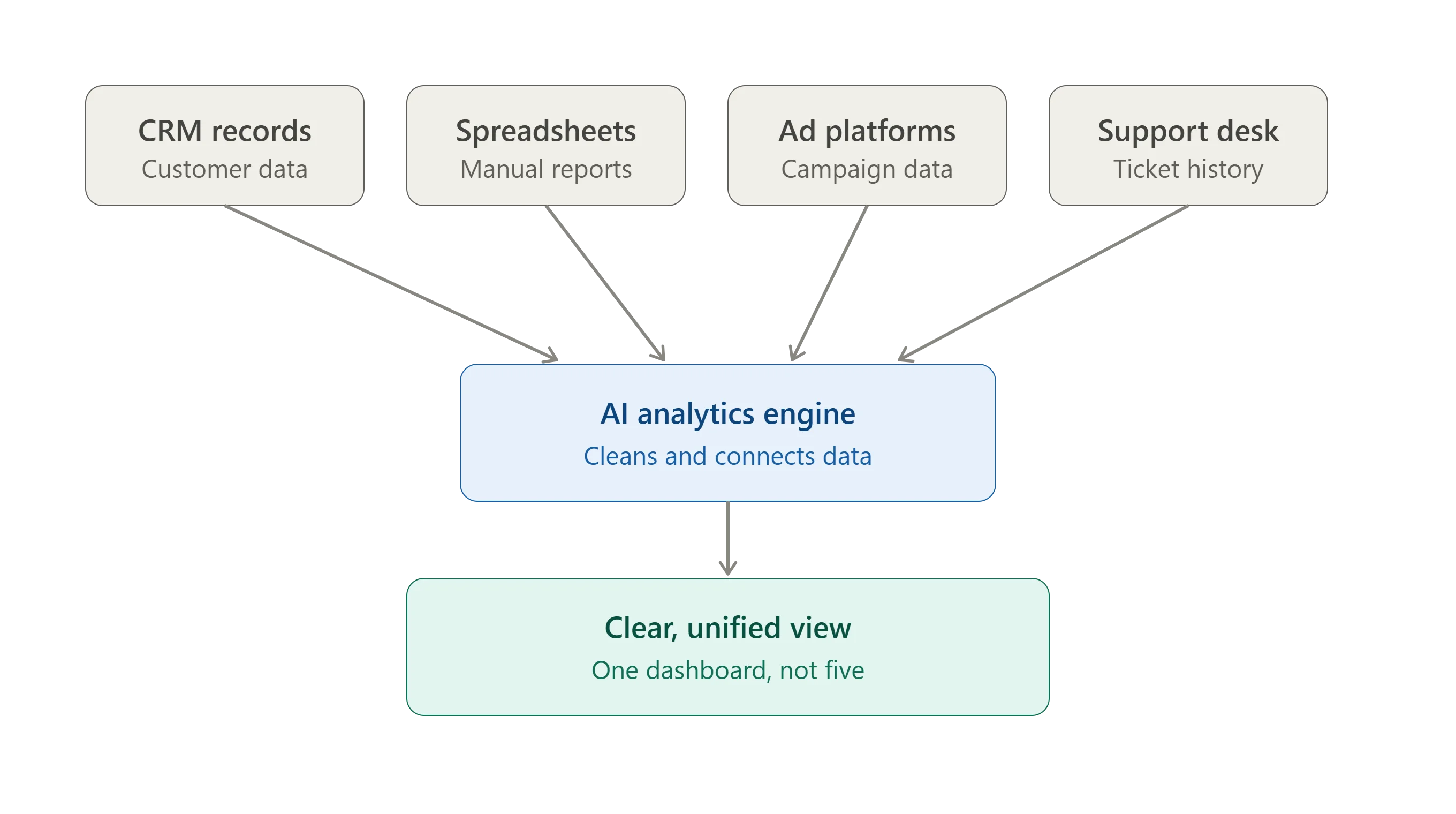
AI-driven platforms pull from all these sources, clean them up, and organize them without someone manually stitching five spreadsheets together at 9 pm. Work that took an analyst days now takes minutes, and there are fewer errors along the way since there's less copy-paste involved.
Decisions Made on Gut Feel Alone
A surprising number of business calls still get made on instinct, or on a report that's already a month stale by the time anyone reads it. In a market that moves fast, that's basically a bet. AI analytics trades some of that guesswork for actual forecasting.
Say a retailer needs to figure out how much stock to order for next month. A predictive model can weigh past sales, seasonal swings, even outside factors like weather, and land on a reasonable number. The payoff: fewer empty shelves, less cash tied up in stuff that won't sell, and honestly, a lot less stress around ordering day.
Customers Who Vanish Without Warning
Quiet churn is the worst kind. A customer just stops buying, or cancels outright, and by the time anyone notices, the moment to fix it has already passed.
AI analytics tends to catch the early signs first: fewer logins, slower replies, engagement quietly dropping off well before someone actually walks. That buys a business time to step in. Maybe a check-in call, a discount, better support. Something before the relationship's gone for good.
Operations Quietly Bleeding Time and Money
Bottlenecks show up everywhere. A factory floor, a delivery fleet, a support queue that's permanently backed up. AI analytics can watch these processes around the clock and spot inefficiencies a person might not clock for weeks.
A delivery company might use it to figure out which routes are chronically late, and why, then fix it before customers start complaining instead of scrambling after the fact.
Marketing Budgets Going Nowhere
Marketing teams often can't say with confidence which campaigns are actually working versus which ones just look decent on a slide deck. AI analytics breaks performance down by channel in something close to real time, so it's obvious where the money's paying off and where it's just evaporating.
That kind of visibility lets a marketing lead shift spend toward what's actually converting, instead of repeating whatever worked last quarter purely out of habit.
Not Just for Big Companies Anymore
There's still this idea floating around that AI analytics is reserved for big enterprises with deep pockets and a whole data science team on payroll. Not really true anymore. Plenty of affordable, easy tools now hand smaller businesses the same capabilities, letting them make faster, better calls without hiring a whole analytics department to do it.
The Bottom Line
AI analytics doesn't replace judgment. It just hands people better information to work with, if they actually use it. Whether that's cutting through data clutter, catching churn before it happens, or tightening up daily operations, it chips away at the small, everyday friction that quietly costs businesses time and money — the kind nobody notices until it adds up.
Companies that build this into how they operate aren't just chasing a trend. They're building a habit of deciding things based on evidence instead of assumptions. Over time, that habit tends to show up right where it counts — the bottom line.
Read also: The Biggest AI Adoption Challenges in Public Sector Organizations