Sign up with Google
 Sign in with Zoho

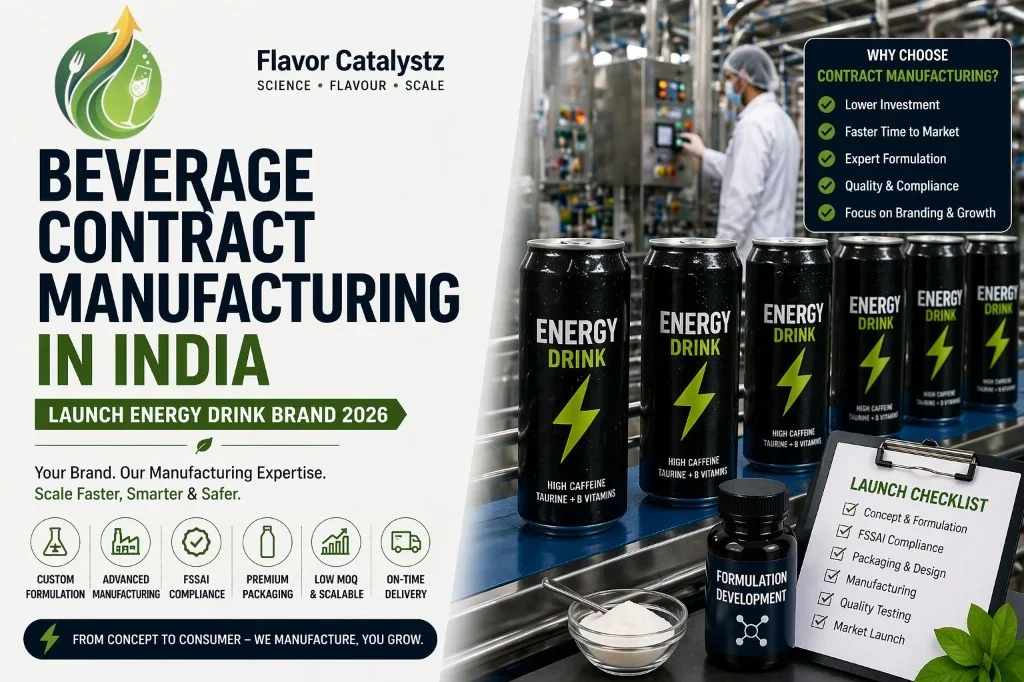
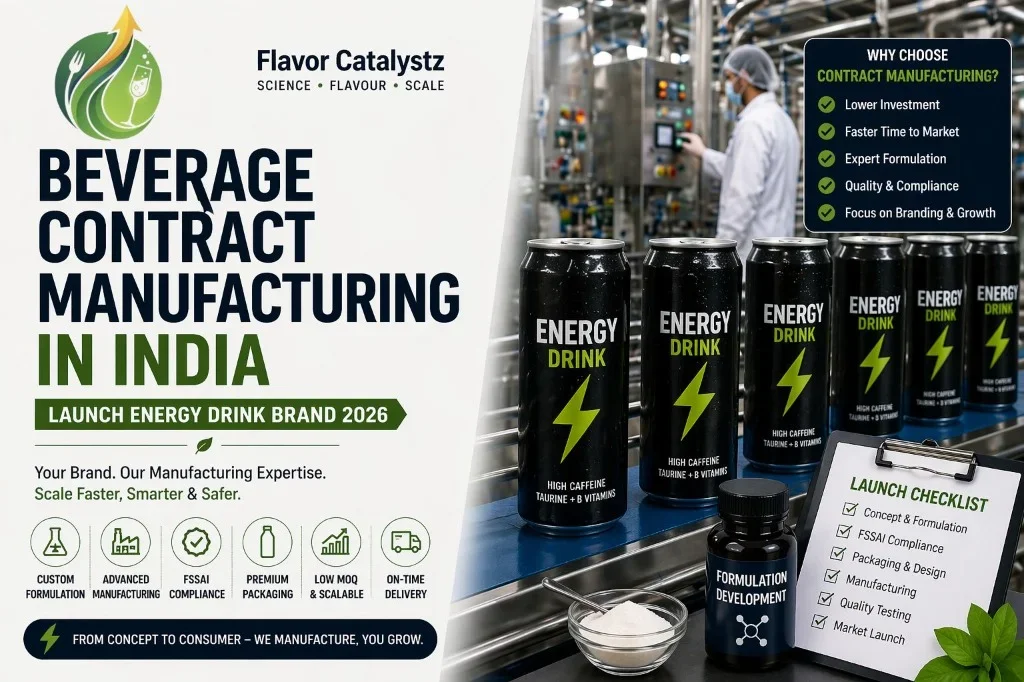
Launching an energy drink brand in India can be a promising business opportunity, but turning an idea into a successful product requires proper planning, product development, manufacturing support, and quality control. Entrepreneurs entering the beverage industry need to understand how products are formulated, manufactured, packaged, and distributed before investing in large-scale production.
Flavor Catalystz helps food and beverage businesses transform product ideas into commercially viable products through beverage formulation, product development, technical guidance, and manufacturing support. With the right development strategy, startups can build an energy drink that meets consumer expectations and is ready for the Indian market.
This guide explains how beverage contract manufacturing works, what is required to launch an energy drink brand in 2026, and how businesses can manage product development and production costs.
What Is Beverage Contract Manufacturing?
Beverage contract manufacturing is a business arrangement in which a brand hires an external manufacturing facility to produce beverages under its own brand name. Instead of investing in a factory, machinery, and production infrastructure, businesses work with an established manufacturer.
This approach is useful for startups that want to enter the beverage market without handling every manufacturing activity themselves.
A contract manufacturer may provide services such as:
- Beverage formulation and recipe development
- Ingredient sourcing and procurement
- Pilot batch production
- Commercial-scale manufacturing
- Filling and packaging
- Quality testing and inspection
- Batch documentation and production support
For new entrepreneurs, beverage contract manufacturing India offers a practical route to developing and launching products while reducing the initial investment in manufacturing infrastructure.
Why Start an Energy Drink Brand in India in 2026?
Energy drinks have become a recognised category in the Indian beverage market. Consumers are exploring different beverage options for convenience, taste, lifestyle preferences, and specific functional benefits.
The category also offers opportunities for brands to develop products for different consumer segments.
Growing Consumer Interest
Urban consumers, young professionals, fitness enthusiasts, and active individuals are exploring new beverage choices. This creates opportunities for brands with distinctive flavours, suitable positioning, and consistent product quality.
Opportunities for Product Differentiation
A new energy drink brand does not have to compete only on price. Businesses can differentiate their products through:
- Unique flavour combinations
- Different sweetness levels
- Sugar-free or reduced-sugar options
- Carbonated and non-carbonated formats
- Convenient packaging
- Clear product positioning
Lower Infrastructure Investment
Setting up a beverage manufacturing facility requires significant capital. Contract manufacturing allows entrepreneurs to use existing production infrastructure instead of building their own facility.
How to Launch an Energy Drink Brand Through Contract Manufacturing
Launching a beverage business involves several stages. Each stage should be completed carefully to avoid unnecessary expenses and production delays.
1. Identify Your Target Market
Before developing the product, understand who will purchase it.
Your target audience will influence the formulation, packaging, pricing, and marketing strategy.
For example:
- Young adults looking for convenient energy beverages
- Working professionals seeking ready-to-drink options
- Fitness-focused consumers
- Consumers interested in sugar-free beverages
- Retail customers looking for new flavour experiences
Research customer preferences, purchasing habits, competing product categories, and expected price points.
2. Select Your Energy Drink Concept
The next step is deciding what type of energy drink you want to introduce.
A clear product concept makes formulation and manufacturing decisions easier.
Popular Energy Drink Formats
- Carbonated energy drinks
- Non-carbonated energy beverages
- Sugar-free energy drinks
- Low-calorie energy beverages
- Functional energy drink concepts
Your formulation must comply with the applicable Indian food safety and product category requirements. Ingredients and claims should be evaluated before finalising the concept.
3. Develop the Beverage Formula
Product formulation is one of the most important stages of launching an energy drink.
The formula determines the beverage's taste, appearance, stability, ingredient composition, and overall consumer experience.
Important Ingredients
Depending on the permitted product category and formulation, an energy drink may involve:
- Water as the primary base
- Sweeteners or sugar
- Acidity regulators
- Approved flavours
- Permitted caffeine sources, where applicable
- Permitted vitamins and other functional ingredients
- Stabilising ingredients, where technically required
- Carbon dioxide for carbonated products
Why Flavour Development Matters
Consumers often judge a beverage by its first taste. A product may have an interesting concept, but an unpleasant aftertaste or excessive sweetness can affect repeat purchases.
Flavour development should consider sweetness, acidity, aroma, carbonation, mouthfeel, and aftertaste.
A properly developed formula should also be tested for stability under expected storage conditions.
4. Find the Right Contract Manufacturer
Choosing the right production partner is essential for maintaining product quality and meeting business requirements.
Not every manufacturer offers the same equipment, production capacity, packaging options, or technical capabilities.
Before selecting a facility, evaluate:
- Relevant food manufacturing licences
- Experience with your beverage category
- Production capacity
- Minimum order quantity (MOQ)
- Available packaging formats
- Quality control procedures
- Ingredient handling practices
- Batch traceability
- Storage and dispatch arrangements
Request information about production capabilities and discuss your formulation requirements before making a commercial commitment.
5. Finalise Packaging and Branding
Packaging influences how customers recognise and purchase your energy drink.
Your packaging should communicate the product's identity while protecting the beverage during transportation and storage.
Common Packaging Options
- Aluminium cans
- PET bottles
- Glass bottles
- Other suitable food-grade beverage containers
The right option depends on the formulation, processing method, shelf-life requirements, distribution conditions, and target price.
Ensure that labels include all applicable declarations required under Indian food safety and packaging regulations.
6. Conduct Product Testing and Quality Checks
Before commercial production, the formula must undergo appropriate testing.
Important quality parameters may include:
- pH level
- Total soluble solids (Brix)
- Microbiological quality
- Colour and flavour consistency
- Ingredient compatibility
- Packaging compatibility
- Shelf-life stability
Testing should be designed according to the beverage's formulation and processing requirements.
A manufacturer should also maintain proper batch records and quality documentation.
7. Complete Regulatory Requirements
Food businesses in India must comply with applicable food safety regulations.
Before launching an energy drink, businesses should understand the relevant requirements under FSSAI regulations.
Important areas include:
- Appropriate FSSAI licence or registration
- Permitted ingredients and additives
- Product category classification
- Ingredient declarations
- Nutritional information
- Allergen declarations, where applicable
- Labelling and packaging requirements
- Advertising and product claims
Energy drinks require particular attention to ingredient permissions, caffeine limits where applicable, warning statements, and category-specific standards.
Do not assume that an ingredient permitted in one beverage category is automatically permitted in another. Regulatory review should be completed before commercial production.
Estimated Cost of Energy Drink Contract Manufacturing in India
The cost of launching an energy drink brand depends on the product formula, ingredients, packaging, manufacturing quantity, testing, and logistics.
There is no single manufacturing price that applies to every beverage.
Factors That Influence Manufacturing Cost
1. Ingredients: Specialised flavours, permitted functional ingredients, sweeteners, and other formulation components can change the cost per unit.
2. Packaging: Aluminium cans, PET bottles, labels, closures, and printed packaging have different cost structures.
3. Production Volume: Larger production batches may reduce the manufacturing cost per unit, depending on the facility and production requirements.
4. Formulation Complexity: Products requiring additional processing, stabilisation, or specialised ingredients may need more development work.
5. Testing and Compliance: Laboratory testing, shelf-life studies, documentation, and regulatory checks should be included in the project budget.
Estimated Budget Planning Table
These are budget categories, not fixed market quotations. Obtain individual quotations based on your product specifications and order quantity.
Popular Beverage Manufacturing Options for Startups
Choosing a suitable beverage format helps businesses plan production and target the right consumer segment.
The following table highlights product opportunities that entrepreneurs can explore in 2026.
The best opportunity depends on consumer demand, product differentiation, manufacturing feasibility, and the brand's financial resources.
Understanding MOQ in Beverage Contract Manufacturing
MOQ stands for Minimum Order Quantity. It refers to the minimum number of units a manufacturer agrees to produce in one manufacturing order.
For startups, MOQ is an important factor because it directly affects the initial investment and inventory planning.
What Determines the MOQ?
- Manufacturing equipment
- Packaging material availability
- Ingredient procurement requirements
- Production line capacity
- Batch size
- Product processing requirements
How Can Startups Manage MOQ?
Start with a realistic sales forecast rather than ordering large quantities without market validation.
Consider these steps:
- Finalise the product concept.
- Develop and approve the formula.
- Request a pilot batch, where available.
- Discuss packaging and production requirements.
- Compare quotations from suitable manufacturers.
- Estimate storage and distribution expenses.
- Plan inventory according to expected demand.
A lower MOQ can be helpful during the initial launch, but the manufacturer must still be capable of producing a consistent and compliant product.
Benefits of Working With a Beverage Contract Manufacturer
Contract manufacturing offers several advantages for emerging beverage brands.
Reduced Capital Investment
Businesses do not need to purchase expensive production machinery or establish a complete manufacturing facility.
Access to Manufacturing Expertise
An experienced manufacturing partner can provide production knowledge, equipment, and operational support.
Faster Product Development
Working with an established facility can simplify the transition from approved formulation to commercial production.
Easier Business Expansion
Once a product gains market acceptance, businesses can discuss higher production volumes and additional product variants.
Better Focus on Brand Development
Entrepreneurs can concentrate on sales, distribution, marketing, and customer relationships instead of managing daily factory operations.
Common Mistakes to Avoid When Launching an Energy Drink Brand
A promising beverage idea can face difficulties when important development decisions are overlooked.
Avoid these common mistakes:
1. Ignoring Market Research: Developing a product without understanding customer preferences can lead to weak demand.
2. Selecting Ingredients Without Regulatory Review: Every ingredient must be appropriate for the intended product category and comply with applicable regulations.
3. Focusing Only on Low Manufacturing Cost: A low quotation does not guarantee good product quality or reliable production.
4. Skipping Shelf-Life Testing: A beverage must maintain its required quality and safety throughout its declared shelf life.
5. Ordering Excessive Inventory: Large initial orders can create storage, cash-flow, and expiry-related challenges.
6. Ignoring Packaging Compatibility: Packaging must be suitable for the beverage formula and selected processing conditions.
How Flavor Catalystz Can Support Beverage Product Development
Developing a commercial beverage requires more than combining ingredients. It involves technical formulation, flavour selection, product testing, regulatory considerations, and manufacturing planning.
Flavor Catalystz supports businesses looking to develop new beverage concepts and prepare them for commercial opportunities.
Its beverage development support can include:
- Beverage concept development
- Energy drink recipe formulation
- Flavour development and optimisation
- Ingredient selection guidance
- Prototype development
- Product improvement
- Manufacturing planning support
- Technical and regulatory guidance
For startups, having a structured development process can help reduce avoidable formulation mistakes and improve product readiness before commercial manufacturing.
Final Thought
Launching an energy drink brand in India requires a combination of market understanding, the right formulation, reliable manufacturing, and proper regulatory planning. Businesses should focus on creating a beverage that delivers consistent quality, appealing flavour, and a clear market identity.
Choosing the right beverage contract manufacturing India partner can make the journey from product concept to commercial launch more organised and manageable. With product development and formulation support from Flavor Catalystz, entrepreneurs can take a more structured approach to building their beverage brands and exploring opportunities in India's growing beverage industry.
Frequently Asked Questions
1. What is beverage contract manufacturing in India?
Beverage contract manufacturing is a process in which a business hires an external manufacturing facility to produce beverages under its own brand name. It allows startups to launch products without establishing their own factory.
2. How much does it cost to launch an energy drink brand in India?
The total investment depends on formulation, ingredients, packaging, testing, manufacturing quantity, marketing, and distribution. Businesses should request quotations based on their actual product specifications.
3. Can startups launch an energy drink without owning a factory?
Yes. Startups can work with suitable third-party manufacturers that have the required infrastructure, capabilities, and applicable licences.
4. What is the MOQ for energy drink manufacturing?
MOQ varies by manufacturer, production equipment, packaging format, and ingredient requirements. It is important to discuss minimum production quantities before finalising a manufacturing partner.
5. Which licences are required to sell energy drinks in India?
Businesses must meet applicable FSSAI registration or licensing requirements. The exact requirements depend on the business activity, product classification, manufacturing arrangement, and applicable regulations.
6. How long does it take to develop an energy drink?
The timeline depends on formulation complexity, ingredient sourcing, sample approvals, testing, packaging development, and regulatory review. A simple project may progress faster than a specialised formulation requiring multiple trials.
7. Can I manufacture sugar-free energy drinks?
Yes, sugar-free concepts may be developed using permitted sweeteners, subject to applicable product standards, ingredient permissions, and labelling requirements.
8. How do I select the right beverage contract manufacturer?
Evaluate manufacturing experience, licences, production capacity, MOQ, quality systems, packaging options, testing facilities, and commercial terms before making a decision.





.webp)