Sign up with Google
 Sign in with Zoho

Walk into any electronics store this season and you will see small coin-shaped Bluetooth tags marketed for "keys, bags, pets and kids". They are cheap, they need no SIM, and the battery lasts for months. It is easy to see why so many parents slip one into a school bag and call it a day.
But a tag designed to find lost luggage and a device designed to keep a child safe are solving very different problems. Before you choose, it is worth understanding how each one works and where each one fails.
How Bluetooth tags locate things
A Bluetooth tag has no GPS and no mobile connection of its own. It sends out a short-range signal. When a compatible phone passes nearby, that phone quietly reports the tag's approximate position to the network, and you see it on a map.
In a crowded city this can work surprisingly well for a lost wallet. The catch is that the location is only as fresh as the last phone that walked past. In a quiet lane, a park in the early morning or a moving car, updates can be delayed or simply stop. Many tags also include anti-stalking alerts that notify nearby phones when an unknown tag is travelling with them, which is great for adult safety but confusing when the "unknown tag" is in your child's bag.
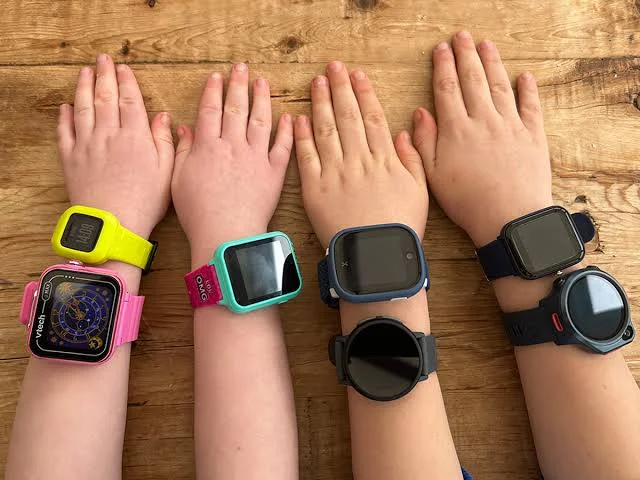
How a child's watch with tracker works
A tracking watch carries its own SIM and its own satellite positioning. Rather than waiting for strangers' phones, it works out where it is using satellite systems, Wi-Fi and mobile towers, and sends that position directly to the parent app over 4G.
Better watches go further. Some combine several satellite constellations, such as GPS, GLONASS, Galileo, BeiDou and QZSS, which helps in crowded markets and between tall buildings where a single system struggles. Some keep a location history, so you can see the route your child took home and how long they stayed at each place.
Side-by-side: what really matters to parents
Location freshness. Tags rely on passers-by; tracking watches report on their own. For a child, minutes matter.
Two-way contact. A tag cannot ring you. A watch lets your child call you, and lets you call or video call them to see their surroundings.
Where it is carried. Tags live in bags, and bags get left in classrooms, buses and friends' homes. A watch stays on the wrist.
Alerts. Watches can notify you when your child arrives at or leaves a familiar place. Tags generally cannot.
Running cost. Tags have no monthly plan. Watches need a SIM with a small data allowance, typically around 1 GB a month for normal use.
Battery. Tags last months; watches usually need charging every day or two. That daily charge is the price of real-time capability.
So is a Bluetooth tag useless for families?
Not at all. Tags are genuinely handy for school bags, lunch boxes, cycle keys and the water bottle that keeps disappearing. Think of them as a lost-and-found tool. They are just not a safety tool for a person, and responsible tag makers say as much in their own guidance.
Questions to ask before buying a tracking watch
- How many satellite systems does it use, and does it perform in crowded areas?
- Can you view location history, and for how many days?
- Does it support 4G calling and video calling over VoLTE on Indian networks?
- Can you limit calls to approved contacts and block unknown numbers?
- Is the data between watch, cloud and parent app encrypted?
- Is the parent app free, or does it require a subscription?
The bottom line
If your aim is to stop losing school bags, buy a tag. If your aim is to know where your child is and be able to reach them, you need a watch built for that job.
Companies that focus only on children's wearables have spent years refining exactly these features. imoo, for instance, designs its watch phones around location accuracy, approved-contact calling and a free parent app. Its Z7 is a good illustration of a child's watch with tracker done properly: five satellite navigation systems, a 14-day location history, front-and-rear camera video calls and stranger-call blocking, all without an open browser or social media.
Use a tag for things. Use a tracking watch for your child. Most families will find a place for both.