Sign up with Google
 Sign in with Zoho

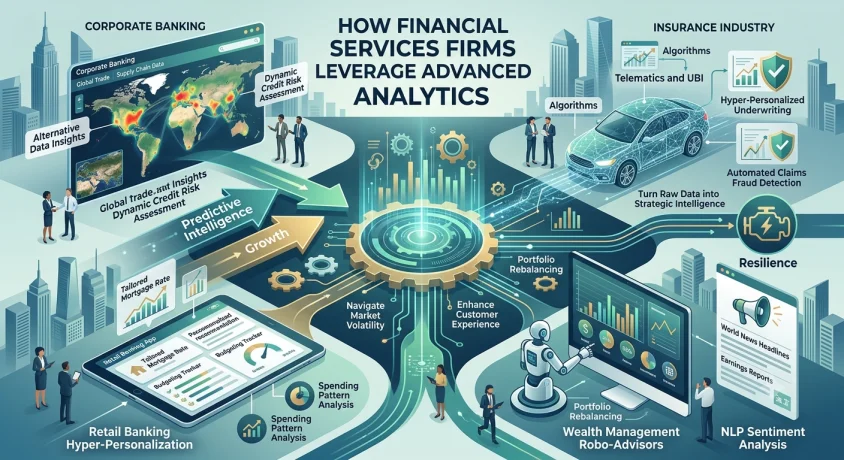
Global financial services must process vast amounts of information. They must efficiently turn raw data into strategic intelligence to compete. Failing to do so will mean missing competitive advantages. Thus, advanced analytics matters. In fact, today, even the legacy banks are teaming up with agile fintech startups. They both now rely heavily on machine learning for predictive insights and risk mitigation. This post will discuss how financial services tap into advanced analytics for resilience and business growth.
The Transformation of Corporate Banking
Let us first look at corporate finance. Historically, corporate banking was mostly relationship-driven. Therefore, multiple manual processes and legacy IT systems were not necessarily disadvantageous immediately. Besides, executive intuition had a greater role to play.
Today, that will not be enough. Global interconnected markets have increased the complexity of financial analysis and decision-making. Moreover, corporate clients have intricate and fast-paced needs. Considering all these factors, a sophisticated approach is of utmost significance.
This is where corporate banking analytics becomes a massive enabler of data-driven changes. Corporate banks now embrace advanced data science as well. As a result, they get a real-time view of their clients.
For instance, they can assess financial health, operational risks, and future capital requirements. Similarly, credit risk assessment is a key area where advanced corporate banking analytics shines the brightest.
The Increased Availability of and Preference for Alternative Data
Banks enhance the insights from historical financial statements with more contextual and current predictive models powered by alternative data sources. Think of real-time alerts about global supply chain disruptions via satellite imagery and heatmap visualization. New technologies also offer additional decision-making support through the pattern discovery concerning macroeconomic indicators and geopolitical shifts.
That multi-faceted approach is popular because it facilitates dynamic evaluations vital for creditworthiness. Therefore, banks can offer tailored corporate lending solutions. They simultaneously decrease default rates while protecting their balance sheets, which gets easier.
Furthermore, analytics optimizes liquidity management and makes it seamless to ascertain pricing strategies. Banks analyze vast datasets of transaction patterns and cash flow cycles. They also have better tools that monitor market volatility. These improvements allow banks to provide proactive treasury management guidance.
Clients can hence optimize how they allocate their working capital across various investment opportunities. In a nutshell, advanced analytics transforms banks and similar institutions offering financial services in a way that empowers them to deliver greater value.
How Advanced Analytics Supports the Insurance Industry
The insurance sector is changing because underwriting no longer relies heavily on static actuarial tables. The issue about risk projections and premium determination not being realistic enough had a lot to do with the broad demographic averages. In simpler terms, this traditional approach resulted in generic pricing models. Consequently, low-risk individuals paid more. It could not capture all the nuances of modern risks.
For instance, dynamic pricing is the standard. Consider the auto insurance market. Telematics devices and smartphone apps help monitor driving behavior in real time. Thus, insurers can analyze granular data points. They look at braking severity and acceleration patterns to log cornering speeds and driving times. Thus, insurers can objectively offer highly modified usage-based insurance (UBI) policies. These policies will fit the exact risk profile of the driver.
Enhancing Claims Settlement and Insurance Fraud Prevention
Analytics is modernizing claims management. For instance, machine learning algorithms automatically estimate incoming claims. They also identify straightforward, low-risk cases. So, these cases can receive immediate automated payouts.
Additionally, the algorithms flag suspicious or complex claims for human review. This significantly reduces processing times and operational costs. Given the better and more precise claims verification and settlement experiences, the customer experience becomes less stressful.
The role of advanced analytics in fraud detection involves uncovering hidden relationships. They can now find links between claimants and medical providers. Going even further, they spot connections among legal representatives and auto repair shops.
In these ways, insurers can identify organized fraud rings and alert the authorities. Traditional systems could miss such cases. When insurers reduce fraudulent payouts and protect their profit margins, they can offer competitive premiums to honest policyholders.
Hyper-Personalization in Wealth Management and Retail Banking
Wealth management and retail banking stand to gain a lot from advanced analytics. In retail banking, the primary focus has always been on hyper-personalization. After all, modern consumers expect banks to understand their financial habits. They seek tailored advice similar to e-commerce product recommendations engines.
Advanced analytics helps banks study and visualize spending patterns. They also review major life events and savings goals. Banks can thus offer the right product at exactly the right time. Besides, this capability can help with personalization of a mortgage rate or a targeted credit card. Imagine banking apps helping customers with customized budgeting insights.
In wealth management, robo-advisors are already leading the way as they democratize complex investment strategies. AI algorithms drive these platforms. These strategies were once reserved for high-net-worth individuals (HNWIs).
However, digital platforms continuously analyze market data. They assess individual risk tolerances. That way, rebalancing portfolios can be autonomous. This optimizes returns and strictly manages risk.
Additionally, portfolio managers can use natural language processing (NLP). They will run sentiment analysis on global news and social media. They also analyze quarterly earnings reports. Thus, they can gauge market mood in real time. Managers can make informed decisions and stay ahead of volatile swings using those insights.
Conclusion
Advanced analytics is central to survival and growth across global financial services markets. First, by replacing rigid legacy processes and static tables with new tech, firms can unlock new strengths or add to their existing ones.
Think about how machine learning, live alternative data, predictive insights, and modern institutions are reimagining corporate banking, insurance, and wealth management.
This profound shift means that the days when leaders in financial services could rely on historical intuition are gone. Instead, precise execution empowers firms to mitigate risks instantly. They can now swiftly automate fraud detection and deliver deeply personalized, timely customer experiences.
Ultimately, the future of finance belongs to agile, smart organizations. If you want to convert overwhelming information into immediate strategic intelligence, you must also explore and embrace advanced analytics.