Sign up with Google
 Sign in with Zoho
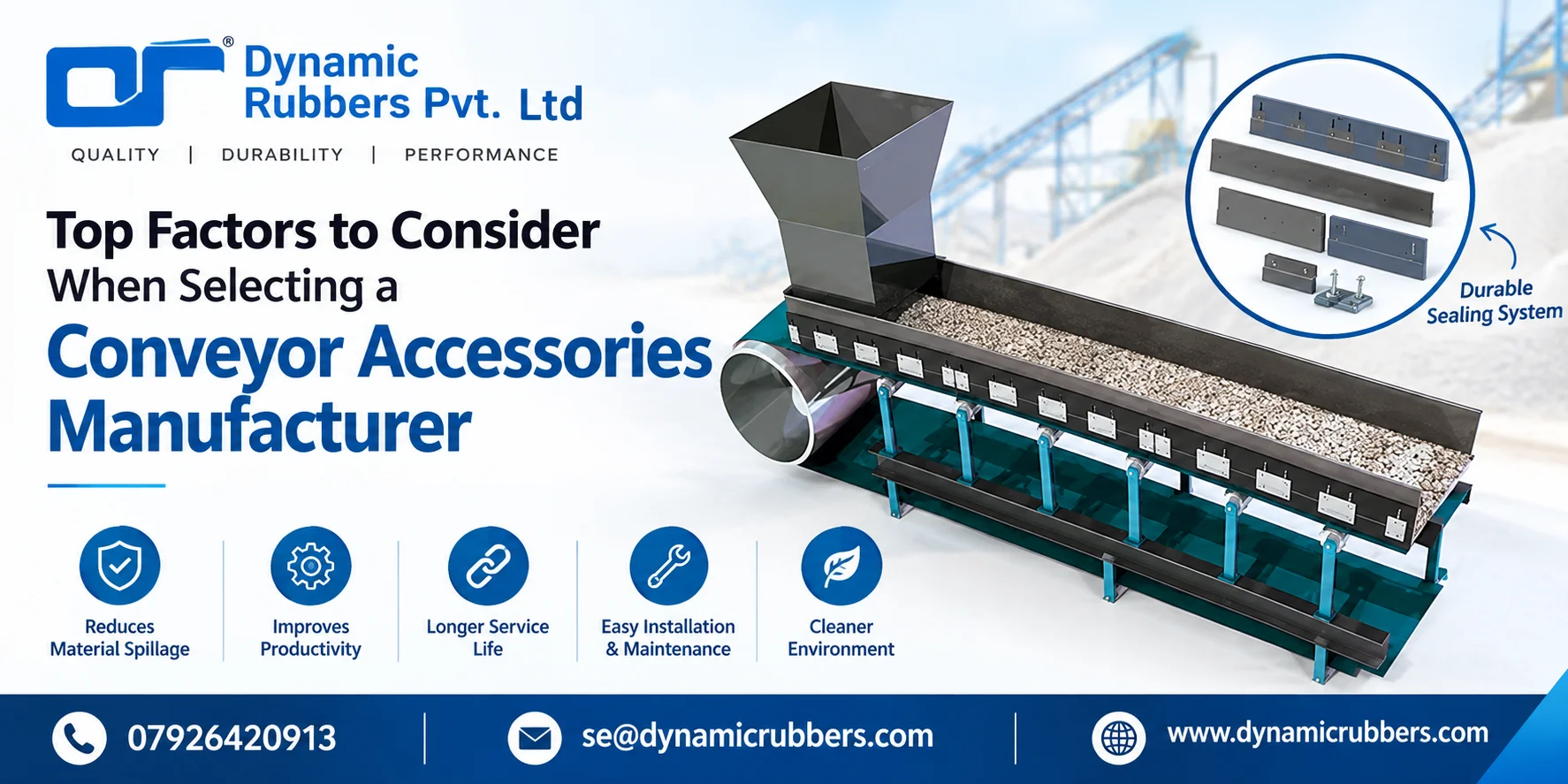
Choosing the right Conveyor Accessories Manufacturer is an important decision for industries that depend on reliable material handling. Conveyor accessories may look like small components, but their performance can directly affect material spillage, maintenance requirements, conveyor belt life, workplace cleanliness and overall productivity.
We believe the right manufacturer should offer more than a standard product. The manufacturer should understand the conveyor application, material being transported, operating conditions and sealing requirements before recommending a solution.
At Dynamic Rubbers Pvt. Ltd., we focus on practical conveyor sealing solutions designed to improve performance while keeping installation, maintenance and replacement costs under control.
1. Look for Experience in Conveyor Sealing Solutions
One of the first factors we recommend considering is the manufacturer's experience with conveyor systems and accessories.
Material spillage is particularly common around transfer points. Traditional solutions such as rubber strips or pieces of used conveyor belting may provide basic sealing, but they can wear quickly, lose their shape and require frequent replacement.
A specialist manufacturer can offer a more application-focused solution. For example, our segmented skirt board sealing system uses interlocking sealing blocks that can follow the contour of the conveyor belt and provide consistent material containment.
This approach is especially useful where conventional rubber skirting struggles to maintain proper contact with the belt.
2. Check the Material Used in the Accessories
Material selection has a direct impact on durability and performance.
Conveyor sealing blocks may need to operate under different conditions, including abrasive materials, temperature variations, continuous operation and heavy material flow. For this reason, we provide sealing blocks in Polymer, Rubber and Polyurethane, with high-temperature grade options available for suitable applications.
Before selecting a product, we recommend checking:
- Material being conveyed
- Operating temperature
- Level of abrasion
- Conveyor belt speed
- Required sealing pressure
- Environmental conditions
The right material can help extend service life and reduce unnecessary replacement.
3. Consider How Well the System Follows the Conveyor Contour
A conveyor belt does not always maintain one perfectly flat surface. Troughing and belt movement can create challenges for conventional skirt sealing.
Our segmented modular design allows individual blocks to be adjusted to the conveyor contour using a hammer. This helps the sealing system maintain effective contact while accommodating the shape of the belt.
For applications involving different conveyor configurations, this flexibility can make installation and maintenance easier.
4. Examine the Design of the Sealing System
A good conveyor sealing system should provide reliable containment without putting unnecessary stress on the conveyor belt.
Our main sealing system consists of three primary components:
- Interlocking Sealing Blocks
- Back Plate
- Clamping Plate
The back plate is permanently attached to the main equipment's skirt plate, while the blocks are secured using a chained twin-bolt clamp arrangement.
The interlocking design creates a continuous sealing arrangement, while the clamping system provides rigidity and helps prevent block oscillation during operation.
5. Ask About Installation and Maintenance
Maintenance time is an important consideration for any industrial conveyor system.
A complicated sealing system can increase downtime and require specialist intervention. We therefore recommend choosing accessories that are straightforward to install and maintain.
Our modular blocks are designed for swift installation and easy replacement. Instead of replacing an entire long rubber strip, individual worn blocks can be replaced as required.
This modular approach can help reduce maintenance time and make replacement more cost-effective.
6. Consider Long-Term Operating Costs
The lowest purchase price does not always represent the lowest overall cost.
Frequent replacement, excessive spillage, cleaning requirements and conveyor belt damage can increase the total operating cost of a sealing system.
A properly designed skirt sealing solution can help address several of these issues at the same time. Longer-lasting blocks can reduce replacement frequency, while improved sealing can reduce material loss and cleaning requirements.
At Dynamic Rubbers, we focus on solutions that balance initial cost, service life, maintenance and operational performance.
7. Look for Additional Sealing Options
Some conveyor applications require more than primary skirt sealing.
Fine dust or small particles can sometimes bypass the main sealing system because of belt sway, changing contact pressure or small gaps between the belt and sealing surface.
Our additional sealing system is designed to work with the main sealing arrangement and provide another layer of containment where required.
This can be particularly useful when controlling fine material and dust around transfer points is an important operational requirement.
8. Don't Overlook Tail-End Sealing
Tail-end areas can present their own sealing challenges because of the conveyor's troughing contour and material movement.
Our tail-end sealing solution uses overlapping and interlocking blocks to provide comprehensive sealing. The modular blocks can be adjusted according to the conveyor contour, helping create an effective barrier against material escape.
When selecting a manufacturer, we recommend asking whether the company can provide solutions for the complete conveyor sealing requirement rather than focusing on only one section.
Why Choose Dynamic Rubbers Pvt. Ltd.?
At Dynamic Rubbers Pvt. Ltd., we understand that conveyor accessories need to perform in real industrial environments.
Our segmented skirt board sealing system is designed around practical requirements such as durability, easy installation, modular replacement and effective material containment.
The key benefits include:
- Reduced material spillage
- Longer block service life
- Easy block replacement
- No conveyor belt damage
- Reduced cleaning requirements
- Better workplace cleanliness
- Improved productivity
- Cost-effective maintenance
- Adjustable sealing for conveyor contours
By selecting the appropriate sealing material and configuration for the application, we can help industries create a more controlled and maintainable conveyor system.
Final Thoughts
Selecting a Conveyor Accessories Manufacturer should involve more than comparing product prices. We recommend evaluating material quality, application experience, sealing design, conveyor compatibility, installation requirements, replacement costs and after-sales support.
A well-designed modular sealing system can help reduce spillage, simplify maintenance and support cleaner conveyor operations. With its interlocking blocks, adjustable design and multiple material options, the Dynamic Rubbers sealing system provides a practical solution for industries looking to improve conveyor material containment.
Frequently Asked Questions
What should we consider when choosing a Conveyor Accessories Manufacturer?
We recommend considering the manufacturer's experience, product materials, conveyor compatibility, customization options, durability, installation process, maintenance requirements and long-term operating costs.
What is conveyor skirt board sealing?
Conveyor skirt board sealing is a system installed along conveyor loading and transfer areas to help prevent transported material from escaping from the sides of the conveyor belt.
What are segmented sealing blocks?
Segmented sealing blocks are individual modular pieces used to create a conveyor sealing system. Their design allows individual blocks to be adjusted, removed or replaced without necessarily replacing the complete sealing arrangement.
What materials are used for conveyor sealing blocks?
Depending on the application, sealing blocks can be manufactured from materials such as Polymer, Rubber or Polyurethane. High-temperature grades can also be considered for applications involving elevated operating temperatures.
How does interlocking conveyor sealing help reduce spillage?
Interlocking blocks are designed to work together as a continuous sealing arrangement. This helps close potential gaps and maintain material containment along the conveyor edge.
Can conveyor sealing blocks follow the belt contour?
Yes. A segmented modular design can be adjusted to the conveyor belt contour. This is particularly useful for troughed conveyor belts where a straight sealing strip may not provide consistent contact.
Does better conveyor sealing help reduce cleaning requirements?
Effective sealing can reduce material spillage around transfer points. As a result, there may be less material accumulation around the conveyor, potentially reducing routine cleaning requirements and associated manpower.
Can individual sealing blocks be replaced?
Yes. One of the advantages of a modular block system is that worn or damaged blocks can be replaced individually, helping simplify maintenance and control replacement costs.