Sign up with Google
 Sign in with Zoho

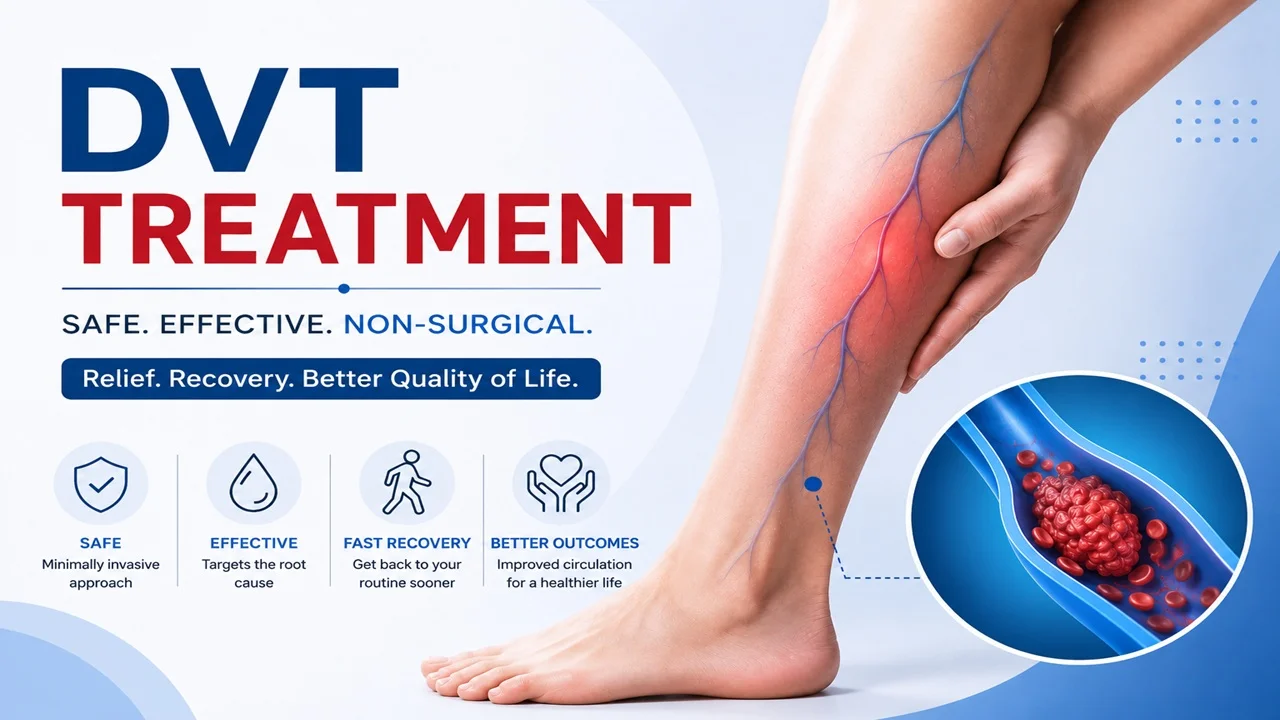
There is a moment most patients describe it the same way when the leg starts to feel wrong. Not painful exactly, more like a heaviness that won't lift. A warmth that has no business being there. A swelling that a good night's sleep doesn't fix.
For some people, that moment passes and they ignore it. For others, it's the beginning of a medical journey they never expected to take.
Deep Vein Thrombosis, or DVT, affects hundreds of thousands of people every year. And yet one of the most common questions I hear from patients and their families after the initial shock of the diagnosis is this:
Does this mean I need surgery?
In most cases, the honest answer is no. And that's genuinely good news worth understanding.
What Is DVT, and Why Does It Scare People So Much?
Deep Vein Thrombosis happens when a blood clot forms inside one of the deep veins of the body most often in the legs. The veins we're talking about aren't the superficial ones visible under your skin. These are the larger vessels buried deep within the muscle tissue, responsible for returning blood back to the heart.
When a clot blocks that flow, the blood backs up. That's where the swelling, the warmth, the tenderness come from.
What makes DVT genuinely dangerous and not just uncomfortable is what can happen next. A portion of the clot can break loose, travel through the bloodstream, and lodge itself in the lungs. This is called a Pulmonary Embolism, and it is a life-threatening emergency. Pulmonary embolism prevention is, frankly, the reason DVT deserves to be taken seriously from day one.
But here's what many patients don't realize:
the fact that DVT can become dangerous doesn't automatically make surgery the answer. Modern medicine has moved a long way from the operating theatre when it comes to blood clot treatment.
Why Non-Surgical DVT Treatment Is Now the Standard Approach
The instinct most people have when they hear "blood clot" is that something needs to be physically cut out or removed through major surgery. That was partly true decades ago. It's much less true now.
Vascular medicine has undergone a quiet but profound transformation over the last twenty years. The development of endovascular techniques procedures performed from inside the blood vessels themselves using thin catheters and imaging guidance has meant that the vast majority of DVT cases can be treated without a single surgical incision worth speaking of.
This matters enormously for patients. Non-surgical DVT Treatment approaches typically mean shorter hospital stays, faster recovery, lower infection risk, and critically results that are comparable to or better than traditional open surgery for most cases.
Let me walk you through what DVT treatment without surgery actually looks like in practice.
1. Anticoagulation: The Bedrock of Blood Clot Treatment
For many patients, particularly those with smaller clots or clots caught early, anticoagulation therapy is the primary treatment. These are medications commonly called blood thinners that don't dissolve the clot directly but prevent it from growing larger and stop new clots from forming while the body's natural systems slowly break down the existing one.
Anticoagulants have come a long way. The older warfarin-based regimens required frequent blood monitoring and strict dietary restrictions. Newer direct oral anticoagulants (DOACs) have simplified this considerably for most patients.
That said, anticoagulation alone isn't always enough. For larger clots particularly those in the iliac or femoral veins simply preventing the clot from growing isn't the same as actually clearing it. This is where more active non-surgical interventions become relevant.
2. Catheter-Directed Thrombolysis: Dissolving the Clot From Within
One of the most significant advances in deep vein thrombosis treatment is Catheter-Directed Thrombolysis, or CDT.
Here's how it works: a vascular specialist guides a thin, flexible catheter essentially a very narrow tube through a small access point, usually in the back of the knee or the groin, directly to the site of the clot. Through that catheter, a thrombolytic drug (a clot-dissolving medication) is delivered precisely where it needs to go.
The key word there is "precisely." Systemic thrombolysis where the drug is given through a standard IV drip sends the medication throughout the entire body, which raises the risk of bleeding elsewhere. Catheter-directed delivery concentrates the drug at the clot itself, using a smaller total dose with a better safety profile.
The procedure is performed under imaging guidance, which means the specialist can watch in real time as the clot dissolves and the vein reopens. Most patients require admission for monitoring during the process, but the procedure itself involves no general anaesthesia and no surgical wound.
For extensive DVT particularly the kind that threatens long-term vein function CDT can be remarkably effective at preserving the valves inside the veins, reducing the risk of a chronic condition called Post-Thrombotic Syndrome that can cause lasting leg pain, swelling, and ulcers years after the initial clot.
3. Mechanical Thrombectomy: Physical Clot Removal Without Open Surgery
Sometimes the clot is too large, too old, or too stubborn to respond well to thrombolysis alone. In these situations, Mechanical Thrombectomy offers another option still without open surgery.
A mechanical thrombectomy uses specialized devices, also delivered through a catheter, to physically break apart and aspirate (suction out) the clot material from within the vein. Think of it as clearing a blocked pipe from the inside, using tools delivered through a straw-sized access point rather than cutting the pipe open.
There are several device types used for this purpose, and interventional specialists often combine mechanical thrombectomy with directed thrombolysis for the best results a hybrid approach that addresses both the immediate blockage and any residual clot material simultaneously.
Recovery after mechanical thrombectomy is typically measured in days, not weeks. Many patients are walking the same day.
The Role of the Interventional Radiologist in Modern DVT Care
This is where I want to spend a moment, because patients are often confused about who actually performs these procedures and why that matters.
An Interventional Radiologist is a physician who has completed full medical training followed by specialized expertise in image-guided procedures performed inside blood vessels and other structures. They are not surgeons in the traditional sense, but they are certainly not radiologists who just read scans either. They sit in a remarkable space between the two capable of diagnosing the problem with imaging and treating it with catheter-based tools, often in the same session.
For DVT, this matters a great deal. The interventional radiologist is typically the physician managing CDT, mechanical thrombectomy, and endovascular treatment overall. Their expertise in both the anatomy and the imaging guidance technology is what makes these non-surgical approaches safe and precise.
Dr. Akash Bansal, a respected Interventional Radiologist in Delhi, is among the specialists in India who have built significant experience in advanced vascular care for conditions like DVT. As a Vascular Specialist in Delhi with a focus on minimally invasive procedures, Dr. Bansal brings both the technical expertise and the imaging-guided precision that complex DVT cases require. Patients from across the region seek consultation for Endovascular Treatment under his care not because surgery isn't available, but because minimally invasive management, done well, often produces better outcomes with significantly less disruption to the patient's life.
Finding the right specialist matters. For something as consequential as deep vein thrombosis, you want someone who has done these procedures hundreds of times, not dozens.
Minimally Invasive Procedures: A Note on What That Actually Means
The phrase "minimally invasive" gets used so frequently in medical marketing that it has started to feel like advertising language rather than a genuine clinical distinction. Let me try to give it some substance.
In the context of DVT and endovascular treatment, "minimally invasive" means the following things in practice:
Access point: Rather than a surgical incision large enough for a surgeon's hands, the entire procedure is performed through one or two needle-stick access points small enough to be closed with manual pressure or a single stitch.
No general anaesthesia required: Most CDT and mechanical thrombectomy procedures are performed under local anaesthesia with sedation, not full general anaesthesia. This removes a significant category of risk and speeds up recovery.
No cutting through healthy tissue: Traditional vascular surgery to access deep veins involves cutting through layers of tissue. Catheter-based approaches follow the natural architecture of the vascular system no healthy tissue needs to be disrupted.
Faster return to function: Patients who undergo minimally invasive procedures for DVT typically return to normal activities significantly faster than those who require open vascular surgery.
These aren't trivial differences. For older patients, or those with underlying health conditions that make surgery risky, minimally invasive approaches can be the factor that makes treatment possible at all.
Pulmonary Embolism Prevention: The Bigger Picture
I want to come back to pulmonary embolism, because it's the reason DVT demands prompt attention rather than a wait-and-see approach.
The goal of deep vein thrombosis treatment whatever form it takes is not just to relieve the immediate symptoms in the leg. It's to prevent the clot from dislodging and traveling to the lungs. A pulmonary embolism can be fatal; even non-fatal pulmonary embolisms can cause lasting damage to lung function.
Non-surgical blood clot treatment addresses this risk in two ways. First, anticoagulation immediately reduces the risk of clot propagation and embolism. Second, active interventions like CDT and mechanical thrombectomy reduce the total clot burden there's simply less clot material available to become an embolism.
In patients where the risk of pulmonary embolism is considered very high and anticoagulation isn't appropriate (due to active bleeding, recent surgery, or other contraindications), a vena cava filter a small device placed in the main abdominal vein through a catheter can be used to physically catch any clots before they reach the lungs. This is itself a non-surgical, catheter-based procedure.
Questions Patients Should Ask Before Starting DVT Treatment
One thing I've noticed over years of working in health communication is that patients who ask good questions at the outset tend to have better experiences throughout their treatment. Here are the questions worth raising at your consultation:
1. What is the extent of my clot?
DVT isn't one-size-fits-all. A small calf vein clot is managed very differently from an extensive ilio-femoral DVT. Understanding what you're dealing with shapes everything else.
2. What is the risk of post-thrombotic syndrome in my case?
This chronic complication affects a significant proportion of DVT patients long-term. Active clot removal (vs. anticoagulation alone) may reduce this risk for certain patients.
3. Am I a candidate for catheter-directed thrombolysis or mechanical thrombectomy?
Not everyone is underlying bleeding risk, the age of the clot, and other factors affect eligibility. But you should ask, because many patients are never told these options exist.
4. How experienced is this team in these procedures?
Volume matters in endovascular work. Ask how many of these procedures the team performs annually.
5. What does monitoring look like during and after treatment?
Anticoagulation in particular requires careful monitoring and dose adjustment. Know what follow-up looks like before you leave the consultation.
Who Is Most at Risk for DVT?
Understanding your personal risk helps contextualize how seriously to take symptoms. DVT is significantly more common among people who:
- Have been immobile for extended periods (long-haul flights, post-surgical bed rest, hospitalization)
- Have a personal or family history of blood clots
- Are taking hormonal medications including oral contraceptives or HRT
- Are pregnant or in the postpartum period
- Have certain inherited clotting disorders (thrombophilias)
- Have active cancer or are receiving cancer treatment
- Are significantly overweight
- Have a history of varicose veins or prior DVT
This doesn't mean that DVT only happens to high-risk individuals. Healthy, active people get DVT too particularly following injury, surgery, or prolonged immobility. The symptoms are always worth taking seriously.
The Warning Signs You Shouldn't Ignore
DVT doesn't always announce itself dramatically. Sometimes it's subtle enough that people write it off as a muscle pull or general fatigue. The classic warning signs include:
- Swelling in one leg (typically one-sided, not both)
- Persistent warmth or redness over the affected area
- A heaviness or aching in the leg that worsens when walking or standing
- Visible distension of surface veins over the calf or thigh
Pulmonary embolism symptoms are different and require immediate emergency attention: sudden shortness of breath, chest pain that worsens with breathing, rapid heart rate, or coughing up blood. If you experience any of these, call emergency services immediately. this is not a situation for a scheduled appointment.
What Advanced Vascular Care in Delhi Looks Like Today
India has made significant strides in endovascular and vascular medicine over the past decade. Delhi, in particular, has developed a cluster of specialists and facilities capable of delivering interventional vascular care at a level that compares favorably with international standards.
Advanced vascular care in this context means access to:
- High-resolution fluoroscopy and ultrasound guidance for catheter-based procedures
- Experienced interventional teams who manage both the procedural and post-procedural care
- Multidisciplinary collaboration between interventional radiology, haematology, and vascular surgery when complex cases require it
- Modern anticoagulation protocols using the latest generation of medications
- Structured follow-up to monitor for recurrence and long-term complications
Patients seeking DVT treatment in Delhi no longer need to travel abroad or wait for referrals to multi-speciality hospitals. Specialists like Dr. Akash Bansal have built focused practices dedicated to exactly this kind of care bringing the full range of non-surgical options to patients who, a generation ago, might have faced either major surgery or inadequate treatment.
A Final Word: What "Non-Surgical" Doesn't Mean
I want to close with something that often needs clarifying, because I've seen patients misunderstand it and delay care as a result.
Non-surgical DVT treatment is not the same as no treatment, or conservative treatment, or treating yourself at home. Catheter-directed thrombolysis, mechanical thrombectomy, and the other procedures described here are serious medical interventions performed by trained specialists in appropriately equipped facilities. They require careful patient selection, skilled execution, and proper follow-up.
The "non-surgical" distinction simply means the blood clot removal and vein restoration is achieved without open surgery which, for patients, translates into shorter recovery times, lower complication rates, and less physical disruption. It doesn't mean less medical expertise is involved. If anything, the precision required for image-guided catheter work demands a very high level of specialist skill.
If you or someone you love has been diagnosed with DVT, the most important step is prompt consultation with a qualified vascular specialist or interventional radiologist. Understand your options. Ask the questions. Don't assume that because surgery isn't on the table, there's nothing powerful that can be done.
There almost certainly is.
This article is intended for educational purposes and general patient awareness. It does not constitute medical advice. Always consult a qualified specialist for diagnosis and treatment specific to your individual situation.