Sign up with Google
 Sign in with Zoho
Missing teeth affect far more than your smile. They can change the way you eat, speak, and feel about yourself in social situations — and, left untreated, they can lead to bone loss and further dental problems down the line. If you're searching for dental implants in Coventry, you're likely weighing up your options, wondering about cost, and wanting to know what the process actually involves before committing.
This guide walks you through everything: what dental implants are, how the procedure works, realistic costs in the Coventry area, recovery timelines, and the key questions to ask any clinic before you book a consultation.
What Are Dental Implants?
A dental implant is a small titanium (or titanium alloy) post that's surgically placed into the jawbone to act as an artificial tooth root. Once it has fused with the bone — a process called osseointegration — a crown, bridge, or denture is attached on top, giving you a replacement tooth that looks, feels, and functions like a natural one.
Unlike dentures, implants don't rely on adhesives or clasps, and unlike bridges, they don't require grinding down healthy adjacent teeth for support. This makes them the closest thing to a natural tooth replacement available in modern dentistry.
Why People in Coventry Choose Implants Over Other Options
- Long-term durability – with proper care, implants can last 15–25+ years, often a lifetime
- Bone preservation – implants stimulate the jawbone the way a natural root would, preventing the bone shrinkage that follows tooth loss
- No impact on neighbouring teeth – bridges require reshaping adjacent teeth; implants stand independently
- Natural look and feel – custom-matched crowns blend with your existing smile
- Improved chewing and speech – far more stable than removable dentures
Types of Dental Implants Available in Coventry
Most Coventry dental practices offer a range of implant solutions depending on how many teeth need replacing:
Single Tooth Implants
A single implant post with a crown on top, ideal for replacing one missing tooth without affecting the teeth either side.
Implant-Supported Bridges
Two or more implants supporting a bridge of replacement teeth, used when several adjacent teeth are missing.
All-on-4 / All-on-6 Implants
A full arch of replacement teeth secured onto just four or six strategically placed implants — a popular option for patients missing most or all of their teeth who want a fixed (non-removable) solution.
Implant-Retained Dentures
Traditional dentures clipped onto a small number of implants for extra stability, a good middle-ground option for those wanting more security than standard dentures without the cost of a full fixed arch.
The Dental Implant Procedure: Step by Step
Understanding the process can help ease any nerves about treatment. Here's what typically happens.
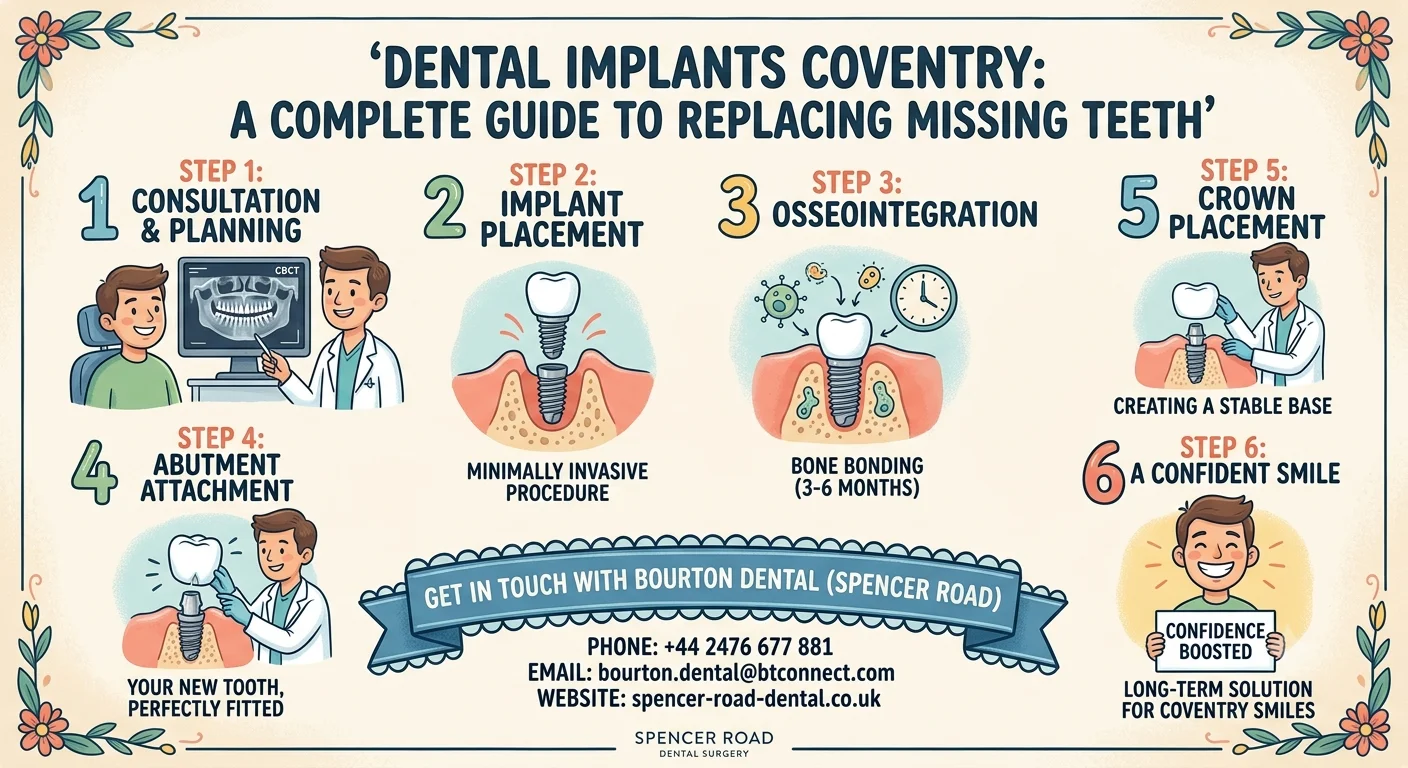
1. Initial Consultation and Assessment
Your dentist will examine your teeth and gums, take X-rays or a 3D CT scan, and assess your jawbone density. This determines whether you're a suitable candidate or whether you might need a bone graft first.
2. Treatment Planning
A personalised plan is created, covering the number of implants needed, the type of restoration, timeline, and cost.
3. Implant Placement Surgery
Under local anaesthetic (sometimes with sedation for anxious patients), the implant post is placed into the jawbone. This is typically a day procedure.
4. Healing and Osseointegration
The implant needs time to fuse with the bone — usually 3 to 6 months. A temporary restoration may be fitted in the meantime so you're not left with a gap.
5. Abutment and Crown Fitting
Once healed, a small connector piece (abutment) is attached, and your custom-made crown, bridge, or denture is fitted on top.
6. Follow-Up Care
Your dentist will check the fit, your bite, and overall healing, with regular check-ups afterwards to monitor the implant long-term.
How Much Do Dental Implants Cost in Coventry?
Cost is usually the biggest factor in people's decision-making, and prices vary depending on the clinic, the complexity of your case, and the materials used. As a general guide for the Coventry area:
Prices are indicative only and vary between practices — always request a detailed, written quote following a consultation.
Many Coventry dental clinics offer 0% finance plans or monthly payment options to spread the cost, which is worth asking about if budget is a concern.
Are Dental Implants Available on the NHS?
Generally, no. The NHS only funds dental implants in rare cases where tooth loss is due to illness, accident, or a birth condition affecting your jaw. For most patients, implants are a private treatment.
What to Look for in a Coventry Dental Implant Clinic
Not all clinics offer the same level of expertise. Before booking, consider asking:
- Is the dentist GDC-registered and do they have specific implant training or a certificate in implant dentistry?
- How many implant procedures have they carried out? Experience matters significantly with implant surgery.
- Do they use 3D CT scanning for precise implant placement, rather than 2D X-rays alone?
- What's included in the quoted price — does it cover the consultation, scans, the implant, abutment, and crown, or are these billed separately?
- What guarantee or aftercare do they offer if something goes wrong?
- Can they show before-and-after cases similar to yours?
Reading verified patient reviews and checking before-and-after photos on a clinic's website or Google Business profile is one of the most reliable ways to gauge quality before committing.
Recovery: What to Expect After Getting Implants
Most patients return to normal activities within a few days, though full healing takes longer:
- Days 1–3: Mild swelling and discomfort, manageable with over-the-counter painkillers
- Week 1: Stick to soft foods, avoid smoking and strenuous exercise
- Weeks 2–4: Gums settle, stitches (if used) dissolve or are removed
- Months 3–6: Osseointegration completes, and the permanent crown or bridge is fitted
Good oral hygiene — brushing, flossing (or using interdental brushes), and regular check-ups — is essential to keep implants healthy for the long term, just as it is with natural teeth.
Am I a Good Candidate for Dental Implants?
Most adults in good general health with adequate jawbone density are suitable candidates. However, your dentist will want to check for:
- Sufficient bone density (bone grafting can help if this is lacking)
- Healthy gums, free from active gum disease
- Good general health — uncontrolled diabetes or certain medical conditions can affect healing
- Non-smoking status, or willingness to quit, since smoking significantly increases implant failure rates
A thorough consultation and scan will confirm your suitability.
Frequently Asked Questions
How long do dental implants last? With good oral hygiene and regular dental check-ups, implants can last 15–25 years or longer — the implant post itself often lasts a lifetime, though the crown may need replacing after 10–15 years due to normal wear.
Is getting a dental implant painful? The procedure itself is performed under local anaesthetic, so you shouldn't feel pain during placement. Mild discomfort and swelling afterwards is normal and manageable with standard painkillers.
How long does the whole process take? From consultation to final crown fitting, the process typically takes 3 to 9 months, largely due to the healing and osseointegration period. Same-day options exist for suitable candidates but aren't right for everyone.
Can I get dental implants if I've been missing a tooth for years? Yes, though prolonged tooth loss often leads to bone shrinkage, which may mean a bone graft is needed first to build up enough bone to support an implant.
What's the difference between an implant and a bridge? A bridge relies on adjacent natural teeth for support (which often requires grinding them down), while an implant stands independently in the jawbone, preserving your other teeth.
Do dental implants need special care? Implants are cared for just like natural teeth — brushing twice daily, flossing or using interdental brushes, and attending regular dental check-ups and hygiene appointments.
Final Thoughts
Dental implants remain one of the most reliable, long-lasting solutions for replacing missing teeth — restoring both function and confidence. If you're considering dental implants in Coventry, the best next step is booking a consultation with a registered, experienced implant dentist who can assess your individual case, talk you through costs, and create a treatment plan tailored to you.
Take your time comparing clinics, ask plenty of questions, and don't be afraid to seek a second opinion if you're unsure — this is a long-term investment in your health and smile.
This article is for general informational purposes and does not constitute medical or dental advice. Always consult a qualified, GDC-registered dentist for advice specific to your circumstances.