Sign up with Google
 Sign in with Zoho

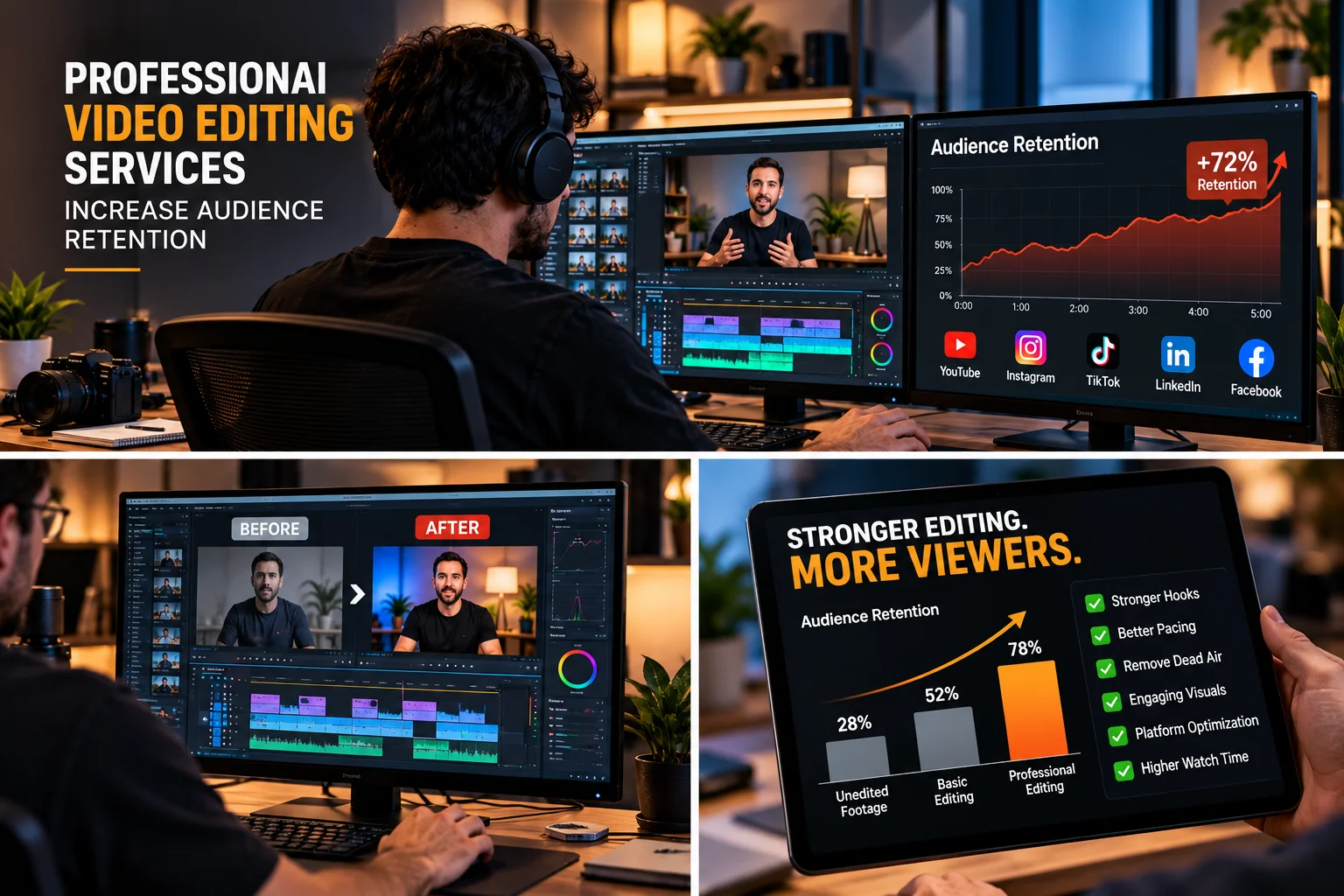
Getting people to click on a video is only the first step. The real challenge is convincing them to keep watching. Professional video editing services help businesses, creators, and brands turn raw footage into structured, engaging content designed to hold attention from the opening seconds through the final call to action.
Audience retention measures how much of a video viewers continue watching. On platforms such as YouTube, retention provides important insight into whether the content actually keeps viewers interested. YouTube's own analytics highlights intros, top moments, spikes, and dips so creators can identify exactly where audiences stay engaged or leave.
Good editing cannot rescue a weak idea completely, but it can dramatically improve how effectively a strong idea is communicated.
What Is Audience Retention?
Audience retention shows how long viewers continue watching your video.
For example, if viewers watch an average of five minutes of a ten-minute video, the average percentage viewed would be approximately 50%.
Retention can reveal whether viewers:
- Leave during the introduction
- Remain engaged through the main content
- Rewatch important sections
- Skip certain segments
- Stay long enough to reach the call to action
YouTube specifically recommends analyzing the first 30 seconds and reviewing areas where viewers remain engaged, rewatch sections, or leave.
This makes retention more than a vanity metric. It becomes feedback for improving future content.
Why Audience Retention Matters
A video may have an excellent thumbnail and title that generate clicks, but poor retention indicates that the content did not fully satisfy viewer expectations.
Stronger retention can support several business objectives:
- Longer watch time
- Greater content consumption
- More opportunities to communicate key messages
- Higher chances of viewers reaching a CTA
- Better brand recall
- More effective educational content
For YouTube creators, retention is also closely connected to overall content performance. Current creator guidance consistently emphasizes strong openings, tighter pacing, and reducing unnecessary sections as effective ways to keep viewers watching.
Professional editors therefore think beyond making footage look attractive. They edit for attention.
1. Professional Editing Strengthens the Opening Hook
The beginning of a video has one of the hardest jobs: convincing the viewer to stay.
A slow introduction can lose attention before the actual value begins.
Editors can improve the opening by:
- Removing unnecessary greetings
- Starting with the strongest statement
- Showing the result before explaining the process
- Using an interesting visual immediately
- Introducing a clear question
- Previewing what the viewer will learn
YouTube recommends testing and improving the first 30 seconds when intro retention is weak.
For short-form videos, the decision happens even faster. Current retention-focused editing guides emphasize opening immediately with the strongest visual, question, problem, or payoff rather than a long introduction.
The editor's goal is simple: give viewers a reason to watch the next moment.
2. Removing Dead Air Keeps the Video Moving
Raw recordings naturally contain:
- Long pauses
- Repeated sentences
- Filler words
- Mistakes
- Awkward transitions
- Unnecessary explanations
Individually, these moments may seem small.
Together, they make a video feel slow.
Professional editors identify where pacing begins to drag and remove unnecessary material without making the conversation feel unnatural.
This process increases information density.
Instead of making viewers wait for the next useful idea, the edit delivers information efficiently.
Retention-focused guides repeatedly identify trimming pauses and slow sections as one of the most practical ways to improve watchability.
This does not mean every second needs a cut. Natural pauses can create emphasis. The important skill is knowing which pauses improve communication and which simply waste viewer attention.
3. Pacing Controls Viewer Attention
Pacing is the rhythm of a video.
Fast pacing can create excitement, while slower pacing can give viewers time to understand an important concept.
The mistake is using the same rhythm throughout the entire video.
Professional editors vary pacing based on:
- Subject matter
- Platform
- Audience
- Video length
- Emotional tone
- Information complexity
A tutorial may need enough time for viewers to understand each step.
A short social video may need significantly faster transitions.
A documentary or interview may intentionally hold certain shots longer.
Good editing does not simply mean “more cuts.”
It means the right cut at the right moment.
If businesses want to understand broader editing approaches before selecting a style, Delenzo Technologies' guide to the types of video editing services explains how different editing requirements fit different content formats.
4. B-Roll Prevents Visual Fatigue
A talking-head video can contain excellent information but still become visually repetitive.
B-roll introduces additional visual context.
Examples include:
- Product footage
- Screen recordings
- Workplace scenes
- Customer interactions
- Charts
- Demonstrations
- Location footage
- Close-up details
B-roll has two benefits.
First, it creates visual variety.
Second, it can improve comprehension by showing what the speaker is discussing.
Retention-focused editors increasingly recommend using B-roll as an explanatory element rather than simply decoration.
If someone talks about a product feature, showing that feature is often more effective than leaving the speaker on screen throughout the explanation.
5. Pattern Interrupts Reset Attention
Viewers become accustomed to visual patterns.
If nothing changes for too long, attention can decline even when the topic remains relevant.
A pattern interrupt introduces something new.
Examples include:
- Camera angle changes
- Punch-ins
- B-roll
- Text overlays
- Graphics
- Animation
- Sound changes
- Screen recordings
The objective is not to overwhelm the audience.
Pattern interrupts should support the message.
When every sentence includes a dramatic zoom, sound effect, or animated graphic, editing itself can become distracting.
Professional editors balance visual change with clarity.
6. Captions Improve Accessibility and Comprehension
Captions have become particularly valuable for social media and short-form video.
They help audiences follow content when:
- Sound is turned off
- Audio quality is difficult to understand
- The speaker talks quickly
- Important terminology appears
- Viewers have hearing impairments
Editors can highlight important phrases rather than covering the screen with unnecessary text.
Captions are especially effective when synchronized naturally with speech and designed for easy reading.
Short-form retention research commonly identifies captions as a valuable tool for holding attention and helping viewers follow fast-moving content.
7. Visual Storytelling Makes Information Easier to Follow
Retention is not created only by cuts.
Structure matters.
Professional editors organize footage so information progresses logically.
A business video might follow:
- Problem
- Why the problem matters
- Possible solution
- Evidence
- Recommendation
- Call to action
Without clear progression, viewers may become confused and leave even if individual shots look professional.
Editors can restructure sections, move important information earlier, and remove repeated ideas.
That is one reason professional editing affects more than aesthetics.
It helps transform footage into a story.
8. Sound Design Supports Emotional Engagement
Visual editing receives most of the attention, but audio plays an equally important role.
Professional editors may improve:
- Dialogue clarity
- Music levels
- Background noise
- Sound effects
- Transitions
- Audio balance
Music can create energy, while silence can emphasize an important statement.
Poor audio, on the other hand, can make even excellent footage difficult to watch.
The objective is not to add constant sound effects. Audio should reinforce what the viewer is seeing and hearing without distracting from the message.
9. Editors Use Graphics to Simplify Complex Ideas
Some ideas are difficult to explain using speech alone.
Graphics can make them easier to understand.
Examples include:
- Charts
- Statistics
- Timelines
- Icons
- Lower thirds
- Comparisons
- Step-by-step animations
When information becomes easier to process, viewers have fewer reasons to leave because they are confused.
This is particularly important for:
- SaaS companies
- Financial services
- Educational content
- Product demonstrations
- B2B marketing
- Tutorials
Good graphics clarify information rather than simply making the video look more expensive.
10. Professional Editing Removes Repetition
Business videos often begin with much more footage than the final audience needs.
Speakers may repeat themselves, explain the same point several ways, or include information that does not support the video's purpose.
Editors make difficult decisions about what should remain.
Removing repetition produces a stronger final product.
This is also one of the differences between basic editing and professional editing.
Basic editing may simply combine clips.
Professional editing asks whether every section deserves the viewer's attention.
Businesses handling editing internally should also watch for common video editing mistakes that can reduce clarity and overall content quality.
11. Editing Aligns the Video With the Platform
A successful YouTube video may not automatically work as an Instagram Reel or TikTok.
Different platforms encourage different viewing behaviors.
YouTube
Long-form content can use:
- Deeper explanations
- Chapters
- B-roll
- Story development
- Mid-video re-engagement
Reels, Shorts, and TikTok
Short-form content usually requires:
- Immediate hooks
- Faster pacing
- Vertical framing
- Captions
- Faster visual changes
- Concise messaging
Professional editors adapt content rather than simply resizing the same video.
This improves the chances that the content feels natural on the platform where viewers encounter it.
12. Retention Analytics Can Improve Future Edits
Editing should not end when a video is published.
Performance data can inform the next video.
YouTube's audience retention report identifies:
- Intro performance
- Top moments
- Spikes
- Dips
A spike may indicate a section that viewers rewatched or shared, while a dip can reveal where viewers skipped or stopped watching.
Editors can use this information to recognize patterns.
For example:
- Repeated intro drops may indicate openings are too slow.
- A consistent decline during explanations may indicate pacing problems.
- Strong retention during demonstrations may suggest audiences prefer practical visuals.
- Spikes may reveal topics worth expanding into new content.
Advanced retention workflows increasingly treat analytics as feedback for future editing rather than judging each video in isolation.
Professional Editing vs DIY Editing
Modern editing software has made basic video creation more accessible.
Businesses can use tools such as Adobe Premiere Pro, DaVinci Resolve, Final Cut Pro, or CapCut.
However, owning software does not automatically create strong retention.
The difficult decisions involve:
- What to remove
- Where to cut
- How quickly to move
- Where to add B-roll
- When to use graphics
- How to structure the story
- How to interpret retention data
Businesses deciding whether to edit internally or outsource can compare the advantages in this guide to DIY vs professional video editing services.
How Audience Retention Supports Business Results
Retention matters beyond platform analytics.
The longer viewers stay engaged, the more opportunities a business has to communicate:
- Product benefits
- Brand positioning
- Customer problems
- Differentiators
- Testimonials
- Offers
- Calls to action
A viewer who leaves after ten seconds may never hear your strongest argument.
A viewer who watches most of the video is exposed to much more of your message.
For businesses using video for marketing, professional editing can therefore contribute to engagement and conversions by improving how information is presented.
Delenzo Technologies also explores this connection in its guide on how professional video editing boosts engagement and conversions.
Final Thoughts
Professional video editing increases audience retention by removing friction between the viewer and the message.
It strengthens opening hooks, improves pacing, removes dead air, introduces visual variety, improves audio, adds meaningful captions and graphics, and structures information more clearly.
The strongest editors do not add effects simply because they can.
Every editing decision should answer one question:
Does this make the video easier or more compelling to continue watching?
Businesses should also review retention analytics after publication and use those insights to improve future videos.
The combination of good footage, strong storytelling, professional editing, and performance analysis creates a repeatable system for producing content audiences are more likely to watch.
FAQs
How does video editing improve audience retention?
Editing improves retention by removing unnecessary pauses, strengthening hooks, improving pacing, adding useful visual changes, improving audio, and organizing content into a clearer story.
What editing techniques help keep viewers watching?
Effective techniques include tighter cuts, B-roll, captions, pattern interrupts, graphics, strong audio, clear hooks, and removing repetitive sections.
Are faster cuts always better for audience retention?
No. Cut speed should match the platform, audience, topic, and emotional tone. Excessively fast editing can make content difficult to understand.
Can professional editing improve YouTube audience retention?
Yes. Professional editors can improve openings, pacing, visual storytelling, and overall clarity. YouTube retention analytics can then show where viewers stayed engaged or dropped off.
Is professional video editing worth it for businesses?
It can be especially valuable when video supports marketing, sales, education, or brand building and the business needs consistent quality, stronger storytelling, and better viewer engagement.