Sign up with Google
 Sign in with Zoho

I recently audited a D2C brand that was running 11 Meta campaigns at the same time. One ad said "India's Most Affordable Skincare," another one said "Premium Luxury Formula," and a third one was shouting "50% OFF - Limited Stock!"
Individually, all three ads were good. But together? If I was a new customer, I would be completely confused. Is this a cheap brand, a premium brand, or a discount brand?
This is the biggest hidden problem with scaling Meta ads. You don't realize when your brand starts sounding like 3 different companies.
When you have multiple products, multiple audiences, and maybe 2-3 designers or agencies working in parallel, your brand messaging starts to drift. And Meta's algorithm doesn't care, but your customer does.
Consistency doesn't mean you have to use the same headline or same creative everywhere. It means no matter who sees your ad - a college student or a 40-year-old business owner - they should feel it’s coming from the same brand.
*Why Does This Even Matter? Customers Don't See One Ad*
Think about how you discover a brand on Instagram. You might see a Reel on Monday, then a UGC review on Thursday, and then a retargeting ad with an offer on Sunday. You never see the brand through just one ad.
Each of those 3 touchpoints is adding up to one image in your mind.
If the first ad is funny and casual, the second one is super technical, and the third one is making a completely different promise about the product, you lose trust. You start to wonder, "Do these guys even know what they are selling?"
I have seen this happen a lot with SaaS companies. One campaign says "So simple, your intern can use it," and the next campaign says "Enterprise-grade security for large corporations." Both can be true, but if you don't explain the connection, your audience will be confused about who the product is actually for.
A consistent brand gives you a solid base. You can then test different hooks and angles without losing your identity.
*Step 1: Decide What Should NEVER Change*
Before you launch your next 5 campaigns, sit with your team and lock 3 things.
*1. Your Brand Promise:* What is the one core value you deliver? For example, for Deepsolv, the promise is clear - helping growth teams decide what creative to test next. For your brand, it could be "Making work easier" or "Skincare that actually works for Indian skin." Everything else can change, but this shouldn't.
*2. Your Brand Voice:* Are you friendly, expert-like, funny, or very professional? You can have different tones for different audiences, but the personality should feel the same. A brand can't be super funny in one ad and extremely formal in the next.
*3. Your Product Truth:* This is most important. Your price, your features, your guarantee, your results - they should be the same everywhere. I have seen brands where one ad says "Delivery in 2 days" and another ad from the same brand says "Delivery in 5 days." That kills trust instantly.
Write these three things in a one-page document and share it with everyone - your internal team, your freelancers, your agency. This is not a 50-page brand guideline. Just a simple, practical sheet.
*Step 2: Same Brand, Different Stories*
You don't need to say the same thing to everyone. In fact, you shouldn't.
Let's take a project management tool. For a founder, the biggest pain is "I don't have visibility into what my team is doing." For a team member, the pain is "I am tired of managing tasks in 5 different Excel sheets."
Both are valid, and both can be solved by the same product. So your ad for the founder can talk about oversight and reporting, while your ad for the team member can show how easy task management is.
You changed the emphasis, not the brand identity. Both ads still support the main promise - making work easier to coordinate.
This is where most teams need a better system to organize their creative ideas. Instead of guessing, having a structured [creative intelligence strategy](https://www.deepsolv.ai/) helps you map out which message is for which audience and whether it still fits your main brand story. It stops you from repeating the same benefit 10 times.
*Step 3: Stop Working in Silos*
This is a real problem in growing teams. One person is handling performance campaigns, another is handling retargeting, and an agency is making creatives for a new product launch. None of them talk to each other daily.
After a month, you realize you have 3 different ways of writing your product name, 2 different logos being used, and 4 ads offering 4 different discounts.
The solution is simple - a shared source of truth.
Create a shared doc or Notion page that has:
- Your core brand promise in one line
- Approved product descriptions and claims
- Words you always use vs. words you never use
- Your tone examples - 2-3 good ad copies and 2-3 bad ones
- Audience-wise benefits - what to say to whom
And do a quick 30-minute creative review every Friday. Not to judge designs, but to ask one question - "If a new customer saw all our ads this week, would they understand what we stand for?"
*Step 4: Do a Portfolio Review, Not Just an Ad Review*
We all review individual ads - CTR, hook rate, ROAS. But we rarely review our entire portfolio of ads together.
Put all your active Meta ads on one board. Now ask:
- Are we only talking about features and forgetting to show real-life use cases?
- Are we talking to only one stage of the funnel? Like only showing offers to new audiences?
- Are we repeating "50% OFF" in 8 out of 10 ads?
Sometimes you will find that you are not missing performance, you are missing a message. Maybe no ad is talking about your warranty, or your founder story, or how easy your product is to use.
But remember - just because a message is missing doesn't mean you should immediately make an ad for it. Check if your customers actually care about it. Look at comments, reviews, and DMs.
*Step 5: Use AI to Organize, Not to Decide*
When you have 100+ creatives, managing them manually is impossible. You need help to organize, tag, and compare them.
This is where AI tools are genuinely useful. They can help you group your ads by theme, find which messages are repeated too much, and organize all your videos, headlines, and hooks in one place.
But don't let AI make the final brand call. An AI might think two ads with the words "affordable" and "cheap" are the same, but as a human, you know one feels positive and the other feels negative. Human judgment is still non-negotiable for brand.
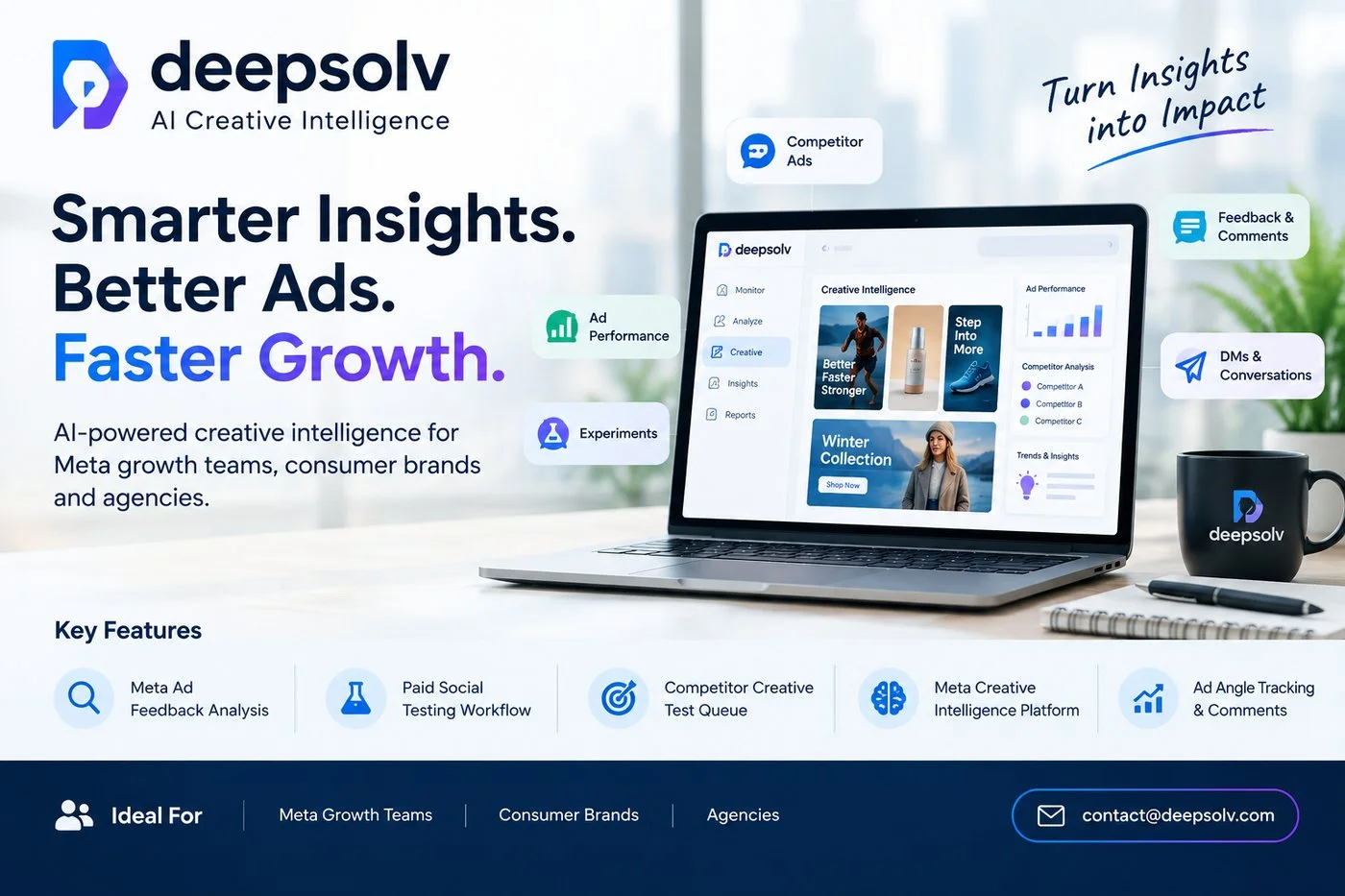
Platforms like [Deepsolv](https://www.deepsolv.ai/) are built exactly for this. They focus on AI-powered creative intelligence for Meta growth teams. Instead of just giving you more dashboards, they help you understand why a creative worked, what your competitors are doing, and whether your current ads are still aligned with your brand and customer voice. If you are running Meta at scale, it's worth exploring how organized creative insights can save your team hours every week.
*Step 6: Track Consistency and Performance Separately*
An ad can be 100% on-brand and still fail. And an off-brand ad with a heavy discount can sometimes give you great ROAS for 2 days.
So don't mix both metrics.
In your weekly review, have two separate checks:
1. *Brand Check:* Is our message, voice, and product claim accurate and consistent?
2. *Performance Check:* What is the CPA, ROAS, conversion rate?
If an on-brand ad fails, it doesn't mean you should abandon your brand voice. It might be the wrong audience, wrong offer, or wrong placement.
The goal is to build a brand that people recognize and trust, while still learning which specific messages drive results for which audience.
*Final Thought*
Scaling Meta ads is not just about producing more creatives. It's about making sure every new creative adds to your brand story, not confuses it.
You need a clear promise that never changes, a practical guide that everyone follows, regular reviews to catch drift, and a smart way to organize all your creative data.
When you get that right, you can run 20 campaigns at once and still sound like one brand. And that’s what makes customers remember you and trust you enough to buy.