Sign up with Google
 Sign in with Zoho

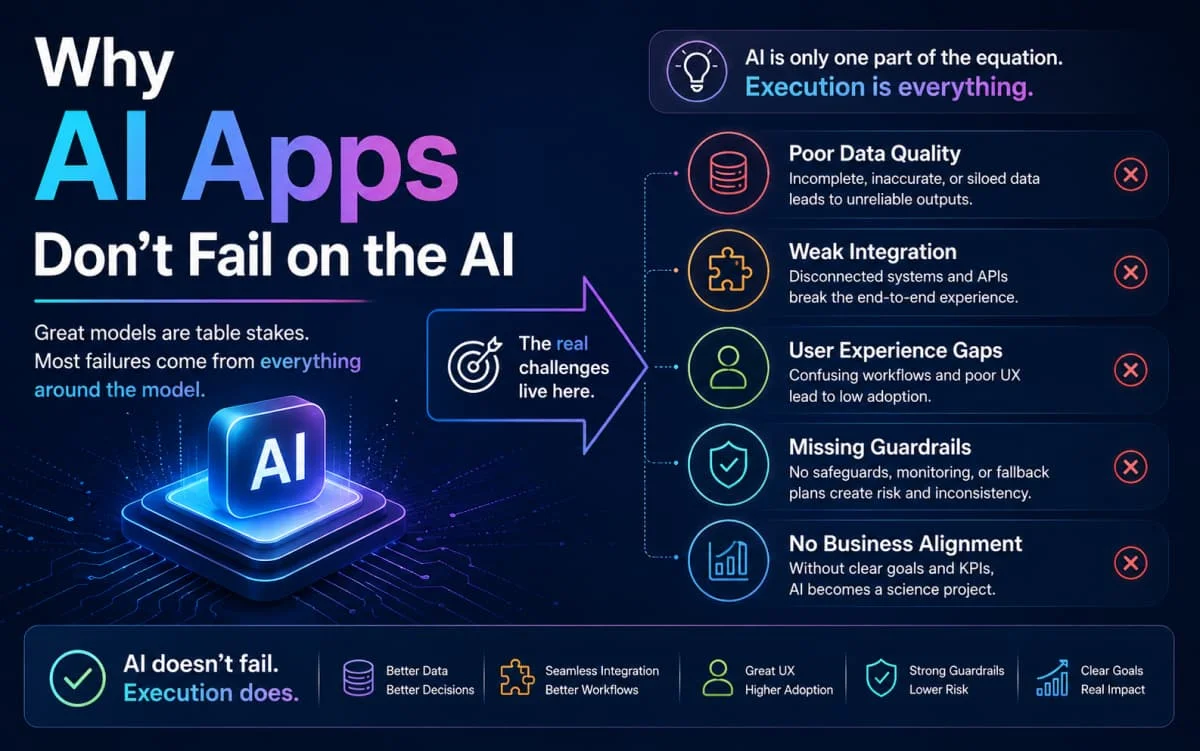
The demo always works. A sharp model answers questions, drafts the email, flags the anomaly, and everyone in the room nods. Six months later the same capability sits unused inside a pilot that never reached the people it was built for. The gap between those two moments is where most AI applications actually die, and the cause is almost never the model.
The failures cluster around everything that surrounds the model, which is exactly the part teams underinvest in when they treat the algorithm as the product.
This piece walks through what custom AI applications really are, where they break, the outcomes they produce when built well, and the integration, permissions, technology, and adoption work that separates a shipped product from a shelved pilot.
The AI Model Was Never the Hard Part
Foundation models arrive competent. A capable large language model (LLM) or a well-trained classifier handles the reasoning most business problems need, and the marginal gain from swapping one model for a slightly better one is small. What changes outcomes is the application wrapped around it: how it reaches live data, how it respects who is allowed to see what, and how it fits the tasks a person performs on a normal Tuesday.
Custom AI app development services exist to build that wrapper well. The work looks less like tuning a neural network and more like plumbing, identity, and interface design. A recommendation engine that cannot read current inventory recommends products that are out of stock. A support assistant that lacks account context gives confident, wrong answers. The intelligence was fine. The connective tissue was missing.
A useful mental model helps here: the model is a component, and the application is the system. A car engine is impressive on a test bench, yet nobody drives a bench. The transmission, the steering, the brakes, and the seat position decide whether the engine moves anyone anywhere. AI follows the same rule. The reasoning capability is real, but value shows up only once that capability is fastened to data, identity, and a workflow with the tolerances a business actually runs on.
That reframing matters because it changes where budget and attention go. Spend the effort where the failures happen.
Where AI App Development Solutions Actually Break
Three fault lines account for most of the wreckage, and none of them are about accuracy:
- Integration: The model needs live, trustworthy data from customer relationship management (CRM) systems, order databases, ticketing tools, and document stores. When those connections are brittle, batch-delayed, or missing, the app reasons over stale inputs and produces answers nobody trusts.
- Permissions: An assistant that can read every record is a breach waiting to happen; one that can read nothing is useless. Getting access control right, per user and per data source, is genuinely difficult and usually deferred.
- Adoption: A capability that forces people out of the tools they already use, or that adds friction to a task they had already mastered, gets quietly ignored regardless of how smart it is.
Strong AI app development solutions treat these three as the primary engineering problem, not as follow-up work. The pattern repeats across a mid-market lender that shelved a document-processing model because it could not connect to the loan origination system, and a retailer whose pricing assistant worked in staging but never got wired to the point-of-sale feed. Both projects had good models. Both stalled at the seams.
A fourth, quieter failure deserves naming: cost that nobody scoped. A prototype that calls a large model on every keystroke feels magical in a demo and turns punishing at production volume. Without caching, smaller models for routine steps, and retrieval that keeps prompts short, unit economics quietly sink the project. Teams that model cost per transaction early, the way they would size any other infrastructure, avoid the surprise that kills funding at review time.
Fix the seams, and the same model that looked mediocre in a pilot starts producing results people rely on.
What Custom AI App Development Services Deliver in Production
Judge an AI application by what it changes in daily work, not by benchmark scores. The outcomes that survive contact with production tend to look concrete and measurable.
Consider a few representative deployments. A claims team routes incoming documents through an extraction model that populates the adjudication system directly, cutting manual keying and shortening cycle time. A field-service group gives technicians a mobile assistant that reads equipment history and manuals, so a first-year hire diagnoses faults that once required a decade of experience. A finance department runs anomaly detection against transaction streams and flags the 12 items worth a human's attention out of tens of thousands.
Each of these is a use case where the model is ordinary and the surrounding application is exceptional. The extraction model matters less than the write-back into the adjudication system. The assistant's answers matter less than its live link to service records. This is the practical case for investing in custom AI app development services rather than another round of model evaluation: the differentiated value lives in the wiring, the access rules, and the interface, all of which have to be built for a specific business.
Benefits follow from that focus. Cycle times drop because data moves without re-keying. Error rates fall because the app validates against systems of record. Trust rises because outputs cite their sources and respect who is asking. Those gains compound: a shorter claims cycle frees adjusters for complex cases, and a technician who resolves faults on the first visit lifts customer satisfaction and cuts truck rolls at the same time. None of that comes from a higher benchmark score. It comes from an application that puts the model where the work already happens.
Permissions Are a Product Decision
Access control decides whether an AI app can ship at all, and it belongs in the first design conversation. A support assistant grounded in company knowledge is only safe if it enforces the same boundaries the underlying systems enforce. A salesperson should see their accounts; a manager, their region; neither should coax the model into surfacing records they were never cleared to read.
Doing this well means mapping identity end to end. Single sign-on (SSO) establishes who the user is. Role-based access control (RBAC) governs what that identity may retrieve, and those rules have to propagate into every data source the model touches, not just the front door. Retrieval has to filter documents by entitlement before they ever reach the prompt, because a model cannot un-see a record it was handed.
Compliance raises the stakes further. Applications that handle personally identifiable information (PII) or protected health data need redaction, audit logging, and retention controls built into the pipeline. Regulators and customers want to know what the system saw, what it produced, and who authorized the access. An artificial intelligence app development company that treats these as launch-blocking requirements, rather than post-launch patches, ships applications that legal and security teams will actually approve.
The Stack That Surrounds the Model
The technologies that determine success sit mostly outside the model file. AI based app development leans on a stack that has matured quickly, and each layer earns its place.
- Data and Retrieval: Vector databases and retrieval-augmented generation (RAG) ground the model in current, permissioned content, so answers reflect the organization's own facts rather than the model's training memory.
- Orchestration: Frameworks that chain model calls, tool use, and business logic turn a single prompt into a dependable workflow with checkpoints and fallbacks.
- Integration: Application programming interfaces (APIs), event streams, and connectors move data between the app and systems of record in near real time.
- Observability: Logging, evaluation harnesses, and monitoring catch drift, hallucination spikes, and latency regressions before users do.
- Deployment: Machine learning operations (MLOps) practices version the model, the prompts, and the retrieval index together, so a change is traceable and reversible.
Selecting the model is the shortest decision in the project. Choosing where data lives, how retrieval stays fresh, how the app fails gracefully when a call times out, and how a bad answer gets caught before a user acts on it takes far longer and matters far more. Those choices are what an experienced partner brings to the table, and they rarely appear in a proof of concept that only had to impress once.
None of this is exotic, and that is the point. A team that gets retrieval, orchestration, and observability right will beat a team chasing a marginally stronger model every time. The stack is where reliability comes from.
Building for the People Who Have to Use It
Adoption is the quietest failure and the most expensive. A tool can be accurate, secure, and well-integrated and still go unused because it asks people to change how they work without giving back enough to justify the switch.
Design for the person at the keyboard. Embed the capability inside the application they already open, whether that is the CRM, the service console, or the email client, so using AI is not a detour. Make outputs explainable: show the source, show the confidence, let the user correct a wrong answer and see the correction stick. Start with one high-friction task and win it decisively before expanding scope, because a narrow tool that clearly saves time earns the trust that a sprawling one never will.
Rollout is a process, not an event. The strongest engagements pair the build with change management: training grounded in real tasks, a feedback loop that routes user corrections back into evaluation, and a small group of early users whose wins give the rest of the organization a reason to follow. Measure adoption directly, not just accuracy, and treat a low usage rate as a defect to fix rather than a training problem to lecture away.
Watch how the best teams sequence this. They ship a thin slice to a handful of users, sit beside those users while they work, and rebuild the rough edges before a wider release. Every correction becomes a test case. Every complaint becomes a backlog item. By the time the tool reaches hundreds of people, it has already survived the objections that sink a big-bang launch.
The app that people reach for by habit is the one that pays back its cost. Everything upstream, the model included, exists to earn that habit.
The App Is What Ships, So Build the App
AI applications rarely fail because the intelligence fell short. They fail on integration that never held, permissions left for later, and interfaces people quietly refused. Getting AI app development solutions to production is an engineering and design discipline aimed at the seams, not a model-selection exercise. The teams that win in the next few years will be the ones that treat the model as the easy part and pour their effort into the connective work around it, backed by proven AI application development services that build for real workflows. The next competitive edge will not come from a smarter model everyone can buy; it will come from the app that finally makes that intelligence usable.