Sign up with Google
 Sign in with Zoho

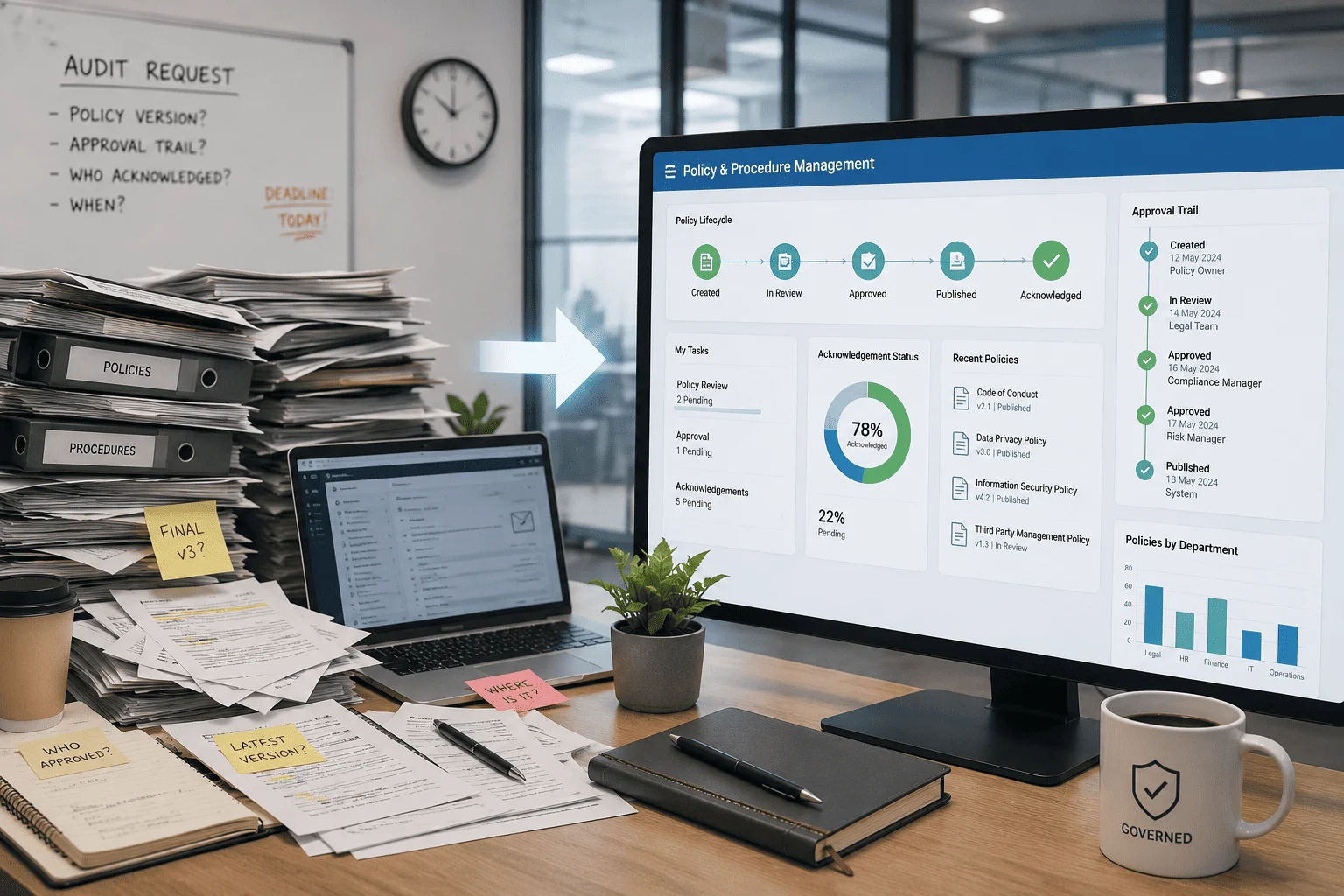
Every governance, compliance, or admin lead has sat through the same exercise: an auditor asks for the current version of a policy, the approval trail behind it, and a record of who has acknowledged it. What follows is rarely a five-minute lookup. More often it is a scramble through shared drive folders, email threads, and printed sign-off sheets, trying to reconstruct a history that was never captured in one place to begin with.
That scramble is the real cost of fragmented policy management, not the time spent writing policies, but the time spent proving they were followed.
The Questions an Audit Actually Asks
Most organisations assume an audit is primarily about whether the right policy exists. In practice, auditors spend far more time on a narrower set of questions: which version was in effect on a given date, who approved it and when, who was required to acknowledge it, and whether that acknowledgement is on record. A policy that exists but cannot answer those four questions with evidence is, from an audit standpoint, functionally the same as a policy that does not exist.
This is where email-and-shared-drive governance breaks down. A policy document sitting in a folder proves nothing about its approval history unless every revision, comment, and sign-off was also filed somewhere retrievable and in most organisations, it wasn't. The approval happened in an email thread that got archived, forwarded, or quietly deleted eighteen months later.
Why "We Have the Policy" Isn't the Same as "We Can Prove It"
Three gaps show up repeatedly during audit preparation across governance-heavy sectors banking, energy, government, and healthcare among them:
- No verifiable version history. Multiple copies of the same policy circulate with no reliable way to confirm which one was active on a specific date.
- No structured approval record. Sign-offs happened, but the evidence lives in inboxes rather than a searchable, exportable log.
- No acknowledgement tracking. Even when a policy was correctly approved and distributed, there is often no record of who actually read and accepted it.
Each of these gaps is a structural problem, not a staffing one. Email and shared drives were never designed to govern a lifecycle with defined stages, timestamps, and accountable owners.
What a Governed SharePoint Policy System Changes
A SharePoint policy and procedure management system replaces that reconstruction exercise with a live, queryable record. Every policy and procedure moves through defined stages: created, in review, approved, published, acknowledged, with each transition logged automatically, not manually recorded after the fact.
Practically, this means:
- Full version history by default. Every revision is timestamped and retained, so confirming what was in effect on any given date is a lookup, not an investigation.
- Structured, exportable approval trails. Power Automate-driven workflows route approvals through defined roles, with every decision logged in a format that can be handed straight to an auditor.
- Acknowledgement tracking built in. Policies can require a logged read-and-accept step from named employees, closing the gap between "the policy was distributed" and "the policy was received."
- Role-based access control. Sensitive policies are restricted at the platform level, which itself becomes part of the audit evidence proof that access, not just distribution, was governed.
What This Looks Like in Practice
Beeah Group, a sustainability organisation with more than 6,000 employees, faced exactly this challenge across a high volume of internal and external correspondence and policy communications. Moving to a SharePoint Online-based system integrated with Power Automate, Power BI, and DocuSign delivered a 65% reduction in correspondence processing time and a 50% increase in operational efficiency, alongside complete real-time visibility across the communication lifecycle. Audit preparation stopped being a multi-week reconstruction project and became a matter of pulling an existing report.
That shift from reconstructing evidence to retrieving it is the practical difference between a policy system that merely stores documents and one that is actually audit-ready.
Where to Start
Organisations don't need to migrate every policy at once. A typical rollout starts by assessing current approval chains and correspondence routing, then structuring a SharePoint Online environment around how the organisation actually operates rather than a generic template. Automated workflows for routing and approval follow, with reporting and e-signature integration layered in for full visibility, and a phased rollout that brings departments on board with proper training rather than a single disruptive cutover.
For governance-heavy enterprises in Saudi Arabia weighing up whether their current policy and correspondence setup would hold up under audit scrutiny, the more useful question to ask first is usually not "do we have the policy," but "can we prove it, in minutes, if asked today."
Neologix builds governed SharePoint policy, procedure, and correspondence management systems for exactly this kind of audit-readiness requirement, drawing on delivery experience across regulated industries in Saudi Arabia and the wider region.
Before and After: What Actually Changes
Under the old model, an audit request for a policy's history typically meant emailing three or four people to ask who has the latest version, searching inboxes for an approval that may or may not have been kept, and hoping nobody forwarded the wrong attachment along the way. The final answer was often a best guess assembled under time pressure, not a verified record.
Under a governed system, the same request becomes a filtered export: version history, approver, timestamp, and acknowledgement status, all pulled directly from the platform. The difference isn't just speed; it's that the second answer is defensible in a way the first one never was, because it was captured at the moment each action happened rather than reconstructed afterwards from memory and inboxes.
Frequently Asked Questions
Does this replace our existing policy documents, or just how we manage them?
It replaces the management layer, not the content. Existing policies and procedures are migrated into the governed repository along with their available history, and future revisions follow the structured lifecycle from that point forward.
How long does implementation typically take?
Most single-department rollouts are structured over several weeks, covering workflow assessment, platform configuration, and adoption support. Multi-department or multi-entity rollouts take longer, depending on the number of approval hierarchies involved.
Can this integrate with e-signature tools we already use?
Yes. Approval and correspondence workflows commonly integrate with e-signature platforms such as DocuSign, removing the print-sign-scan cycle from the approval chain entirely.
Is this only relevant for large enterprises?
The pressure is most visible in large, multi-department organisations, but the underlying problem no verifiable record of who approved what, and when shows up at any organisation with a formal audit or compliance obligation, regardless of headcount.


.webp)