Sign up with Google
 Sign in with Zoho

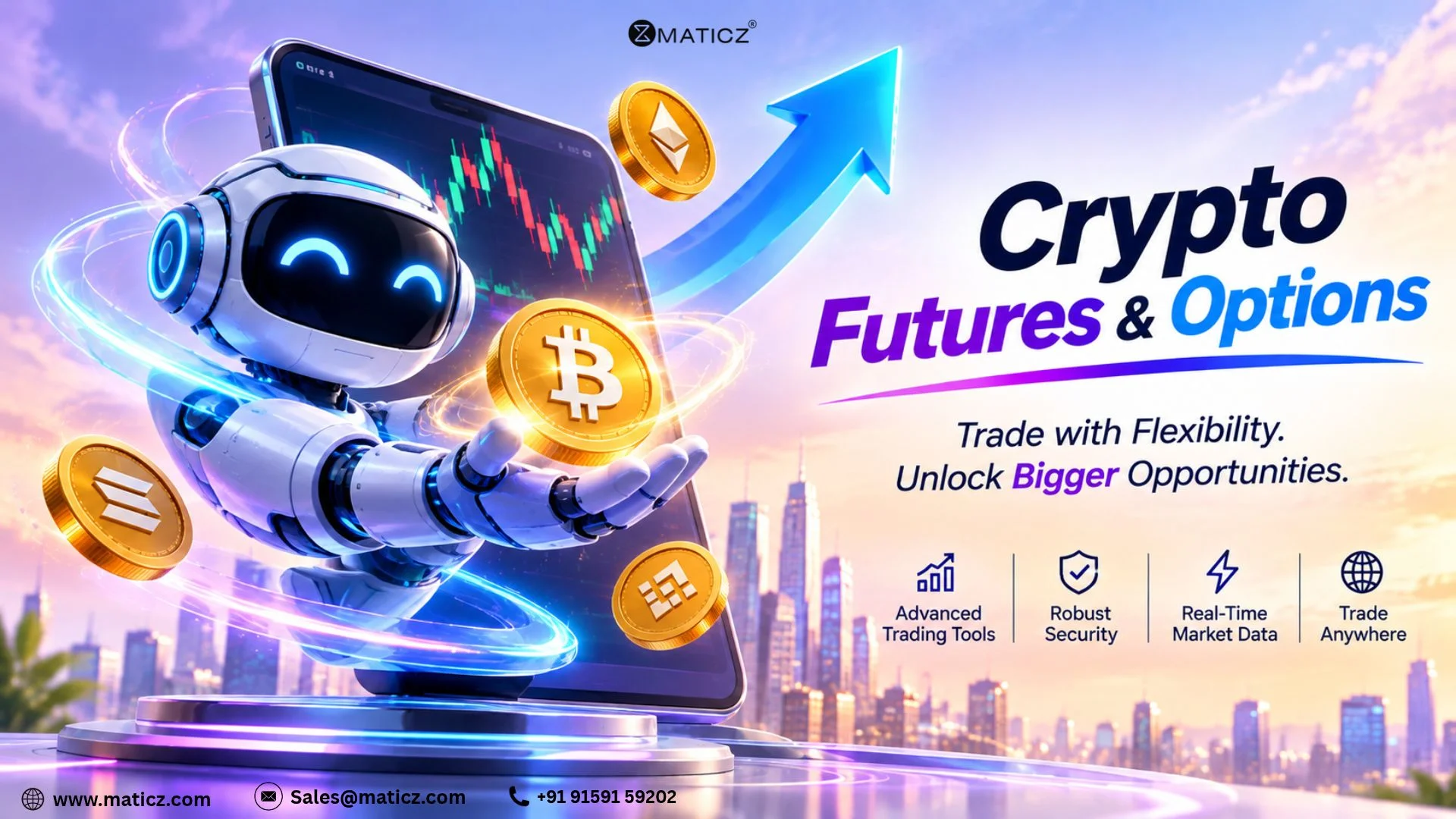
As we know, the crypto industry has outgrown its initial focus on only offering spot markets. Companies are now looking to add additional products such as futures and options to their offerings, to cater for a wider range of traders. But there are many considerations to take into account when developing a new crypto futures or options platform. A high quality infrastructure will be critical. There are several key areas which need to be considered to ensure your futures and options exchange meets these requirements. These include: order book performance, liquidity provision, risk controls, price feeds etc.
Here we will discuss some of the main considerations.
1. Building a Powerful Trading Engine
The trading engine will form the heart of every crypto futures and options trading venue. Its role is to receive user orders, match them against each other and facilitate trades according to certain logic. Ideally, the engine will be able to execute many concurrent orders while minimizing latency. Furthermore, the engine needs to accommodate various forms of orders such as: spot, limit, stop and advanced conditional orders. A robust matching function will allow the trading engine to keep order books up-to-date and continue executing trades smoothly when market volume increases.
2. Implementing Real-Time Market Data Processing
As the crypto asset space never closes, asset values may fluctuate dramatically over very short time intervals. As such, there is a requirement for effective mechanisms to capture, compute and share this data. By establishing a suitable real-time data feed, customers can view live asset prices, volumes, order book updates etc. This allows participants to stay informed about key developments in the market. With appropriate technology (e.g. WebSockets, data feeds, consolidation), customers can benefit from improved speed of data transmission. In the case of an options product, additional parameters such as implied volatilities, premium, expiry date and further statistics can be made available.
3. Ensuring Efficient Liquidity Management
A further consideration is the level of liquidity offered to participants on a crypto futures and options exchange. The degree of liquidity determines the ease with which customers will be able to fill their orders and avoid material slippage. Insufficient liquidity will lead to higher bid-ask spreads and greater potential for adverse movement when filling orders. Exchanges may therefore seek to bring in third parties (external liquidity pools, MM's, other venues) to supplement the liquidity on offer. By consolidating this, customers can expect a greater breadth of liquid markets.
4. Developing Reliable Risk Management Systems
Leverage, margin and expiry are all key elements of futures and options markets. In the absence of controls to manage these, an exchange can quickly run into difficulties. At a minimum, one would expect the platform to calculate margin, track open positions, trigger auto-liquidations and control client exposures. In the case of futures, this will be based on initial and ongoing margin and P&L. Options will additionally require ability to price contracts, and calculate various Greeks (Delta, Gamma, Theta and Vega). This allows the exchange to track their clients exposures and enforce any desired risk limits.
5. Prioritizing Platform Security
Security is another essential part of high-performance trading infrastructure. Exchanges handle sensitive user information, account balances, transaction records, and trading activities.
Businesses should implement multiple security measures, including:
- Multi-factor authentication for account protection.
- Encryption to secure sensitive information.
- Role-based access controls for administrative operations.
- Secure wallet integrations and asset management.
- Continuous monitoring to identify unusual activities.
- Regular security testing and vulnerability assessments.
Combining these measures helps protect platform operations and improve user confidence.
6. Designing Scalable Infrastructure
An exchange will see higher demands on its technology as it scales. If an exchange is able to operate at a low volume, this could cause issues as volumes rise. There are various ways that companies can ensure they have sufficient capacity to meet demand. Examples include: use of cloud technologies, load balance, distributed systems and improved database solutions. Key elements of an exchange's functionality (e.g. customers, orders, prices, wallets, limits) can be decoupled through the use of micro services. These can then be managed based on the business' requirements. Finally, the exchange should test for areas where the technology may fall short prior to going live.
7. Choosing the Right Development Company
To develop a sophisticated cryptocurrency exchange, one will require knowledge across multiple domains including but not limited to: Blockchain, Exchanges, Finance and Cyber Security. By engaging a specialist in building crypto futures and options trading platforms, you can begin to define and build out your desired set of core functionalities for your exchange. Depending on the requirements, this may range from developing bespoke trading engines, integrating liquid providers, creating futures and options products, supporting user wallets and hardening your system against cyber threats. Alternatively, some companies may wish to consider off-the-shelf technologies and have these adapted to meet their specific business needs. When choosing a company to work with to deliver these services, there are various factors to consider around their skill set, track record, integrations, growth strategy and post-deployment.
Conclusion
A robust set of technologies underpins any successful crypto futures or options exchange. These include trading engine, live markets, liquidity, risk and cyber security, among others. With the growth of the sector, there will be further demands placed on these platforms and their underlying technology. By implementing suitable technology and collaborating with skilled developers, companies can create powerful crypto futures and options platforms.