Sign up with Google
 Sign in with Zoho

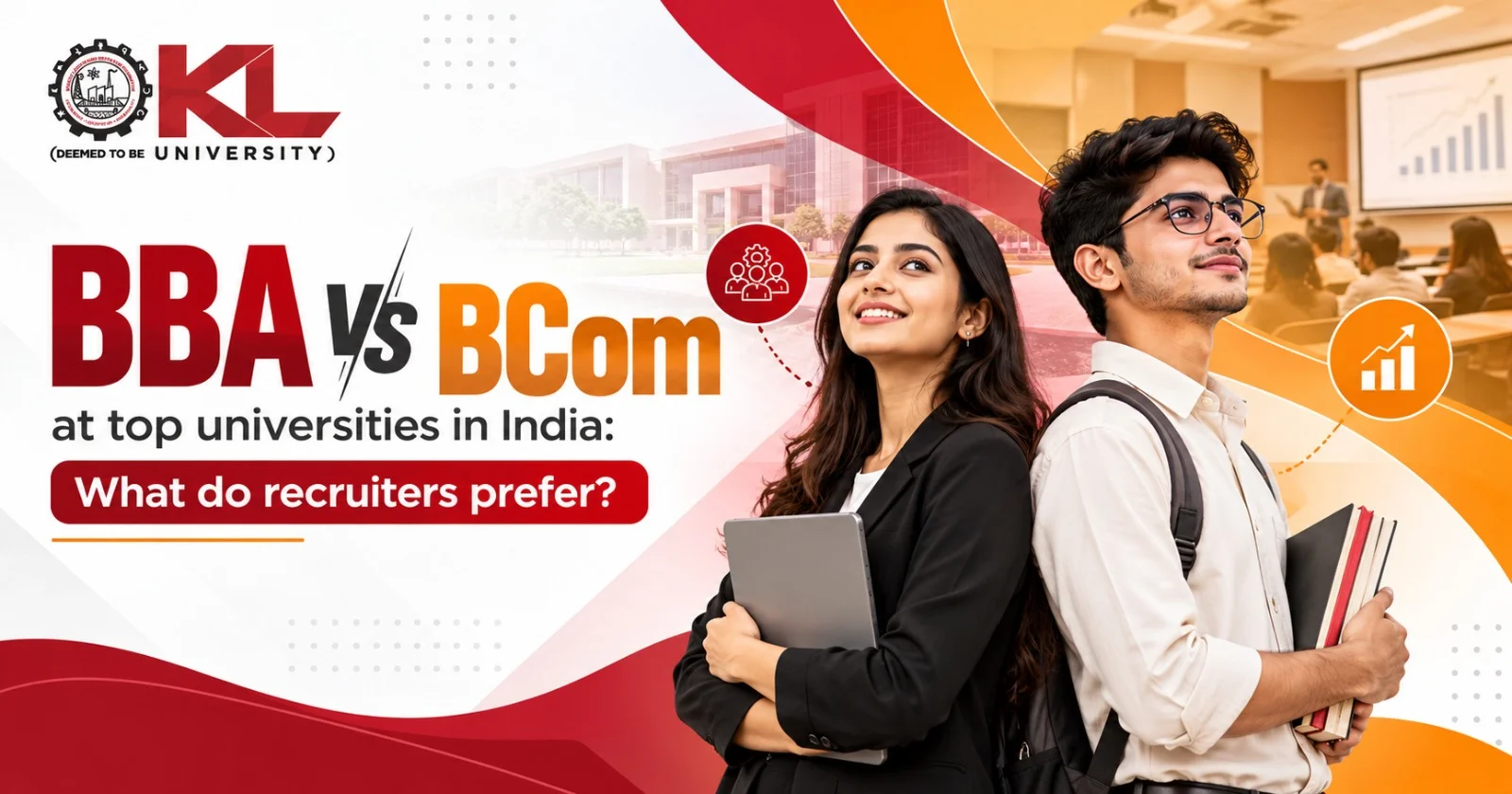
Does a BBA give you an advantage in a management role? Does a BCom make you a stronger candidate for finance? These are reasonable questions, but the answers depend on more than the name printed on your degree. The top universities in India can make a significant difference.
Employers hire for specific roles, and the knowledge needed for one job may differ considerably from another. A candidate's academic foundation matters, but so does their ability to apply it, communicate clearly, and learn on the job.
If you’re someone eyeing the top universities in India and are still confused between the two choices, understanding each one in depth can help. What will you be prepared for, what qualifications are useful, and how to decide what fits - let’s understand all of it.
BBA vs BCom: What will you actually study?
First things first, what is even covered in the two programmes?
A BBA usually focuses on how businesses operate. You get to study marketing, human resources, management, operations, entrepreneurship, business communication, and analytics. You’ll also undertake projects, especially at the top universities in India, which will revolve around developing business plans, studying customers, and solving organisational problems.
Now, talking about a BCom graduate, generally they have a stronger foundation in commerce. So if you opt for this, expect subjects like accounting, taxation, economics, business law, auditing, and financial management. This knowledge can help you explore accounting, financial reporting, banking, and related professional qualifications.
So you see, there is an overlap here. Both may cover economics, finance, and business fundamentals. The exact subject combination depends largely on the institution.
This makes reading the syllabus thoroughly while comparing the top universities in India extremely important. Also make sure to look at electives, practical assignments, internship opportunities, and the scope for further study.
Which degree fits your career interests?
Start with thinking about what you might enjoy, rather than trying to predict your entire career at 18.
These are possible pathways, not guaranteed outcomes. A student's skills, experience and the requirements of a specific role matter too.
What do recruiters look for beyond your degree?
A degree tells an employer what you have studied. Your experience helps demonstrate how you can use that knowledge. The top universities in India build:
Practical experience
An internship is your window to the real business world. A marketing student might help research an audience. A BCom student could assist with financial records under guidance. No matter which programme, practical experience is crucial.
Apart from that, case studies and independent projects also add value. The top universities in India provide many opportunities for such exposure. Just make sure to keep track of what you worked on, the decisions you made, and what you learnt.
Digital and analytical skills
Business roles involve spreadsheets, dashboards, reporting systems, and digital platforms. The tools could vary, but the ability to interpret information and explain what it means is useful across many functions.
The World Economic Forum's Future of Jobs Report 2025 identifies analytical thinking as a leading core skill. It also estimates that 39% of workers' existing skill sets could be transformed or become outdated between 2025 and 2030.
This makes the point very clear. While you evaluate the top universities in India, check if they build analytical skills into their courses. Check if you’ll work with data, if digital tools are used in assignments, and if students can apply their learning to business problems.
Communication and commercial awareness
Recruiters also want candidates who can explain their thinking. That could mean presenting a campaign idea, interpreting a financial report or explaining why a business decision makes sense.
So yes, only knowing something doesn’t cut it, you should be able to put it across. This is why the top universities in India focus on presentations, group assignments, case competitions, and internships. Students build confidence even before entering the workplace.
Integrated degree options with ACCA, CMA or EA?
While you’re here choosing between BBA and BCom, there are integrated options available at the top universities in India that are worth looking into.
BCom with ACCA
The Association of Chartered Certified Accountants (ACCA) qualification covers financial reporting, taxation, audit, performance management and strategic business leadership.
If you’re interested in accounting, audit and finance, and opt for a professional programme, this should be your pick. The qualification includes examinations, an ethics and professional skills module, and a practical experience requirement. Exemptions depend on which institution you pick, in the sense of what has already been covered in your programme.
BBA or BCom with CMA
The US Certified Management Accountant (CMA), offered by the Institute of Management Accountants, focuses on financial planning, performance, analytics, and strategic financial management. It has two examination parts, along with education and experience requirements.
It may interest you if you are considering management accounting, budgeting, and business finance.
What is the EA qualification?
The US Enrolled Agent (EA) credential focuses on US taxation. The process includes a three-part Special Enrollment Examination, an application for enrolment, and a suitability check.
It is a specialised pathway, so students should understand its scope before committing.
When comparing top universities in India, ask whether professional exam preparation is integrated into the timetable, what exemptions are available, and whether exam fees are included.
How does KL University approach these pathways?
KL University (KLU), one of the top universities in India, offers several undergraduate options for students interested in business and commerce. These include BBA Global Finance with ACCA, BBA Global Finance with CMA, BBA Business Analytics, BBA Multi Specialisations, and BCom (Hons) pathways with ACCA, CMA and EA. Additionally, it also offers an integrated five-year BBA+LLB programme for students interested in business and law.
These options illustrate why you should compare individual programmes rather than assume all BBA or BCom courses are alike. A student interested in analytics may prioritise different subjects from someone planning to pursue accounting or US taxation.
Check the latest course structure, eligibility criteria, fees, professional-body requirements, and available student support directly with the institution.
Final verdict: BBA or BCom?
Neither degree is universally better.
BBA may suit you if you want to explore management, marketing, business operations, entrepreneurship or business analytics. Look for a course with relevant electives, practical projects, and opportunities to understand how organisations work.
BCom may suit you if you are interested in accounting, taxation, financial reporting or a professional qualification such as ACCA, CMA or EA. Look for a solid commerce foundation and clear support for further study.
Both degrees can lead to varied careers.
Ultimately, the best choice among top universities in India is the programme that fits your interests, offers relevant learning opportunities, and gives you a realistic route towards your goals.
FAQs
Do recruiters prefer BBA or BCom?
There is no universal preference. It depends on the job, the employer, and the candidate's relevant skills and experience. Students at the top universities in India with relevant practical exposure and analytical skills are preferred more.
Can I pursue ACCA or CMA with BCom?
You can explore these qualifications with your degree. The top universities in India offer integrated programmes offering both options.
Can BCom graduates work in marketing or management?
Yes. They can explore these areas by developing relevant skills and experience at the top universities in India through electives, projects, and practical exposure.
What should I compare when choosing among top universities in India?
Compare the curriculum, practical learning, internships, integrated qualifications, total fees, and programme-specific career outcomes. Look beyond the ranking and the degree name.