Sign up with Google
 Sign in with Zoho

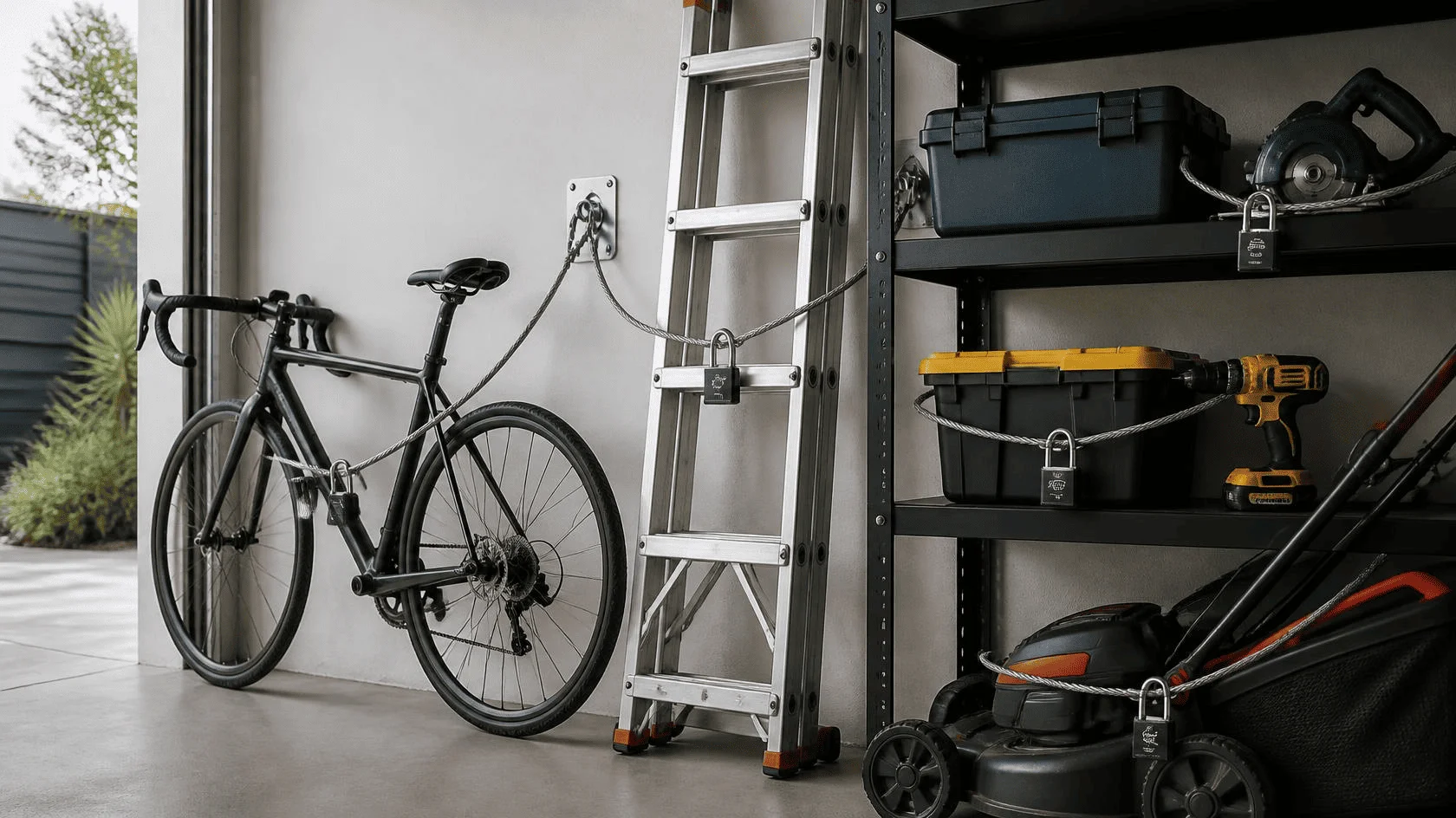
Fixed property is usually the hardest thing to remove from a premises. Portable property is a different story. Bikes, ladders, power tools, outdoor furniture, generators, retail displays, and laptops are all relatively easy to pick up and walk away with — unless something is physically stopping that from happening.
Security cables and locks work by connecting a portable item to a fixed anchor point, adding a practical layer of deterrence against opportunistic theft. They’re not a guarantee, and no cable is suitable for every risk level — but when the right cable, lock, and anchor point are matched to the asset and environment, they significantly raise the effort required to remove an item without authorisation.
Choosing the right combination is where most people go wrong. This guide walks through each decision in plain terms so you can get it right from the start.
What Are Security Cables and Locks?
A security cable is a flexible steel or braided-steel line designed to tether a portable item to an immovable structure. Depending on the product, it may include an integrated locking mechanism or be designed to work with a separate padlock, disc lock, U-lock, or compatible locking hardware.
The basic setup is straightforward: the cable passes through or around the item being secured, connects to a fixed and solid anchor point, and the lock prevents the cable from being released without authorised access.
What makes cables particularly useful is their flexibility. Rigid locks work well for items with a specific shape or security slot. Cables can loop around frames, handles, wheels, rungs, and irregularly shaped equipment that a rigid lock can’t easily accommodate. That adaptability makes them a practical choice across homes, offices, worksites, retail spaces, and outdoor areas.
Step 1: Identify What You Need to Secure
The right security system starts with the asset, not the product shelf. Before comparing cables and locks, get specific about what you’re actually trying to protect and how it will be used.
Work through these questions first:
- What is being secured — a bike, tool, ladder, laptop, generator, patio setting, retail display, trailer, or gate?
- What is the approximate replacement value, and does it justify a more robust system?
- Does the item have a frame, handle, security slot, wheel spoke, or structural point the cable can thread through cleanly?
- How long will the item be left unattended — a few minutes, several hours, overnight, or longer?
- Where is it being secured — indoors, in a public outdoor area, a worksite, a shared car park, or a retail environment?
- Is the primary concern theft, unauthorized movement, or simply tamper evidence?
A laptop in a supervised office environment has very different security requirements from a generator left on an unattended worksite overnight. Getting clear on these specifics before selecting a product prevents the common mistake of under-specifying the system for the actual risk.
Step 2: Choose the Right Cable Type and Size
Once you know what you’re securing and in what environment, the cable itself needs to match that requirement. There are four practical factors to work through.
Cable Material
Look for steel or braided-steel construction as the baseline. A protective outer coating — typically rubber or PVC — helps reduce surface scratches on equipment, improves grip, and provides better resistance to outdoor conditions including moisture and UV exposure.
Cable Thickness
Thicker cables offer more physical resistance but are heavier and less flexible. Match the thickness to the risk level and asset value rather than defaulting to the lightest option for convenience. A thin cable may be appropriate for a laptop in a low-risk indoor setting; a tool or bike in an exposed outdoor location warrants something more substantial.
Cable Length
The cable needs to be long enough to pass through the asset and around the anchor point without strain — but excessive slack works against you. Loose cable is easier to manipulate and creates more room to work for anyone attempting to cut or remove it. Where possible, use adjustable or cinching cables to reduce unused length once the item is secured.
Cable Design
Common designs include looped-end cables, double-loop cables, coiled or retractable cables, integrated-lock cables, and anchor-based systems. The best design depends on the item being secured and the installation environment. A coiled cable is practical for a laptop bag; a double-loop is better suited to securing a frame to a fixed post.
Step 3: Select a Suitable Lock
The cable is one half of the system. The lock is the other, and it matters just as much.
The most common locking options each have practical trade-offs:
- Keyed locks are a strong choice when controlled access is the priority. Factor in key management — where spares are kept, who holds them, and how keys are accounted for when staff change.
- Combination locks work well for shared or lower-to-medium risk environments. Codes should be updated when users change, and codes should not be shared more widely than necessary.
- Padlocks offer flexibility because they pair with a wide range of cable types. Choose a padlock with a robust body and shackle appropriate to the environment — outdoor use requires weather-rated hardware.
- Integrated cable locks are compact and portable, which makes them convenient. Ensure the integrated mechanism is rated appropriately for the intended use — lighter integrated locks are better suited to lower-risk situations.
Whichever lock type you choose, it should resist pulling, prying, and the weather conditions it will be exposed to. For higher-risk settings or overnight outdoor storage, a light-duty cable lock alone is unlikely to be sufficient.
Step 4: Never Overlook the Anchor Point
This is the step most people skip — and it’s the one that determines whether the entire system actually works.
The anchor point is where the cable is fixed. If the anchor point can be cut, lifted, unscrewed, or simply moved, the cable and lock become irrelevant. A strong cable secured to a weak anchor is not a secure system.
When selecting an anchor point:
- Use an immovable structural feature — a purpose-built floor or wall anchor, a secure rack, a fixed post, a structural column, or a reinforced building element.
- Avoid lightweight railings, removable furniture, weak fencing, or anything that can be detached or moved with basic tools.
- Confirm that the cable loop cannot simply be slipped up and over the anchor or item without cutting the cable.
- Where no suitable fixed point exists on a property, consider having a purpose-built anchor point professionally installed.
For business premises, also check that any cable run across a floor or walkway does not create a trip hazard, interfere with access routes, or obstruct emergency exits.
Security Cables for Home Use
At home, security cables are most commonly used to protect items that are stored in semi-exposed areas or left unattended outdoors for periods of time.
Practical home applications include:
- Securing bicycles and scooters to a fixed post, wall anchor, or purpose-built ground anchor in a garage or shared building area.
- Tethering outdoor furniture, barbecues, and garden equipment to a fixed point when not in active use.
- Protecting tools and equipment stored in sheds, garages, or on balconies.
- Securing ladders to a vehicle roof rack or garage anchor when they’re not in use and difficult to store out of sight.
Security cables work best as part of a broader home security approach rather than as a standalone measure. Secure sheds and garage doors, adequate outdoor lighting, and general property security habits all contribute to reducing opportunistic theft risk alongside physical cable security.
Security Cables for Businesses
Commercial environments present a wider range of portable assets and, often, a higher volume of people moving through the space. Cables offer a practical way to secure equipment without making it inaccessible for legitimate use.
Common business applications include:
- Securing power tools and equipment at construction or trade worksites where items may be left between shifts.
- Tethering laptops, monitors, projectors, tablets, and other office technology to desks or fixed furniture.
- Protecting retail displays that need to remain visible and accessible to customers while limiting unauthorised removal of merchandise.
- Securing outdoor hospitality furniture, commercial equipment, or storage assets at premises with outdoor areas.
Businesses should also maintain a record of who holds keys or knows lock combinations, and regularly inspect cables, anchors, and lock hardware for signs of wear, corrosion, or tampering. A cable that was secure when installed may not remain so without periodic checks.
Common Mistakes to Avoid
Most security cable failures come down to the same avoidable errors:
- Choosing a cable that is too thin or light-duty for the asset being protected or the risk level involved.
- Securing the cable to a weak, removable, or structural unsound anchor point.
- Leaving excessive slack in the cable, which creates room to work and makes cutting easier.
- Using a lock that is not rated for outdoor conditions when the installation is exposed to weather.
- Forgetting to secure removable components — a bike wheel, a tool attachment, or a detachable accessory — separately from the main item.
- Sharing keys or codes without a clear process for managing access and updating credentials when people leave.
- Assuming a light-duty cable lock alone is adequate for high-value items or extended unattended periods in exposed locations.
Match the System to the Risk
The best security cables and locks are not necessarily the most expensive ones on the shelf. They’re the ones that match the actual risk — the right cable strength, an appropriate lock type, a genuinely secure anchor, and a length that doesn’t create unnecessary slack or vulnerability.
Take the time to assess what you’re protecting, where it’s being secured, and how long it will be left before selecting a system. A few minutes spent on that process is far less costly than replacing an item that a better-matched system would have protected.
Need advice on physical security hardware for your Cronulla home or business? Contact Clockwork Locksmiths — your local locksmith in Cronulla — for professional guidance on locks, anchor systems, and security solutions across Sydney's Bayside suburbs.