Sign up with Google
 Sign in with Zoho

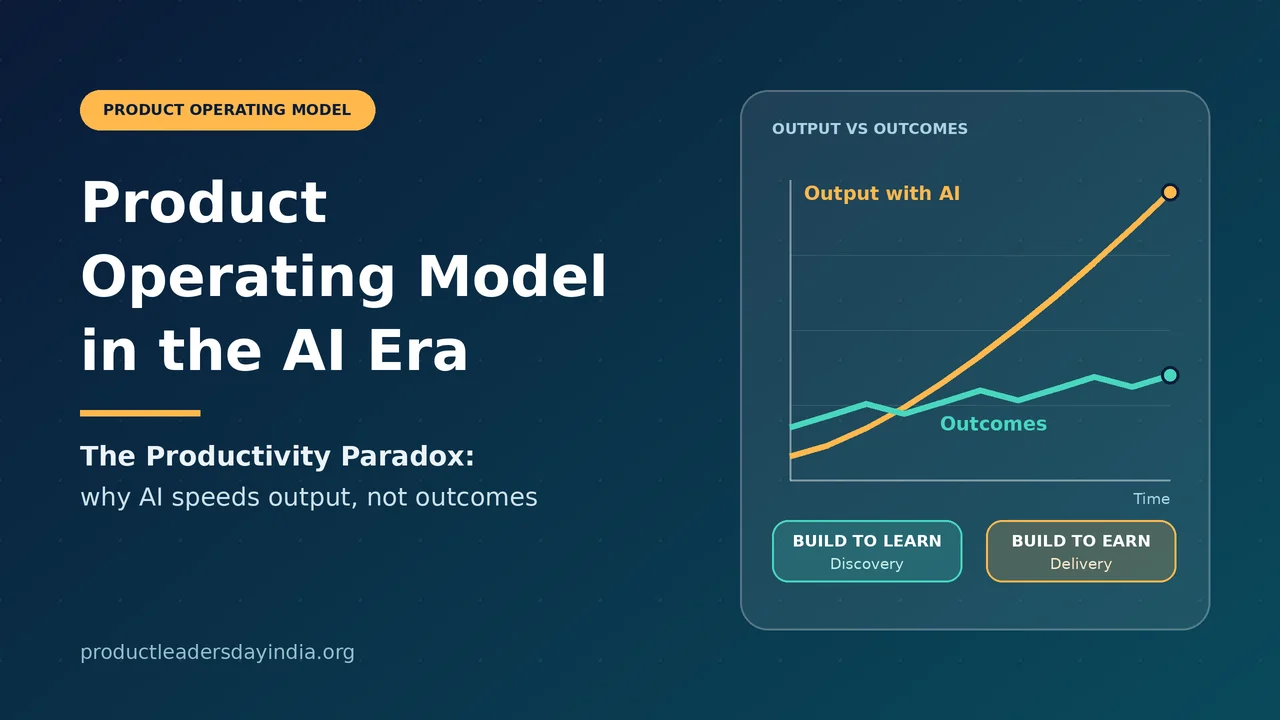
He points to McKinsey research describing growing adoption but a hard-to-find performance impact, and to an Atlassian report where most executives say AI sped things up but very few can show a return across the whole organization.
Why it is not a real paradox
Cagan's explanation is simple. Most people use AI to speed up the old project-model way of working, and slowness was never the only problem with that model. It was built to deliver output, not outcomes. AI product leader Hilary Gridley put it well when she said it has never been easier to run 10 times faster in the wrong direction.
Build to learn, build to earn
The way out is to separate two kinds of work.
- Build to learn is discovery. AI accelerates prototypes and tests that show whether a solution is valuable and viable, before you commit.
- Build to earn is delivery. Once evidence exists, AI accelerates commercial-quality building: reliable, accurate, scalable and performant.
Weaker teams use AI to churn out the old model's paperwork faster: business cases, roadmaps, requirement documents and code. Stronger teams use it to find a solution that is actually worth building.
Four questions for your next leadership meeting
- Strategy: are we using AI speed to test more ideas, or to ship more of the same?
- Teams: do teams own an outcome, or just deliver faster to a plan?
- Governance: do we review outcome evidence, or counts of shipped features?
- Quality: is there a clear threshold between a prototype and production?
Signs you are inside the paradox
- You ship more features every quarter and customer metrics do not move.
- AI-written documents and decks pile up, and nobody can name a decision they changed.
- Prototypes go out to customers as real products, with no quality bar in between.
- Leaders judge AI by hours saved instead of outcomes moved.
- Teams still receive a list of features to build, just with a shorter deadline.
What the research adds
McKinsey's operating-model research says that rolling out generative AI across the software life cycle, and building capability on purpose, can improve developer experience and productivity in areas like code generation, documentation and test creation. It also notes that operating-model maturity, especially ways of working, correlates most strongly with business results. Put that next to Cagan's paradox and the message is clear: AI helps most where the model around it already turns speed into learning.
A 30-day starting plan
Week one, list where teams already use AI and which outcomes those artifacts actually changed. Week two, pick one team, give it an outcome with a baseline, and ask it to use AI for discovery experiments rather than extra output. Week three, introduce an experiment card and a production-readiness note. Week four, hold an evidence review and ask whether AI shortened the time to a decision or just added to the pile.
If the review shows more artifacts but the same decisions, you have found the paradox in your own organization. Fix structure, funding and decision rights before buying more tools.
The full guide, with a checklist and templates, is here: https://productleadersdayindia.org/blogs/ai-driven-product-operating-model/product-operating-model-in-the-ai-era.html
Author: Ayush Bisht, Content Engineer and AI Tools Specialist at AgileWow.