Sign up with Google
 Sign in with Zoho

Relationships rarely develop in a perfectly predictable order. Two people may start as friends, spend months in the talking stage, or become romantically involved almost immediately. Even so, many couples experience similar patterns as attraction develops into emotional intimacy, commitment, and long-term partnership.
Understanding the stages in a relationship can help you recognize what is happening between you and your partner without assuming every relationship must follow an exact timeline. Some phases last weeks, while others can last years. Healthy couples may also move backward, revisit earlier challenges, or skip certain stages altogether.
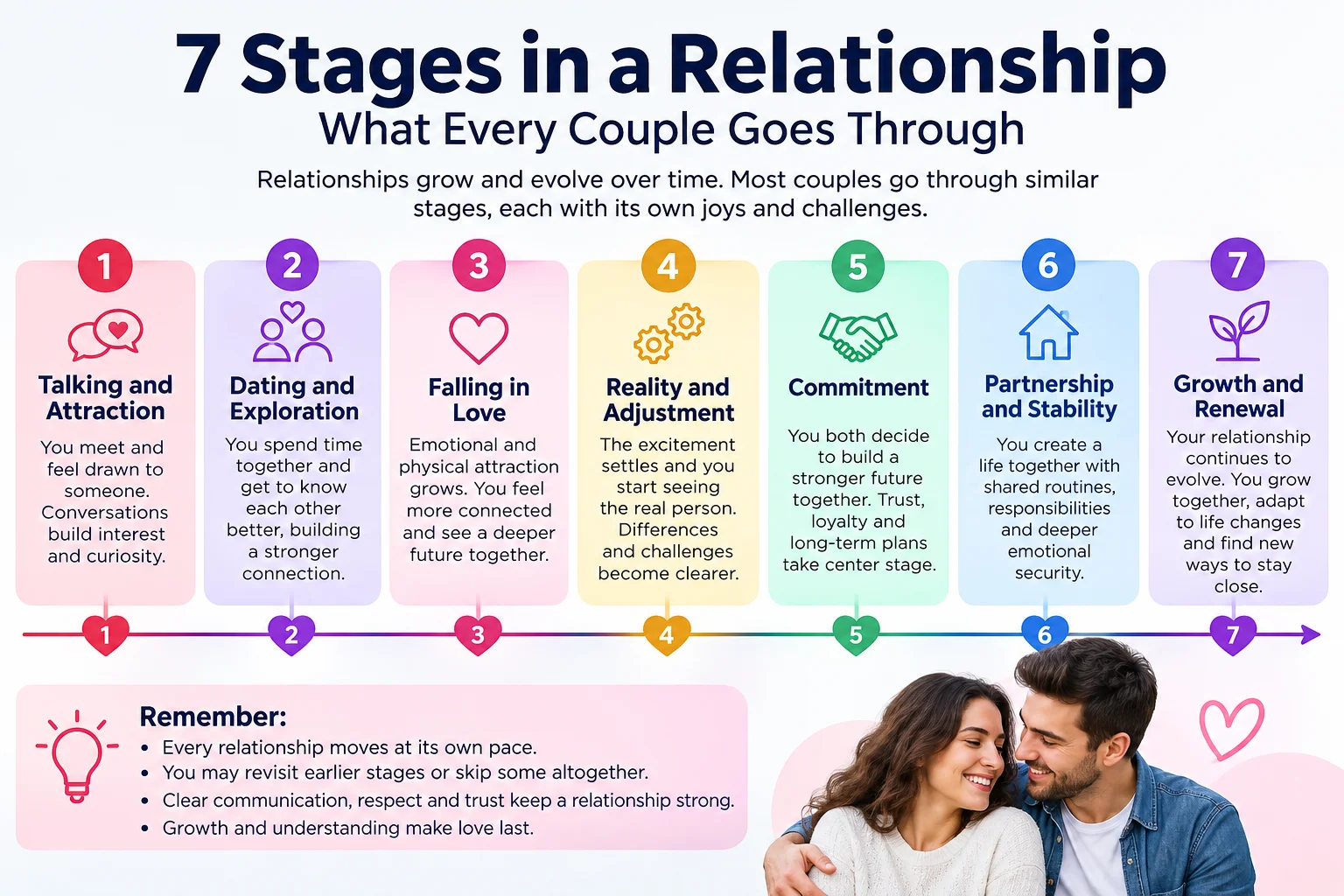
Here are seven common stages that can help explain the relationship journey.
1. The Talking and Attraction Stage
The first stage often begins before an official relationship exists. You are interested in someone, conversations become more frequent, and you start looking for opportunities to spend time together.
This is commonly called the talking stage relationship. You may be learning about each other's personalities while trying to determine whether there is romantic potential.
During this phase, people often focus on:
- Shared interests and hobbies
- Sense of humor and personality
- Communication style
- Physical attraction
- Lifestyle and values
- Whether the interest appears mutual
There is usually a lot of curiosity at this point. However, it is worth avoiding assumptions. Frequent texting or strong chemistry does not automatically mean both people want the same type of relationship.
A useful approach
Let the connection develop naturally while paying attention to consistency. Someone's actions over time usually tell you more than an exciting first few conversations.
2. The Dating and Exploration Stage
Once mutual interest becomes clearer, dating usually becomes more intentional. This is one of the most recognizable stages of dating because both people are actively discovering whether they work well together.
Early dates can reveal things that casual conversations do not. You may notice how the other person handles disagreements, treats service workers, manages commitments, or talks about previous relationships.
This stage is less about finding someone who is perfect and more about understanding compatibility.
Consider questions such as:
- Can we communicate comfortably?
- Do our expectations about dating match?
- Do we respect each other's boundaries?
- Are our lifestyles reasonably compatible?
- Can we enjoy ordinary time together, not just exciting dates?
These observations provide a more realistic picture of relationship compatibility.
3. The Falling-in-Love Stage
As emotional and physical attraction grows, the relationship may enter one of the most exciting stages of falling in love.
You may think about your partner frequently, look forward to seeing them, and feel increasingly emotionally connected. Small interactions can feel unusually meaningful.
This phase can involve strong positive emotions, but it can also make it easy to overlook differences. People sometimes see their partner primarily through the lens of excitement and possibility.
Keep perspective
Enjoy the excitement, but continue getting to know the person as they actually are. Don't rush major decisions simply because the relationship feels intense.
A healthy connection needs more than chemistry. Trust, respect, communication, and compatible expectations become increasingly important as the relationship develops.
4. The Reality and Adjustment Stage
Eventually, the idealized version of the relationship starts meeting everyday reality. This is a significant point in the relationship timeline.
You begin noticing habits, differences, insecurities, communication problems, and conflicting preferences that were easier to overlook earlier.
For example, one partner may want frequent communication while the other needs more personal space. One may prefer saving money, while the other enjoys spending it. Neither preference is automatically wrong, but the differences need to be discussed.
This stage can feel less romantic than the beginning, but it can be extremely valuable.
What healthy couples do here
Instead of trying to "win" disagreements, they learn how to solve problems together. They become more comfortable saying:
- "I see this differently."
- "Can we find a compromise?"
- "That hurt me. Can we talk about it?"
- "What do you need from me?"
The goal is not to eliminate differences. It is to learn how to handle them respectfully.
5. The Commitment Stage
When couples decide that they want to build something more serious, the relationship may move into a deeper commitment phase.
Commitment can look different for different couples. It might mean becoming exclusive, making future plans, introducing each other to family, sharing responsibilities, or simply agreeing that the relationship deserves long-term effort.
At this point, relationship progression becomes less about excitement and more about reliability.
Trust grows when partners consistently follow through on promises, communicate honestly, and support each other through ordinary challenges.
Commitment should also remain voluntary. A relationship becomes healthier when both people choose it freely rather than staying because of fear, pressure, or dependency.
6. The Partnership and Stability Stage
With time, couples often develop routines and a stronger understanding of each other. The relationship may feel calmer than it did during the early dating stages, but calm should not automatically be mistaken for boredom.
You may know how your partner takes their coffee, how they react when stressed, or when they need space after a difficult day.
This familiarity can create emotional security.
At the same time, long-term relationships require maintenance. Work, family responsibilities, financial pressure, and changing personal goals can affect the connection.
Keep the relationship active
Small habits can make a meaningful difference:
- Have regular conversations without phones or distractions.
- Continue expressing appreciation.
- Make time for shared experiences.
- Respect individual friendships and interests.
- Discuss important decisions before they become conflicts.
- Keep learning about how your partner is changing.
A stable relationship should still leave room for growth.
7. The Growth and Renewal Stage
The final stage is not necessarily an endpoint. Long-term relationships continue changing as people grow.
Couples may face major life transitions such as moving, changing careers, becoming parents, caring for relatives, or simply developing different interests. These experiences can require the relationship to adapt.
This is why the 7 stages of a relationship are better understood as a flexible framework rather than a fixed relationship stages timeline.
A couple may return to earlier stages in a new form. After a difficult period, for example, partners may need to rebuild emotional closeness. After years together, they may experience a renewed sense of discovery.
What keeps a relationship healthy?
The strongest relationships are not necessarily those without problems. They are often relationships in which both people can acknowledge problems, repair damage, and continue growing together.
Why Relationship Stages Do Not Follow One Exact Timeline
There is no universal schedule for the phases of a relationship.
One couple may become exclusive after several dates. Another may spend months getting to know each other. Some people meet through friendship, while others begin through online dating.
The important question is not whether your relationship is progressing at the same speed as someone else's. Instead, ask whether the progression feels mutually comfortable and respectful.
If you are constantly pressured to move faster, avoid difficult conversations, or accept behavior that makes you uncomfortable, simply being at a particular "stage" does not make those problems healthy.
Conclusion
The stages in a relationship can provide a useful way to understand how attraction, dating, emotional intimacy, commitment, and long-term partnership may develop. However, real relationships are rarely as neat as a seven-step timeline.
What matters most is how two people communicate, handle differences, respect boundaries, and adapt as their lives change. Whether you're in the talking stage or building a long-term partnership, understanding your current phase can help you make more thoughtful decisions about where the relationship is heading. For more relationship-focused perspectives, readers can also explore resources from Favor.
6. FAQs
What are the stages of a relationship?
The seven commonly discussed stages are attraction and talking, dating and exploration, falling in love, reality and adjustment, commitment, partnership and stability, and growth and renewal.
How long does each relationship stage last?
There is no standard timeframe. Each couple progresses differently depending on their personalities, circumstances, expectations, and level of compatibility.
Is the talking stage considered a relationship?
Not necessarily. The talking stage usually describes a period when two people are getting to know each other and exploring romantic interest before defining the relationship.
What is the hardest stage of a relationship?
The reality and adjustment stage can be challenging because differences that were less noticeable early on become clearer. How couples communicate during this period can strongly influence the relationship.
What are the stages of a healthy relationship?
Healthy relationships generally involve mutual interest, honest communication, emotional intimacy, respect, commitment, effective conflict management, and continued growth. These qualities can develop at different speeds.