Sign up with Google
 Sign in with Zoho

Hair thinning can lead people to research everything from topical treatments and supplements to hair transplants and injectable procedures. Two options that appear frequently in nonsurgical hair restoration are platelet-rich plasma, or PRP, and platelet-rich fibrin, or PRF.
Both treatments start with a patient's own blood. The blood is processed so a platelet-containing portion can be used in targeted areas of the scalp. The preparation process differs between PRP and PRF, which is why a provider may discuss one or both options during a hair-loss consultation.
For people considering platelet-based treatment locally, Anti Aging & Ketamine Center provides PRP/PRF treatment in Bradenton and offers a dedicated hair-restoration program using both PRP and PRF.
PRP has been studied more extensively for hair loss than PRF. The American Academy of Dermatology states that research suggests PRP can be a safe and effective treatment for some patients with hair loss, while newer PRF research is encouraging but still developing.
Understanding the differences can help patients ask better questions before choosing a treatment.
What Is PRP Hair Restoration?
PRP stands for platelet-rich plasma.
The treatment generally begins with a standard blood draw. The sample is placed into a centrifuge, which separates different components of the blood.
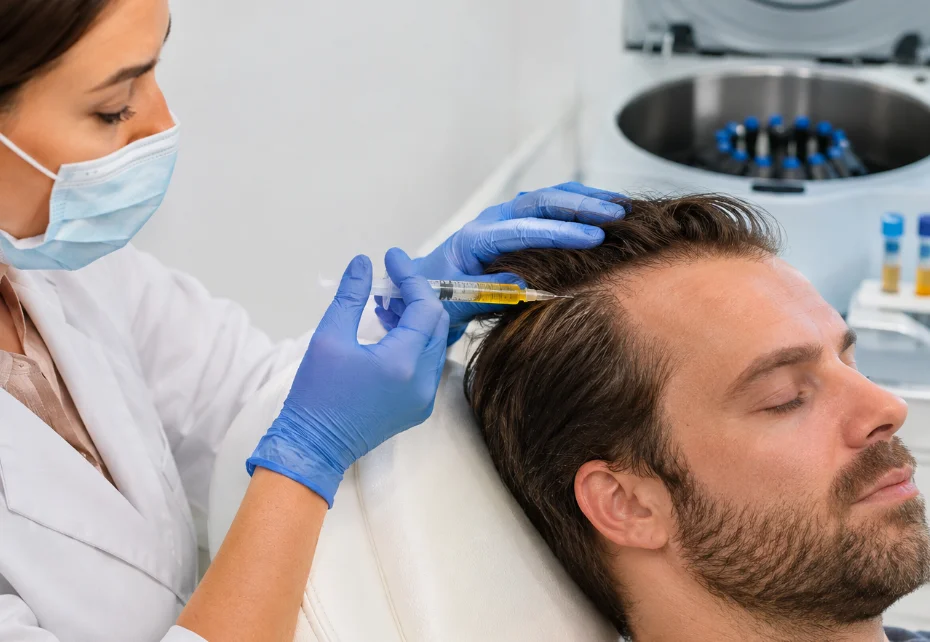
A platelet-concentrated portion of the plasma is then collected and injected into selected areas of the scalp.
The American Academy of Dermatology describes PRP hair treatment as drawing a small quantity of blood, separating it into components, and injecting the plasma into areas affected by hair loss. The organization notes that repeat treatments are typically necessary rather than PRP being a one-time procedure.
Anti Aging & Ketamine Center follows a similar general process for its Bradenton hair-restoration treatments. The clinic states that PRP or PRF is obtained from a patient's blood, processed in a centrifuge, and injected into marked areas of the scalp.
What Do Platelets Have to Do With Hair?
Platelets are blood components best known for their role in clotting.
They also contain signaling proteins and growth factors involved in tissue repair and cellular communication.
The rationale behind PRP hair treatment is to deliver a concentrated platelet-containing preparation around existing hair follicles.
PRP should not be thought of as adding new follicles to the scalp.
It is better understood as a treatment intended to influence existing follicles.
This distinction is particularly important for people with advanced hair loss.
What Is PRF Hair Restoration?
PRF stands for platelet-rich fibrin.
Like PRP, it is produced from the patient's blood using centrifugation.
The primary difference is the way the blood is processed and the resulting composition of the preparation.
Anti Aging & Ketamine Center states that its PRP preparation involves an anticoagulant, while its PRF process does not use chemical additives in the collection tube. The clinic also describes PRF as containing a fibrin matrix associated with a different release pattern for platelet-related components.
PRF has received increasing attention in hair-restoration research.
A 2026 systematic review examining regenerative approaches for androgenetic alopecia included PRF studies and reported promising clinical results. The authors also emphasized substantial differences among treatment protocols and the need for larger randomized trials and longer follow-up.
That last point is important.
Promising research does not mean every PRF protocol has been proven equally effective.
PRP vs. PRF for Hair Loss: The Main Differences
PRP and PRF belong to the same broad family of autologous platelet-based procedures, but they are not identical.
PRP
PRP typically involves:
- Blood collection
- Centrifugation
- Separation of platelet-rich plasma
- Use of an anticoagulant depending on the system
- Scalp injections
PRF
PRF generally involves:
- Blood collection
- A different centrifugation protocol
- No anticoagulant in commonly used PRF preparation methods
- Formation of a fibrin-containing preparation
- Scalp injections
The differences can affect how the final material behaves after preparation.
There is no universally standardized PRP or PRF formulation used by every clinic.
Processing equipment, centrifuge settings, tube type, platelet concentration, leukocyte content, injection volume, and treatment intervals can vary.
This variation is one of the major challenges researchers face when comparing platelet-based hair treatments.
A recent review of PRP for androgenetic alopecia noted that studies remain limited by inconsistent reporting of preparation methods and treatment protocols.
Is PRP or PRF Better for Hair Loss?
There is not enough evidence to declare one universally better.
PRP currently has the larger body of clinical research.
A 2025 systematic review and meta-analysis evaluated 43 randomized controlled trials involving 1,877 participants receiving PRP for alopecia. The review found evidence of benefits for several hair-related outcomes, while also demonstrating that results depend on preparation and study design.
A separate 2024 meta-analysis reported improvement in hair density among patients with androgenetic alopecia treated with PRP. The authors also described the available studies as highly heterogeneous and the overall evidence quality as low, reinforcing the need for better standardized trials.
PRF has less research behind it but is attracting increasing attention.
A 2024 study involving 11 patients with female pattern hair loss reported improvements after a series of injectable PRF treatments. Because the study was small, its findings should be considered preliminary rather than definitive.
A broader 2026 systematic review also found encouraging results for PRF in androgenetic alopecia but called for larger controlled trials and standardized treatment protocols.
The practical answer is that the choice should be individualized.
Which Types of Hair Loss May Be Considered for PRP?
PRP is most commonly discussed in connection with pattern hair loss.
That includes:
- Male pattern hair loss
- Female pattern hair loss
- Androgenetic alopecia
The American Academy of Dermatology discusses PRP as an option for some patients with pattern hair loss and emphasizes that the type of hair loss should be diagnosed before treatment begins.
Anti Aging & Ketamine Center lists concerns such as hair thinning, shedding, balding, and androgenic alopecia among the conditions evaluated within its PRP/PRF hair-restoration program.
That does not mean PRP is appropriate for every person experiencing those symptoms.
Hair thinning is a symptom, not a diagnosis.
Why Diagnosing Hair Loss Matters Before PRP
A person may notice more hair in the shower or see more scalp in photographs and assume hereditary hair loss is responsible.
That is not always the case.
Possible causes of hair loss include:
- Male or female pattern hair loss
- Telogen effluvium
- Alopecia areata
- Thyroid disorders
- Iron deficiency
- Nutritional deficiencies
- Hormonal changes
- Certain medications
- Scalp inflammation
- Infection
- Traction
- Scarring forms of alopecia
The American Academy of Dermatology advises people with hair loss to obtain an appropriate diagnosis because different causes require different treatment strategies.
For example, injecting PRP into the scalp would not address an untreated nutritional deficiency or medication-related cause.
This is why a consultation should involve more than simply confirming that the patient has thinning hair.
What Happens During a PRP or PRF Hair Consultation?
At Anti Aging & Ketamine Center, the published consultation process includes reviewing:
- Medical history
- Current medications
- Allergies
- Previous hair-loss treatments
- Degree of hair loss or thinning
- Treatment goals
The clinic states that this history is important because hair loss can have several possible causes.
A consultation may also be an appropriate time to discuss:
- When the hair loss began
- Whether thinning happened gradually or suddenly
- Family history
- Recent illness
- Recent surgery
- Pregnancy or hormonal changes
- Diet changes
- Stress
- Scalp symptoms
- Prescription medications
- Supplements
Patients should be prepared to discuss the full picture rather than only the cosmetic concern.
What Happens During the Treatment?
The exact technique varies by provider.
Anti Aging & Ketamine Center describes its process as beginning with a small blood draw.
The sample is placed in a centrifuge to prepare PRP or PRF.
The scalp is cleaned and injection locations are marked across the treatment area.
According to the clinic, these injection points may be approximately two centimeters apart.
The injection portion of the appointment generally takes about 15 to 30 minutes depending on the size of the treated area.
Some patients receive injections without numbing, while the clinic states that topical numbing or nitrous oxide may be available in certain circumstances.
Does PRP Hair Restoration Require Surgery?
No.
PRP and PRF scalp injections are nonsurgical procedures.
They do not involve harvesting follicles from one part of the scalp and transplanting them to another.
That makes platelet treatment fundamentally different from FUE or FUT hair transplantation.
PRP or PRF
Uses a preparation from the patient's blood and injects it around existing hair follicles.
Hair Transplant
Physically relocates follicles from a donor area to another part of the scalp.
Someone with early thinning may be considering a very different set of options from someone with extensive areas where functional follicles are no longer present.
Can PRP Create New Hair Follicles?
Patients should be cautious with claims suggesting PRP creates entirely new follicles.
PRP is primarily used in areas where follicles remain.
A provider should evaluate whether there are existing follicles that could potentially respond to treatment.
People with significant bald areas may need to discuss other approaches, including hair transplantation.
The American Academy of Dermatology describes hair transplantation separately from PRP and notes that the appropriate procedure depends on the location and extent of hair loss.
How Many PRP Hair Treatments Are Usually Needed?
PRP hair restoration is generally performed as a series rather than a single injection appointment.
The American Academy of Dermatology describes one commonly used PRP schedule as monthly injections for the first three months followed by treatments approximately every three to six months.
Protocols vary by clinic.
Anti Aging & Ketamine Center describes an initial three-month program followed by maintenance treatments approximately every six to twelve months for some patients.
These schedules should not be interpreted as universal requirements.
The recommended frequency may depend on:
- Diagnosis
- Severity of thinning
- Treatment response
- PRP or PRF preparation method
- Other medications
- Provider protocol
Ask for the entire proposed treatment schedule before purchasing a package.
How Long Does It Take to See Changes?
Hair growth happens slowly.
PRP and PRF are therefore not treatments that should be evaluated after a few days.
Anti Aging & Ketamine Center states that patients may begin noticing visible changes around two to three months after an initial treatment.
The American Academy of Dermatology similarly notes that changes from PRP may become noticeable within the first several months.
Patients should be wary of guarantees.
A responsible provider should explain:
- When photographs will be taken
- When progress will be evaluated
- What counts as a meaningful response
- When the treatment plan should be reconsidered
How Should Hair Restoration Progress Be Measured?
It can be difficult to judge hair density casually in a mirror.
Lighting, hairstyle, hair length, wetness, camera angle, and styling products can all change how thick the hair appears.
A useful monitoring approach may include standardized photographs.
For meaningful comparison, photographs should ideally use similar:
- Lighting
- Camera position
- Distance
- Hair length
- Hair part
- Scalp position
Some practices may use additional hair-measurement techniques.
The goal is to compare treatment progress consistently rather than relying on memory.
PRP vs. Minoxidil
Patients often wonder whether PRP should replace topical medication.
That question does not have a universal answer.
Minoxidil is an established medication used for certain forms of pattern hair loss.
A 2025 systematic review comparing PRP with topical minoxidil found no significant difference in some hair-density outcomes across the included trials, although other measures varied.
That does not mean the treatments are interchangeable.
They differ in:
- Administration
- Frequency
- Cost
- Side effects
- Convenience
- Long-term maintenance
Some treatment plans may use both.
Anti Aging & Ketamine Center notes that its platelet-based hair program may be incorporated into a larger regimen that includes topical or oral medications.
PRP vs. Hair Transplant
These two options serve different purposes.
PRP seeks to support existing follicles.
A transplant relocates follicles.
A person with early thinning may prefer to begin with nonsurgical treatment.
Someone with substantial permanent hair loss may eventually discuss transplantation.
PRP can also sometimes be used alongside transplantation rather than strictly instead of it.
The American Academy of Dermatology notes that PRP may be used alone or around the time of hair transplantation in some treatment plans.
Can Men and Women Receive PRP Hair Restoration?
PRP is used in both men and women.
The treatment decision should still be based on the cause of hair loss.
Female pattern hair loss, for example, can have a different appearance from typical male pattern loss.
Women may notice:
- Widening of the part
- Diffuse thinning over the top of the scalp
- Reduced ponytail volume
The American Academy of Dermatology notes that PRP is being studied and used for female pattern hair loss, while also emphasizing that more research is needed to define its effectiveness fully.
A medical evaluation can also help determine whether hormonal, nutritional, or other factors need investigation.
What Are the Possible Side Effects?
Because PRP and PRF treatment involves blood collection and multiple scalp injections, temporary effects can occur.
Possible issues may include:
- Injection-site tenderness
- Scalp soreness
- Redness
- Swelling
- Bruising
- Minor bleeding
- Headache
- Temporary sensitivity
Anti Aging & Ketamine Center describes post-treatment scalp sensitivity as possible and provides individualized aftercare instructions.
Patients should ask which symptoms are expected and which should prompt a call to the clinic.
Who May Not Be a Good Candidate?
Anti Aging & Ketamine Center states that its PRP/PRF hair-restoration treatment may not be recommended for people with certain:
- Blood disorders
- Platelet disorders
- Active infections
- Anticoagulant therapy
Candidacy should be determined by the treating clinician.
Patients should disclose all prescription medications, over-the-counter medications, vitamins, supplements, and medical conditions during the consultation.
Do not discontinue anticoagulants, aspirin, or other prescribed medications simply because an online article or clinic checklist recommends doing so.
Medication changes should be coordinated with the clinician responsible for prescribing them.
Is PRP FDA Approved for Hair Loss?
This question requires careful wording.
PRP procedures use a patient's own blood, but PRP itself is not an FDA-approved medication for androgenetic alopecia in the same way that certain prescription hair-loss drugs have approved indications.
A 2025 systematic review comparing PRP and minoxidil specifically notes that PRP is not FDA approved as a treatment modality for androgenetic alopecia.
Patients should also distinguish PRP from products such as:
- Stem-cell preparations
- Exosomes
- Umbilical-cord products
- Amniotic products
These are not interchangeable with PRP.
The FDA has issued warnings about unapproved regenerative products being marketed for numerous conditions.
If a clinic proposes adding a stem-cell or exosome product to a hair-restoration treatment, ask specifically what the product is and what regulatory status applies.
How Much Does PRP Hair Restoration Cost?
There is no universal Bradenton price.
Cost can depend on:
- Number of sessions
- PRP versus PRF
- Provider
- Blood-processing system
- Treatment area
- Combination therapy
- Follow-up
- Maintenance treatments
Patients should ask for the expected total treatment cost rather than only the price of the first session.
Useful questions include:
- How many initial treatments are recommended?
- Are maintenance treatments expected?
- Is the consultation included?
- Are medications separate?
- Is follow-up included?
- Are there package discounts?
- What happens financially if treatment is stopped?
PRP hair restoration is often paid for directly rather than through insurance.
Can PRP and PRF Be Combined With Other Hair Treatments?
Yes, depending on the patient and diagnosis.
A clinician may discuss platelet-based therapy alongside:
- Topical medication
- Oral medication
- Low-level laser therapy
- Hair transplantation
- Other medically appropriate hair-loss treatment
The American Academy of Dermatology lists PRP, medications, laser therapy, and transplantation among possible treatment categories for certain types of hair loss.
More treatments are not automatically better.
Every additional therapy should have a reason.
What Should You Ask Before Choosing PRP or PRF?
A good consultation should answer more than "How much does it cost?"
Consider asking:
- What type of hair loss do I have?
- How was that diagnosis determined?
- Why are you recommending PRP or PRF?
- What evidence supports it for my type of hair loss?
- Who performs the injections?
- How is my blood processed?
- How many sessions are recommended?
- How will my progress be measured?
- Will I need maintenance treatments?
- Should I also consider medication?
- What side effects should I expect?
- What happens if I do not respond?
- What is the total expected cost?
- At what point would you recommend a different treatment?
The quality of the answers can be as important as the treatment name.
Signs That Hair Loss Deserves Medical Evaluation
Consider seeking professional evaluation when hair loss is:
- Sudden
- Rapidly worsening
- Occurring in patches
- Associated with scalp pain
- Accompanied by itching or inflammation
- Associated with scaling
- Occurring after a major illness
- Associated with other unexplained symptoms
- Causing significant concern
Hair-loss treatment works best when it addresses the underlying cause.
The American Academy of Dermatology recommends identifying the cause early because many forms of hair loss are easier to address when treatment begins sooner.
Frequently Asked Questions
Is PRP or PRF better for hair loss?
PRP currently has more published research supporting its use for hair loss. PRF research is growing and has produced encouraging findings, but protocols remain less standardized. Neither treatment is automatically the better option for every patient.
Does PRP work for male pattern baldness?
PRP has been studied extensively for androgenetic alopecia, which includes male pattern hair loss. Reviews suggest that some patients may experience improvements in hair density, but results vary and maintenance treatment may be needed.
Does PRP work for female hair thinning?
PRP may be considered for some women with female pattern hair loss. The American Academy of Dermatology notes promising research while also stating that additional study is needed.
Can PRF regrow hair?
Early research suggests injectable PRF may improve some hair measurements in selected patients, but PRF has less evidence than PRP and larger controlled studies are still needed.
How long does PRP hair restoration take?
The injection portion can be relatively brief. Anti Aging & Ketamine Center states that its scalp injection process may take approximately 15 to 30 minutes depending on the treatment area, in addition to preparation time.
How many PRP hair treatments will I need?
There is no single schedule for every patient. An initial series followed by maintenance is common. Anti Aging & Ketamine Center describes an initial three-month program followed by maintenance every six to twelve months for some patients.
Can PRP replace a hair transplant?
Not necessarily. PRP treats existing scalp areas without moving follicles, while transplantation physically relocates follicles. The best option depends on the cause and extent of hair loss.
Choosing Between PRP and PRF in Bradenton
PRP and PRF are related platelet-based treatments, but they should not be treated as identical procedures.
PRP has the larger clinical evidence base for hair restoration. Current research suggests that it may help selected patients, particularly those with certain forms of pattern hair loss, although results vary and study protocols remain inconsistent.
PRF is a newer option with a different preparation method and a growing, but smaller, body of hair-restoration research. Recent studies are encouraging, but additional high-quality research is still needed.
The more important decision is not simply PRP versus PRF.
It is determining:
- What is causing the hair loss?
- Are viable follicles still present?
- Is platelet-based treatment appropriate?
- Should another treatment be used with it?
- What results are realistic?
Anti Aging & Ketamine Center offers both options and begins its hair-restoration process with an individualized assessment of medical history, medications, allergies, previous treatment, hair loss, and patient goals.
Bradenton patients considering nonsurgical hair restoration can learn more about PRP and PRF treatment at Anti Aging & Ketamine Center and discuss which approach may be appropriate for their specific type of hair loss.
Sources
- Anti Aging & Ketamine Center, PRP/PRF Treatment in Bradenton. PRP and PRF processing, consultation, treatment options, and Bradenton services.
- Anti Aging & Ketamine Center, PRP/PRF Hair Restoration. Hair-restoration consultation, procedure, candidacy, treatment timing, and maintenance.
- American Academy of Dermatology, Hair Loss: Diagnosis and Treatment. PRP treatment process, treatment schedules, and hair-loss management.
- American Academy of Dermatology, Male Pattern Hair Loss. PRP and hair-transplant treatment information.
- American Academy of Dermatology, Female Pattern Hair Loss. PRP research and treatment considerations for women.
- 2025 Systematic Review and Meta-Analysis of PRP for Alopecia. Randomized clinical evidence concerning platelet-rich plasma and hair loss.
- 2026 Systematic Review of Regenerative Treatments for Androgenetic Alopecia. Current evidence regarding PRF and other regenerative approaches.
- 2024 PRF Female Pattern Hair Loss Study. Early clinical evidence for injectable PRF.
- U.S. Food and Drug Administration. Consumer guidance regarding unapproved regenerative medicine products.