Sign up with Google
 Sign in with Zoho

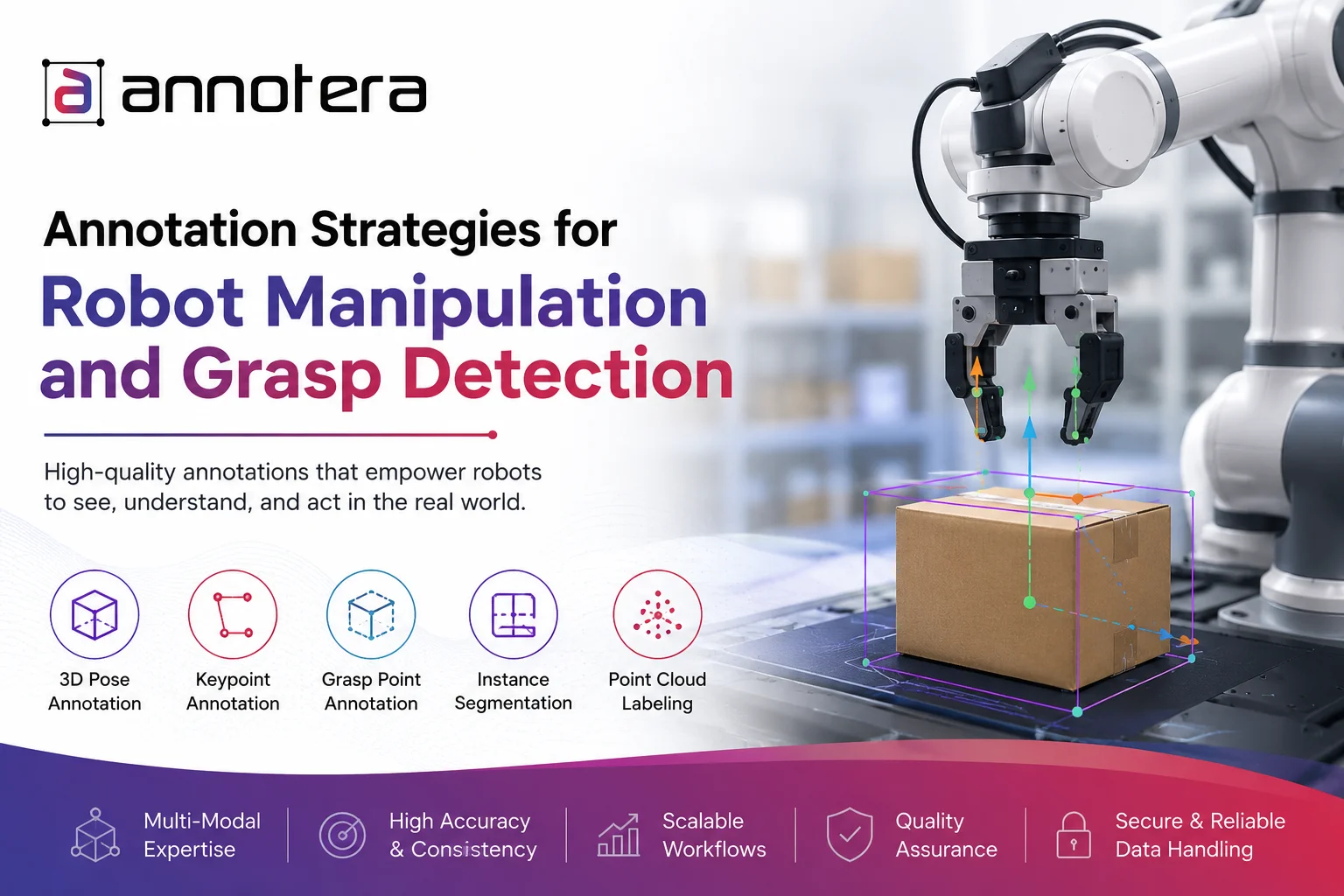
As robots become increasingly capable of interacting with the physical world, their ability to manipulate objects accurately has become one of the defining challenges in modern robotics. Whether it is a warehouse robot picking products from shelves, a manufacturing arm assembling precision components, or a household assistant organizing everyday items, successful manipulation depends on high-quality training data.
At the core of this training data lies accurate annotation. Robots cannot understand how to grasp objects simply by observing images or sensor data—they require meticulously labelled datasets that teach perception models to identify object boundaries, estimate poses, predict grasp points, and understand spatial relationships.
This is why organizations developing next-generation robotic systems increasingly partner with a trusted data annotation company offering specialised robotics data annotation services. With high-quality annotations, developers can build more reliable perception systems while reducing costly failures during deployment.
Why Robot Manipulation Requires Specialized Annotation
Unlike conventional computer vision applications, robot manipulation involves more than object detection. A robot must determine:
- Where an object is located
- Its orientation in 3D space
- Which surfaces are graspable
- Whether obstacles exist nearby
- How much force should be applied
- How the object may move during manipulation
A simple bounding box is rarely sufficient.
Modern manipulation systems combine data from multiple sensors, including:
- RGB cameras
- Depth cameras
- Stereo vision
- LiDAR
- Force and tactile sensors
- Wrist-mounted cameras
- Multi-view camera systems
Each sensor contributes unique information, requiring annotations that accurately align across different data modalities.
Essential Annotation Types for Robot Manipulation
1. Object Detection
Every manipulation pipeline begins with detecting target objects.
Annotators create labels identifying:
- Boxes
- Tools
- Containers
- Household objects
- Mechanical parts
- Food items
- Industrial components
High-quality detection datasets help robots locate grasp candidates quickly and accurately.
2. Semantic Segmentation
Pixel-level segmentation enables robots to understand precise object boundaries.
This becomes particularly important when:
- Objects overlap
- Transparent objects appear
- Multiple similar objects exist
- Small components require precision handling
Semantic segmentation significantly improves manipulation accuracy in cluttered environments.
3. Instance Segmentation
Warehouse bins frequently contain numerous identical objects.
Instance segmentation enables robots to distinguish:
- Cup A from Cup B
- Bolt 1 from Bolt 2
- Individual packages
- Separate fruits
- Multiple tools
Without instance-level labels, robots often confuse neighbouring objects.
4. 3D Pose Annotation
Manipulation requires understanding an object's orientation.
Pose annotation provides:
- Position
- Rotation
- Surface alignment
- Grasp direction
These labels allow robots to calculate the most stable grasp configuration before initiating movement.
5. Keypoint Annotation
Many robotic applications depend on identifying functional object points.
Examples include:
- Door handles
- Tool grips
- Bottle necks
- Drawer handles
- Appliance buttons
- Hinges
Keypoint annotation teaches robots exactly where interaction should occur.
Annotating Grasp Detection Data
Grasp detection is among the most challenging robotics perception tasks.
Instead of asking:
"Where is the object?"
The system asks:
"Where should the robot place its fingers to lift the object successfully?"
Typical grasp annotations include:
- Parallel gripper positions
- Suction cup locations
- Multi-finger grasp regions
- Finger contact points
- Gripper width
- Grasp angle
- Confidence score
These labels help robots identify successful grasp candidates while avoiding unstable or unsafe grasps.
Multi-Modal Annotation Improves Manipulation Accuracy
Modern robots increasingly combine several sensor streams simultaneously.
Training datasets may include:
- RGB images
- Depth maps
- Point clouds
- Thermal images
- Force measurements
- Robot joint positions
- Camera calibration data
Each modality requires synchronized annotations.
For example, an annotated grasp point on an RGB image must correspond precisely to the same location in a depth map and 3D point cloud.
This alignment significantly improves robot perception under varying lighting and environmental conditions.
Handling Complex Real-World Scenarios
Robot manipulation becomes considerably harder outside laboratory environments.
Datasets should include annotations for situations such as:
Cluttered Scenes
Objects overlap and partially hide one another.
Robots learn to isolate individual grasp targets despite visual complexity.
Reflective Surfaces
Metal, glass, and glossy packaging often confuse vision models.
Proper annotations help models recognise these challenging materials.
Transparent Objects
Transparent containers remain difficult for both RGB and depth sensors.
Detailed annotations improve recognition despite incomplete depth information.
Deformable Objects
Clothing, bags, cables, and food items continuously change shape.
These datasets require extensive annotation to capture different deformation states.
Occlusions
Real-world manipulation often involves partially hidden objects.
Annotating visible and partially visible regions improves detection robustness.
Annotation Quality Directly Impacts Manipulation Success
Even minor annotation inconsistencies can significantly reduce robot performance.
Common annotation errors include:
- Incorrect segmentation boundaries
- Misaligned grasp points
- Inaccurate pose estimation
- Missing objects
- Poor depth alignment
- Inconsistent class definitions
These errors often result in:
- Failed grasps
- Dropped objects
- Collision with surroundings
- Slower task execution
- Reduced production efficiency
A specialised data annotation company implements multiple quality assurance processes to minimise these issues before datasets reach machine learning teams.
Human Expertise Remains Essential
Although AI-assisted labelling tools accelerate annotation workflows, human reviewers remain indispensable.
Expert annotators verify:
- Difficult grasp positions
- Edge cases
- Ambiguous object boundaries
- Fine segmentation masks
- Rare manipulation scenarios
- Sensor alignment accuracy
Human validation is particularly valuable when creating datasets for physical AI, where robots interact directly with unpredictable real-world environments.
Scaling Annotation for Robotics Projects
Robotics companies often need millions of labelled frames collected across multiple facilities, robots, and environments.
Managing this scale internally can become expensive and time-consuming.
Many organisations therefore choose data annotation outsourcing to access experienced annotation teams, flexible production capacity, and established quality control processes.
Professional robotics data annotation services provide:
- Custom annotation guidelines
- Multi-stage quality assurance
- Domain-trained annotators
- Multi-modal annotation expertise
- Fast project scaling
- Secure data handling
- Consistent taxonomy management
This enables robotics teams to focus on algorithm development rather than dataset preparation.
Best Practices for Robot Manipulation Annotation
To maximise dataset quality, consider these best practices:
- Define clear annotation guidelines before project launch.
- Maintain consistent class definitions across datasets.
- Use multi-stage quality review processes.
- Annotate edge cases and failure scenarios.
- Synchronise labels across RGB, depth, and point cloud data.
- Regularly audit annotation consistency.
- Incorporate human validation for complex scenes.
- Continuously update datasets as robots encounter new environments.
These practices create datasets that generalise better across different robotic platforms and deployment conditions.
Conclusion
Reliable robot manipulation begins with reliable data. From object detection and segmentation to grasp point identification and 3D pose estimation, every annotation contributes to how effectively a robot interacts with the physical world.
As robotics applications continue expanding across logistics, manufacturing, healthcare, agriculture, and service industries, demand for highly accurate training datasets will only increase. Partnering with an experienced data annotation company offering specialised robotics data annotation services enables organisations to accelerate development while maintaining exceptional data quality. Combined with strategic data annotation outsourcing, these services provide the scalable, high-quality datasets needed to build robust physical AI systems capable of performing safe, precise, and intelligent manipulation in real-world environments.