Sign up with Google
 Sign in with Zoho

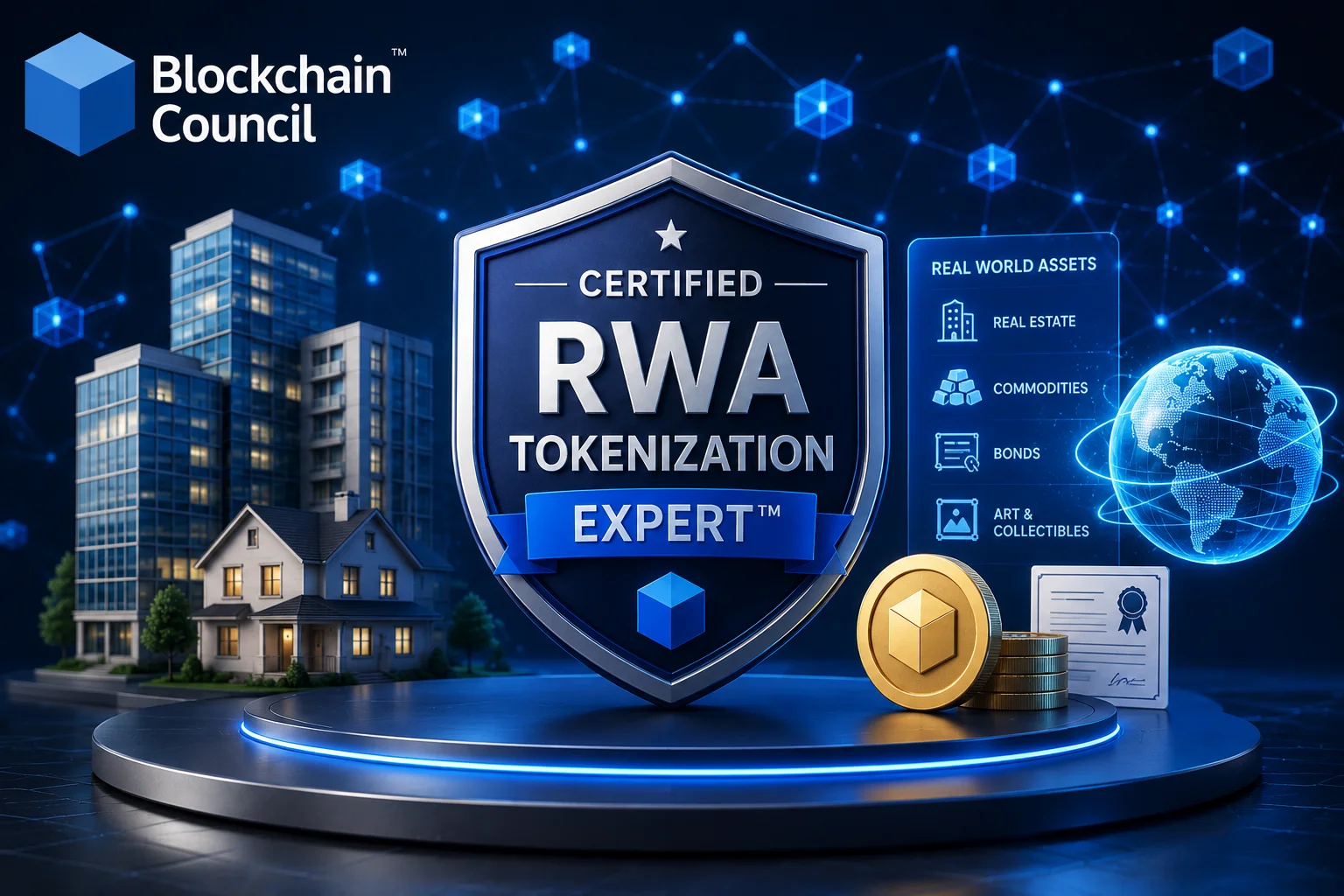
The financial world is changing rapidly as traditional assets move toward digital infrastructure. Real estate, government securities, private credit, commodities, investment funds, and other real-world assets can now be represented through blockchain-based tokens. This development is commonly known as Real-World Asset (RWA) tokenization.
For professionals who want to understand this emerging field, an RWA course can provide a structured foundation in blockchain technology, tokenization models, legal structures, regulatory considerations, asset management, and institutional adoption. The Certified RWA Tokenization Expert™ program by Blockchain Council is designed around these areas and covers the complete lifecycle of RWA tokenization rather than focusing only on creating a blockchain token.
What Is RWA Tokenization?
RWA tokenization is the process of representing ownership rights, financial claims, or economic interests connected to real-world assets through digital tokens on a blockchain. These assets can include real estate, bonds, Treasury products, private credit, commodities, investment funds, deposits, and other traditional financial instruments.
A key point is that the token is not necessarily the physical asset itself. Instead, it can represent a legal claim, ownership interest, or economic right associated with an asset held through an appropriate legal and operational structure.
For example, a tokenized real-estate product may connect an on-chain token with an underlying property, a legal entity, ownership records, investor rights, custody arrangements, and compliance requirements. This means successful tokenization requires much more than blockchain development.
Why Blockchain Matters in RWA Tokenization
Blockchain provides the infrastructure that can record token ownership, execute programmed transfer rules, support transaction histories, and connect participants through a shared digital ledger.
Traditional asset markets often depend on multiple intermediaries and reconciliation processes. Blockchain can help streamline certain parts of these workflows by making ownership records and transaction rules more programmable. However, blockchain does not automatically solve traditional financial risks such as credit risk, valuation challenges, legal enforceability, liquidity limitations, or counterparty risk.
This is why professionals working with RWAs need to understand both blockchain technology and the traditional financial systems surrounding the underlying assets.
What Can Be Tokenized?
RWA tokenization can be applied to a broad range of assets and financial interests.
1. Real Estate
Property is one of the commonly discussed applications of tokenization. Blockchain-based representations can potentially make ownership interests easier to divide, transfer, and manage, depending on the legal structure.
2. Government Securities
Treasury products and other government-backed instruments are increasingly being explored through tokenized financial products. These products demonstrate how blockchain infrastructure can connect traditional capital markets with digital settlement systems.
3. Private Credit
Private loans and credit products can also be represented through blockchain-based structures. Tokenization may support more programmable ownership records and automated transaction processes.
4. Commodities
Gold, agricultural commodities, and other physical assets can potentially be connected to digital tokens through custody and verification arrangements.
5. Investment Funds
Fund interests can be represented digitally, allowing blockchain infrastructure to become part of the issuance, transfer, and administration process.
The Blockchain Council's RWA program specifically covers asset classes, market sizing, legal structures, regulatory frameworks, issuance, accounting, secondary markets, DeFi integration, and institutional infrastructure.
What Does an RWA Course Teach?
A well-structured RWA course should go beyond explaining what tokenization means. Learners need to understand how the underlying asset, legal entity, investor, token, custodian, technology provider, and regulatory framework work together.
The Certified RWA Tokenization Expert™ program includes 15 modules and 101 lessons covering areas such as:
- Foundations of real-world asset tokenization
- RWA asset classes and market sizing
- Legal structure and enforceability
- Global regulatory frameworks
- Blockchain architecture and token standards
- Privacy and data protection
- Issuance and lifecycle operations
- Accounting, auditing, and taxation
- Security and operational resilience
- Secondary markets and liquidity
- RWA integration with DeFi
- Risk management and case studies
- Institutional infrastructure
- Buy-side perspectives
- Business models and distribution
The program lists a 12-hour learning duration, self-paced access, lifetime access, downloadable resources, and a verifiable certificate.
Key Skills You Can Develop Through an RWA Course
An RWA-focused learning program can help professionals build knowledge across several interconnected areas.
Blockchain and Token Standards
Learners can understand how blockchain networks and token standards support asset representation, transfer restrictions, identity, compliance, and settlement. Current RWA systems may use different standards depending on the asset and requirements.
Legal and Regulatory Understanding
Tokenization does not remove existing legal obligations. The legal classification of an underlying asset can influence how its tokenized representation must be issued, distributed, and transferred.
Asset Valuation and Risk
Professionals need to understand valuation, liquidity, credit exposure, counterparty risk, custody, and operational risks. Tokenization can change the way an asset is transferred or managed, but it does not eliminate the fundamental risks associated with the asset.
Institutional Infrastructure
RWA projects can involve issuers, custodians, transfer agents, administrators, distributors, broker-dealers, settlement systems, and other financial-market participants. Understanding these relationships is important for evaluating institutional tokenization projects.
Who Should Consider an RWA Course?
An RWA course can be useful for professionals from several backgrounds, including:
- Blockchain and Web3 professionals
- Banking and fintech professionals
- Investment and asset-management professionals
- Legal and compliance professionals
- Tokenization product managers
- Consultants and entrepreneurs
- Accountants and auditors
- Technology leaders exploring digital assets
The Certified RWA Tokenization Expert™ program states that no prior specialized experience is required and begins with foundational concepts, although a basic understanding of technology concepts is recommended.
RWA and the Future of Blockchain
RWA tokenization represents an important connection between traditional finance and blockchain technology. Instead of creating an entirely separate financial ecosystem, tokenization can bring selected traditional assets and financial processes onto programmable digital infrastructure.
The most valuable opportunity may not simply be the creation of new tokens. It may come from improving settlement, transferability, collateral management, recordkeeping, compliance automation, and access to financial-market infrastructure.
At the same time, successful RWA projects need strong legal structures, reliable asset records, appropriate custody, regulatory compliance, accurate valuation, and operational controls. A blockchain network alone cannot guarantee these conditions.
Building Broader Technology and Business Skills
RWA professionals can also benefit from learning complementary technologies and business disciplines. Blockchain is increasingly connected with artificial intelligence, cybersecurity, data management, fintech, cloud computing, and other emerging technologies.
Professionals interested in expanding their technology knowledge can explore Tech Certifications covering areas such as AI, cybersecurity, software development, data science, and other technology fields.
Similarly, professionals working on the commercial side of technology projects can explore Marketing and Business Certifications to strengthen their understanding of business and marketing-related disciplines.
Combining blockchain expertise with technology, finance, compliance, and business knowledge can help professionals approach RWA projects from a broader perspective.
Why Learn RWA Tokenization Now?
The RWA market is developing at the intersection of blockchain, digital assets, capital markets, and financial regulation. As more institutions explore tokenized securities, funds, Treasuries, private credit, deposits, and other assets, professionals need knowledge that goes beyond basic cryptocurrency concepts.
Learning through an RWA course can help individuals understand how a tokenized asset is structured, where legal ownership sits, how investor rights are established, how transfers are controlled, and how blockchain infrastructure interacts with traditional financial systems.
The goal should not be to assume that every asset needs tokenization. Instead, professionals should learn how to evaluate whether blockchain-based infrastructure creates measurable value for a particular asset, business model, investor group, or financial institution.
Conclusion
RWA tokenization is bringing traditional assets closer to blockchain-based financial infrastructure. Its development involves far more than converting an asset into a digital token. Legal ownership, regulation, custody, valuation, compliance, technology, settlement, liquidity, and institutional processes all play important roles.
For professionals looking to build structured knowledge in this area, an RWA course can provide a useful pathway to understanding the technology and business concepts behind tokenized real-world assets. With a strong foundation in blockchain, learners can better evaluate emerging opportunities while also understanding the limitations and risks involved.
As traditional finance and digital assets continue to converge, professionals who can understand both sides of this ecosystem may be better prepared to participate in the next stage of financial innovation.
FAQs
1. What is an RWA course?
An RWA course teaches real-world asset tokenization, blockchain, regulations, asset management, and related concepts.
2. What is RWA tokenization?
It is the process of representing real-world assets such as real estate, securities, or commodities through blockchain-based tokens.
3. Do I need blockchain experience for an RWA course?
No. Beginners can learn the fundamentals, although basic technology knowledge can be helpful.
4. Is RWA the same as cryptocurrency?
No. RWA represents interests in real-world assets, while cryptocurrencies are digital assets native to blockchain networks.
5. Why is blockchain important for RWA?
Blockchain can support digital ownership records, programmable transactions, transparency, and efficient settlement.