Sign up with Google
 Sign in with Zoho

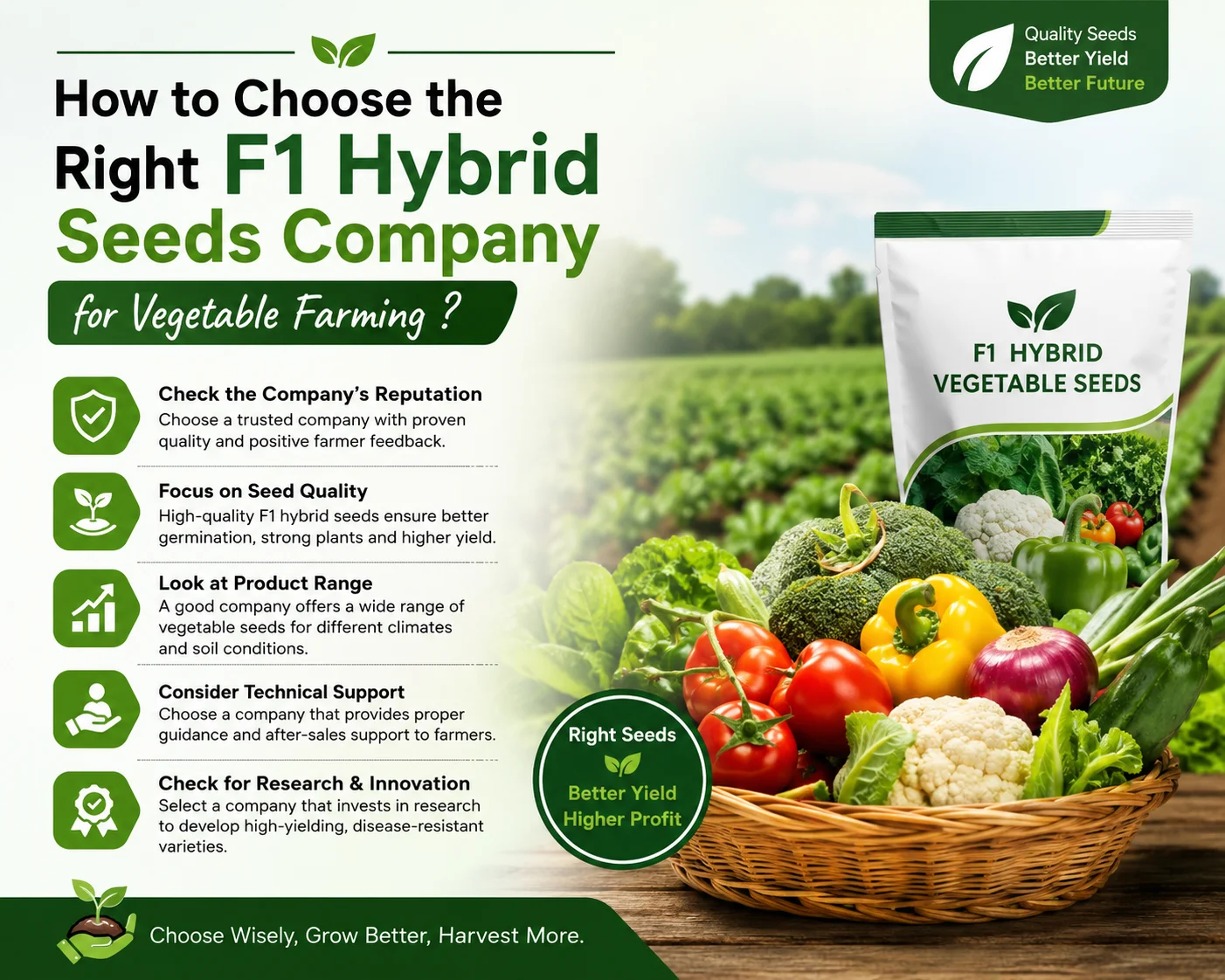
What Should Farmers Look for When Choosing an F1 Hybrid Seeds Company?
Choosing the right seed is one of the most important decisions in vegetable farming. A good seed can support uniform crop establishment, strong plant growth, better produce quality and improved returns. However, not every F1 hybrid seed performs in the same way under every farming condition.
For this reason, farmers should evaluate an F1 Hybrid Seeds Company carefully instead of selecting seeds only because of price, advertising or a popular name. Quality testing, variety performance, crop suitability, technical support and transparent product information should all be considered before making a purchase.
Why Choosing the Right Seed Company Matters
F1 hybrid seeds are produced by crossing selected parent lines to combine desirable characteristics. Depending on the crop and hybrid, these characteristics can include uniformity, yield potential, maturity period, fruit quality and tolerance to specific production challenges.
The Indian Council of Agricultural Research explains that seed certification is intended to help make quality seed available to farmers, with inspection and testing used to maintain required standards.
Therefore, farmers should look beyond attractive packaging and examine the company's approach to seed quality and product development.
Key Factors to Check Before Selecting a Seed Company
1. Seed Quality and Testing
Quality should be the first consideration. Farmers should check whether the company follows systematic quality control procedures and provides appropriate information about the seed lot.
Look for:
- Germination information
- Seed lot details
- Crop and variety name
- Packing and expiry information
- Appropriate labelling
- Quality testing practices
- Proper packaging and storage
Seed testing can involve factors such as physical quality, physiological quality, genetic characteristics and seed health. ICAR also highlights the importance of seed testing and certification in maintaining quality.
2. Performance Under Local Conditions
A hybrid that performs well in one region may not deliver identical results somewhere else. Soil type, temperature, rainfall, irrigation, disease pressure and cultivation practices can influence crop performance.
Farmers should ask whether the company has evaluated its hybrids under conditions similar to their own farms. Field trials and replicated testing can provide more useful information than marketing claims alone.
A reliable company should be able to explain the recommended growing conditions, crop duration and important characteristics of each hybrid.
3. Research and Product Development
Research is another important factor when comparing seed companies. A company with a structured approach to selection, field trials and evaluation is generally better positioned to develop products suited to changing farming requirements.
ICAR notes that modern crop research focuses on improved varieties and hybrids suited to different agro-ecological conditions, along with improved seed-production technologies.
Farmers can therefore ask questions about how a company evaluates new hybrids before purchasing them on a larger scale.
4. Crop Range and Variety Selection
A useful seed supplier should offer options suited to different farming needs rather than promoting a single variety for every situation.
For vegetable farming, farmers may need hybrids for crops such as:
- Tomato
- Cucumber
- Chilli
- Okra
- Bitter gourd
- Bottle gourd
- Watermelon
- Capsicum
- Cabbage
- Cauliflower
For example, Iris Hybrid Seeds provides a range of vegetable hybrid seeds covering several of these crops. Farmers can review its vegetable seed range before comparing suitable varieties.
5. Technical Guidance and Farmer Support
Buying seeds should not be the end of the relationship. Farmers may need guidance about sowing, nursery management, spacing, irrigation, crop nutrition and harvesting.
A farmer-focused F1 Hybrid Seeds Company should provide practical product information and reasonable technical assistance. This can be particularly useful when farmers are trying a new hybrid for the first time.
Iris Hybrid Seeds states that it conducts field trials, selection and evaluation, replication and testing as part of its product development approach.
6. Transparent Product Information
Trustworthy companies should clearly communicate what farmers can realistically expect from a hybrid. Product information should not rely only on statements such as “highest yield” or “best variety.”
Instead, farmers should look for specific information about:
- Crop duration
- Fruit characteristics
- Recommended growing conditions
- Disease or pest tolerance claims
- Harvesting period
- Plant characteristics
- Suitable cultivation practices
Clear information makes it easier for farmers to compare products objectively.
How Farmers Can Compare Seed Companies
Before making a large purchase, farmers can follow a simple evaluation process:
- Identify the crop and target market.
- Compare suitable hybrids from several companies.
- Check seed packaging and quality information.
- Ask about local field performance.
- Speak with experienced farmers or agricultural professionals.
- Start with a small trial area when introducing an unfamiliar hybrid.
- Compare crop performance, quality and market acceptance.
- Choose the product that provides the best overall value rather than simply the lowest price.
This approach reduces unnecessary risk and gives farmers practical information before committing more land to a new hybrid.
Why Farmer Experience Still Matters
Agricultural performance cannot always be predicted from a product label. Experienced growers can provide useful observations about germination, plant vigour, harvesting duration, produce quality and market response.
However, farmer experience should be considered alongside scientific information and local agricultural advice. ICAR's work on participatory vegetable seed production shows how field-level practices such as genetic purity, field monitoring and scientific seed production can influence outcomes.
Choosing Iris Hybrid Seeds
Farmers looking for vegetable hybrids can explore Iris Hybrid Seeds, which offers products across several vegetable crops. The company's website provides information about its seed portfolio, quality approach and product development activities.
However, farmers should always select a hybrid according to their own crop, location, season, soil, irrigation availability and target market. No seed company or hybrid can guarantee a particular yield because farming results depend on multiple environmental and management factors.
Frequently Asked Questions
Q - What is an F1 hybrid seed?
Ans - An F1 hybrid seed is produced from the controlled crossing of selected parent lines. The resulting hybrid may combine desirable characteristics from its parents, depending on the breeding programme.
Q - How should farmers check seed quality?
Ans - Farmers should examine the packaging, lot information, germination details, labelling and relevant quality information. They can also ask the supplier about testing and quality-control procedures.
Q - Is the cheapest hybrid seed the best choice?
Ans - Not necessarily. Farmers should compare expected crop performance, seed quality, technical support, market requirements and overall cultivation economics rather than considering price alone.
Q - Why are field trials important?
Ans - Field trials help evaluate how a hybrid performs under practical growing conditions. Testing across relevant environments can provide more useful information for selecting varieties.
Q - Where can farmers learn more about seed standards?
Ans - Farmers can consult the Indian Council of Agricultural Research for scientific agricultural information and resources related to crop varieties, seed testing and agricultural research.
Final Thoughts
Selecting an F1 hybrid is not simply about choosing a familiar brand. Farmers should evaluate seed quality, local suitability, research practices, product information, field performance and after-sales guidance before making a decision.
A dependable F1 Hybrid Seeds Company should combine quality control with practical agricultural knowledge and transparent communication. By comparing these factors carefully and testing unfamiliar hybrids on a manageable scale, farmers can make more informed decisions and improve the chances of achieving healthy, marketable vegetable crops.