Sign up with Google
 Sign in with Zoho
Artificial intelligence is changing how businesses use CRM platforms, and Salesforce development is becoming more closely connected with AI than ever before. In 2026, businesses are not simply looking for a system to store customer information. They want platforms that can understand data, automate routine work, support employees, and deliver more personalized customer experiences.
This shift is creating new opportunities for businesses investing in Salesforce Development services. From AI-powered agents and intelligent automation to unified customer data and advanced integrations, Salesforce development is moving toward a more connected and intelligent approach.
For businesses planning their Salesforce strategy in 2026, understanding these changes can help them make better technology decisions and prepare for long-term growth.
What Is Changing in Salesforce Development in 2026?
Salesforce development is increasingly moving from traditional customization toward AI-enabled business solutions. Developers are now working with technologies such as Agentforce, Data 360, APIs, automation tools, and AI-powered applications to create more intelligent workflows.
Salesforce's Agentforce platform is designed to help businesses deploy AI agents that can work alongside employees and serve customers around the clock. These agents can use business data, workflows, and APIs to reason and take actions within defined permissions.
This means Salesforce development in 2026 is not only about creating fields, objects, dashboards, or custom applications. It is increasingly about connecting business data, automation, AI, and human teams into one working environment.
1. AI Agents Will Become Part of Everyday CRM Work
One of the biggest developments businesses should expect is wider use of AI agents.
Instead of simply answering questions, AI agents can be designed to perform specific business tasks. For example, an agent may help qualify leads, answer customer questions, summarize information, support service requests, or assist sales teams.
Salesforce provides tools such as Agentforce APIs, SDKs, Agentforce DX, Agent Script, and testing capabilities for developing and deploying these experiences.
For businesses, this means AI can become part of everyday CRM operations rather than being treated as a separate technology.
2. Data Quality Will Become Even More Important
AI is only as useful as the data it can access.
Businesses often have customer information spread across CRM systems, websites, emails, support platforms, data warehouses, documents, and other applications. If this information is incomplete or inconsistent, AI-generated responses may also be less useful.
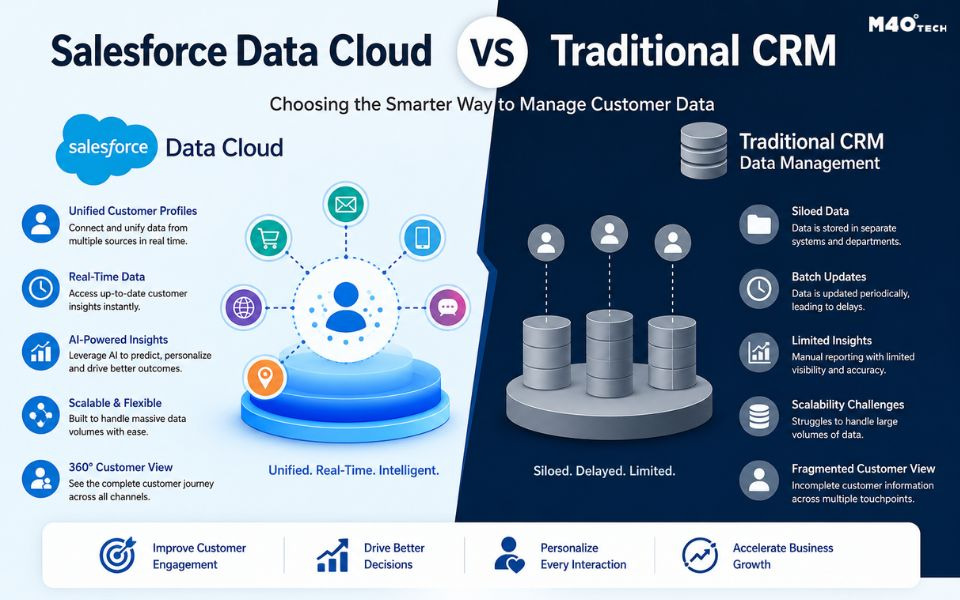
Salesforce's Data 360 provides a foundation for bringing together structured and unstructured business data so AI agents can work with more relevant customer context.
As a result, Salesforce Development services in 2026 will increasingly include data integration, data quality, governance, and preparation for AI—not just application development.
3. More Personalized Customer Experiences
Customers expect businesses to understand their needs without requiring them to repeat information.
AI can help Salesforce implementations deliver more personalized experiences by using customer history, preferences, previous interactions, and real-time information.
For example, a service agent could use customer information to provide a more relevant response, while a sales team could receive AI-generated insights before contacting a prospect.
The goal is not simply to automate communication. It is to make customer interactions more relevant and useful.
4. Automation Will Move Beyond Simple Workflows
Traditional Salesforce automation has already helped businesses reduce repetitive manual tasks. In 2026, automation is becoming more intelligent.
AI-powered systems can combine business rules, customer data, workflows, and actions to handle more complex processes.
Businesses may use automation for:
- Lead qualification
- Customer service requests
- Follow-up activities
- Case management
- Sales recommendations
- Data updates
- Marketing activities
- Internal employee support
This allows employees to spend more time on activities that require human judgment and relationship building.
5. Salesforce Integrations Will Become More Important
Most businesses do not operate entirely within Salesforce. They use multiple applications for payments, marketing, ERP, customer support, analytics, communication, and other operations.
This makes API integration an important part of modern Salesforce development.
A well-designed integration strategy can connect Salesforce with external systems and help businesses create a more consistent flow of information. Developers can use APIs, middleware, and integration platforms to connect Salesforce with the wider technology ecosystem.
6. AI Security and Governance Will Matter More
Businesses cannot adopt AI without considering security, privacy, permissions, and governance.
AI systems may interact with sensitive customer and business information. Therefore, companies need clear rules about what data AI can access, what actions it can perform, and when human approval is required.
Salesforce's platform includes security and trust capabilities designed to help organizations use AI with appropriate controls. Salesforce also emphasizes grounding AI responses in trusted business data and applying security around agent actions.
For businesses, this means AI implementation should be planned together with security and governance instead of being added as an afterthought.
7. Developers Will Focus More on Business Outcomes
The role of Salesforce developers is also evolving.
In the past, development projects often focused primarily on technical requirements. Today, businesses increasingly expect Salesforce solutions to produce measurable business value.
A successful implementation should answer questions such as:
- Can it reduce manual work?
- Can it improve response times?
- Can it help sales teams manage leads more effectively?
- Can it improve customer satisfaction?
- Can it provide better business insights?
- Can it scale as the organization grows?
This is why choosing the right Salesforce Development services provider is important. Technical skills matter, but understanding the company's processes and goals is equally valuable.
How Should Businesses Prepare for Salesforce and AI in 2026?
Businesses do not need to introduce every AI feature at once. A practical approach is to start with specific use cases that can provide measurable value.
First, review your existing Salesforce environment and identify inefficient processes. Next, evaluate your data quality and integrations. Then, select AI use cases where automation or intelligent assistance can solve a genuine business problem.
A phased approach can help businesses control costs, improve adoption, and learn from early implementations before expanding AI across additional departments.
How M40Tech Can Help With Salesforce Development
Implementing AI within Salesforce requires more than activating a feature. Businesses need the right combination of Salesforce customization, integration, automation, data management, and ongoing support.
M40Tech helps businesses build and customize Salesforce solutions around their specific operational requirements. Its Salesforce-focused services can support organizations with development, integrations, automation, CRM customization, and other Salesforce technology needs.
Whether you are modernizing an existing Salesforce environment or planning a new AI-enabled CRM strategy, M40Tech can help you identify practical opportunities and build solutions aligned with your business objectives.
Ready to improve your Salesforce environment? Contact M40Tech to discuss your Salesforce development and AI requirements
Frequently Asked Questions
What should businesses expect from Salesforce development in 2026?
Businesses should expect Salesforce development to become more focused on AI agents, intelligent automation, unified data, integrations, personalization, and secure AI-driven workflows.
Will AI replace Salesforce developers?
AI is more likely to change the role of Salesforce developers than replace them. Developers will increasingly focus on designing, integrating, testing, customizing, and governing AI-powered Salesforce solutions.
How can Salesforce Development services support AI adoption?
Professional Salesforce Development services can help businesses customize Salesforce, integrate external systems, improve data management, build automation, and implement AI capabilities tailored to specific business requirements.
Conclusion
Salesforce development in 2026 is moving toward a more intelligent, connected, and automated model. AI agents, unified data, advanced automation, integrations, personalization, and security will increasingly influence how businesses build and manage their Salesforce environments.