Sign up with Google
 Sign in with Zoho
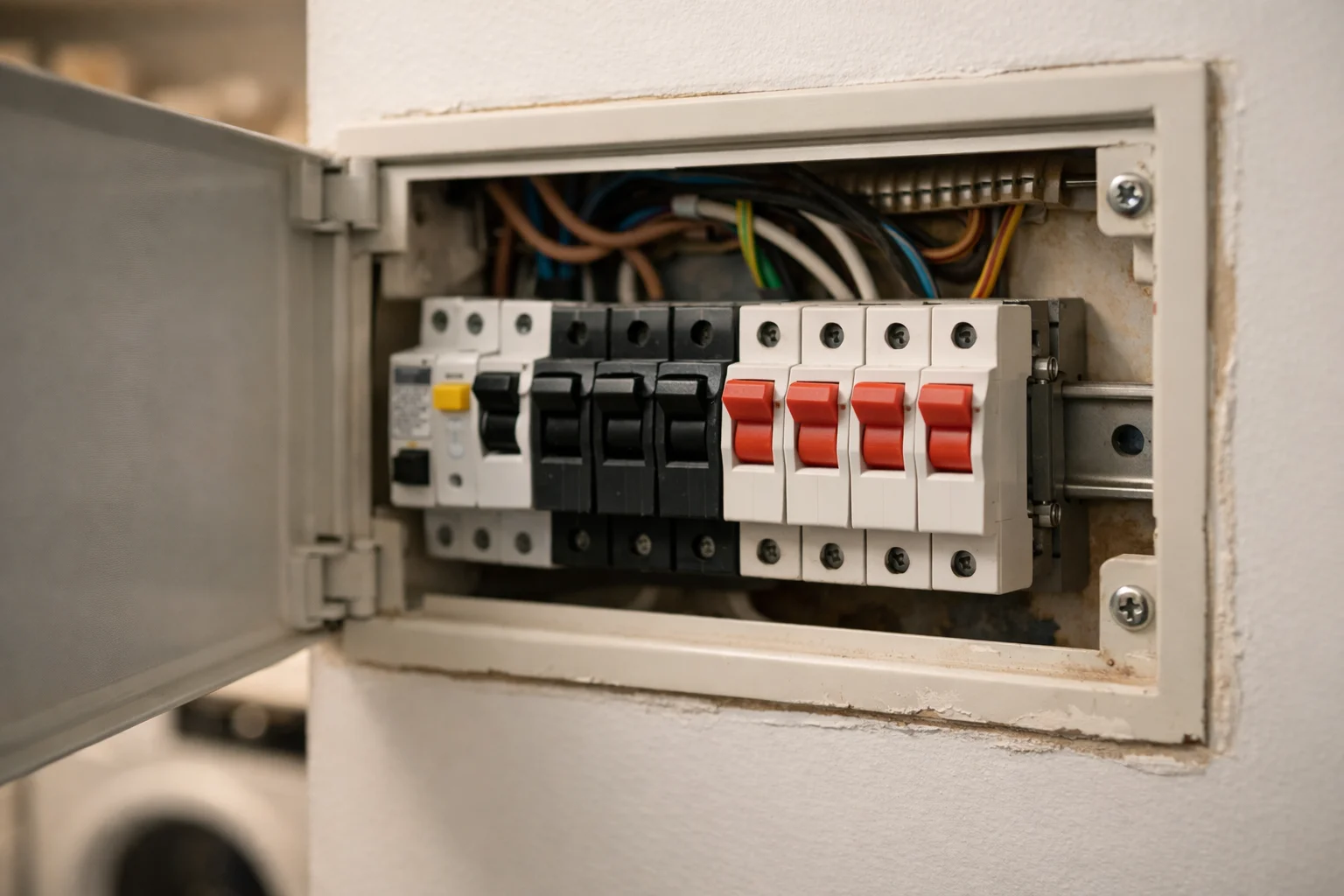
There is a very specific kind of frustration that comes with a tripping circuit breaker. You are mid-way through something — cooking dinner, running the washing machine, finally setting up that home office — and suddenly half the house goes dark. You walk to the switchboard, flip the breaker back, and everything comes back on. Problem solved, you think.
And then it happens again.
For a lot of Sydney homeowners, this pattern repeats itself for months — sometimes years — before anyone looks into what's actually causing it. The breaker is doing its job, after all. It trips, you reset it, life goes on. But understanding why it keeps tripping in the first place is actually quite important, because the range of causes runs from completely harmless to genuinely dangerous, and they don't always look different from the outside.
This guide walks through the most common reasons a circuit breaker trips repeatedly in Australian homes, what each one means, and how to figure out whether you're dealing with something to ignore, something to manage, or something to call an electrician about.
First: What a Circuit Breaker Is Actually Doing
A circuit breaker is a safety device. Its entire purpose is to interrupt the flow of electricity through a circuit when something goes wrong — specifically, when the current flowing through the wires exceeds the limit the circuit was designed to carry.
When too much current flows for too long, wiring heats up. Heated wiring is dangerous: it can degrade insulation, cause arcing (where electricity jumps between conductors), and in worst-case scenarios, start fires inside the walls. The breaker trips before any of that gets a chance to happen.
So a tripping breaker is, on some level, the system working as intended. The problem worth worrying about is why the circuit is drawing more current than it should be — and whether that underlying issue is going to get worse.
The Most Common Reason: Circuit Overload
The single most frequent cause of a tripping breaker in Australian homes is a simple overload — too many things drawing power from the one circuit at the same time.
Most homes are wired with circuits that were designed decades ago, when the average household had far fewer appliances than today. A circuit that was once expected to run a couple of lamps and a television is now being asked to handle a smart TV, a gaming console, a phone charger, a laptop, a desk fan, a heater, and a set of LED strip lights simultaneously.
Each appliance draws current. When the combined draw exceeds the breaker's rating — typically 10 or 16 amps for general purpose circuits in Australian homes — the breaker trips.
The fix for a genuine overload is usually straightforward: spread the load across different circuits rather than plugging everything into the same set of power points. If your home only has one or two circuits serving entire rooms, you may find it impossible to spread things thin enough with what you have, in which case additional circuits are worth thinking about.
The Less Obvious Reason: A Fault in an Appliance
When a breaker trips every time you plug in or switch on a specific appliance — and only that appliance — the circuit itself may be fine. The problem is more likely inside the device.
Appliances develop faults over time. A motor in a washing machine or a vacuum can wear out in ways that cause it to draw far more current than normal. An old heating element in an oven or kettle can develop a partial short. A damaged cord with frayed insulation inside can cause intermittent faults that only show up under load.
The way to test this: try the appliance on a different circuit (ideally in a different room). If it trips that breaker too, the appliance is almost certainly the problem. Have it inspected or replaced before using it again — a faulty appliance that keeps tripping breakers is one that's actively stressing your home's electrical system every time you reset it.
If the appliance works fine elsewhere and the original circuit still trips with something else running on it, the issue is the circuit.
The More Serious Reason: A Short Circuit
A short circuit is different from an overload. Instead of too much current flowing through a healthy circuit, a short is where current finds an unintended path — usually because two wires that should not be touching are making contact. This can happen inside a wall, inside a power point, inside a switch, or inside an appliance.
Short circuits cause a large and sudden surge of current, which is why breakers responding to a short tend to trip immediately and sharply — often with a slight burning smell or a pop from the switchboard.
If you notice any of the following alongside a breaker that keeps tripping — scorch marks around a power point, a burning or hot plastic smell from the switchboard or a wall, a visible spark when something is plugged in, or a breaker that feels warm to touch — those are signs that something more than an overload is happening.
This is not a situation to keep resetting your way through. Short circuits need to be found and fixed by a licensed electrician, full stop. The risk of ignoring them is not inconvenience — it's the possibility of an electrical fire developing inside a wall cavity where you can neither see it nor reach it.
The Hidden Reason: Your Wiring Is Old
Sydney has a significant number of homes built between the 1950s and 1980s that still carry original wiring. In many cases, this wiring is made from materials that are now considered outdated or problematic.
The most well-known example is aluminium wiring. During a period in the 1960s and early 1970s, aluminium was commonly used as a substitute for copper in residential wiring. It's a reasonable conductor, but it has a tendency to expand and contract more dramatically with temperature changes, and it oxidises in a way that copper doesn't. Over decades, this can cause connections at power points and switches to loosen, leading to arcing and heat at the connection points — sometimes years before anything trips a breaker.
Older homes may also have wiring insulated with materials that have degraded over time. Rubber-insulated wiring, for instance, becomes brittle and can crack after 30 or 40 years. Once the insulation fails, bare wires inside wall cavities become a hazard that has nothing to do with how many appliances you're running.
If you're in an older home and your breakers are tripping without an obvious cause, an electrical inspection is worth scheduling — not because something is definitely wrong, but because the cost of finding out is far lower than the cost of not knowing.
The Increasingly Common Reason: Demand Has Outgrown the Switchboard
Even if the wiring throughout your home is in good shape, the switchboard itself may simply not be equipped for what modern households ask of it.
Older switchboards — particularly those with ceramic fuses rather than circuit breakers — were designed around a load profile that looks nothing like today's. A home that now has electric vehicle charging, ducted reverse-cycle air conditioning, an induction cooktop, multiple bathrooms with electric heating, and a full entertainment setup is putting far more demand on its electrical infrastructure than the people who built it ever anticipated.
Signs that a switchboard upgrade may be worth discussing with an electrician include: breakers that trip regularly despite no obvious overload, a switchboard that still uses fuses rather than breakers, no RCD (residual current device) protection on your circuits — which is now standard in new installations in Australia — or a board that simply doesn't have enough circuits to separate your appliances logically.
A modern switchboard with properly rated breakers and RCD protection is not just a capacity upgrade. The RCD in particular is a genuine safety feature: it detects the tiny current fluctuations that indicate electricity is flowing through a person rather than through a circuit, and cuts power in milliseconds. Older switchboards simply don't have this protection.
What You Should and Shouldn't Do Yourself
There are things homeowners can reasonably check on their own. Identifying which appliances are on a tripping circuit, testing them on other circuits, spreading load across different power points, and replacing obviously damaged power boards or extension leads are all reasonable self-help steps.
What is not appropriate for homeowners to do — and is actually illegal in New South Wales and across Australia without a licence — is any work inside the switchboard or on fixed wiring. That includes replacing fuses, touching wiring behind power points or switches, or attempting to modify circuits in any way.
This is not an overly cautious rule. Electricity at mains voltage can kill without warning, and mistakes inside a switchboard can create problems that aren't immediately visible but become dangerous weeks or months later.
If you've identified that the issue is the circuit, the switchboard, or the wiring rather than an appliance, the right step is a licensed electrician. They can run a proper fault test, identify exactly where the problem sits, and tell you honestly whether it's a minor repair or something that needs more attention.
A Quick Note on Safety Switches vs Circuit Breakers
People often use "safety switch" and "circuit breaker" interchangeably, but they protect against different things.
A circuit breaker protects the wiring — it trips when current exceeds a set level, preventing the cables from overheating.
A safety switch (RCD) protects people — it detects current leakage and cuts power fast enough to prevent a fatal electric shock.
You want both. Many older Australian homes have circuit breakers but no RCDs. If you're not sure which you have, the switchboard usually tells you: RCDs have a small test button on them marked "T" or "Test," and they should be tested every few months by pressing that button to confirm they still trip.
The Bottom Line
A circuit breaker that trips once and never again is probably a one-off event — an appliance drawing too much at startup, a brief overload from running too many things at once. That's the system doing its job.
A breaker that trips repeatedly, or that trips suddenly with no obvious cause, is worth taking seriously. At best, you have an appliance that needs attention or a circuit that needs rebalancing. At worst, there's a fault somewhere in your wiring that isn't going to fix itself.
The cost of getting an electrician to look at a repeatedly tripping breaker is modest. The cost of the alternatives is considerably higher, in every sense.
About the Author: This article was contributed by the team at AIM Local, a licensed trade services company providing electrical, plumbing and roofing services to homeowners across Sydney, the Central Coast and Newcastle.